Try GOLD - Free
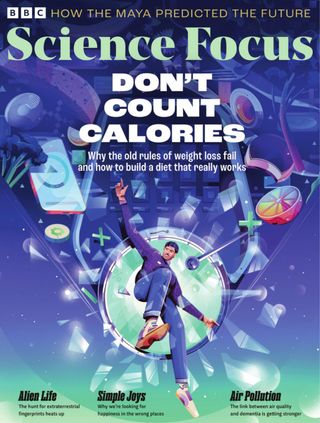
FORGET COUNTING CALORIES TRY THIS INSTEAD...
BBC Science Focus
|January 2026
Calorie counting isn't just difficult, it's riddled with problems that make it practically useless for anyone trying to lose weight.But there are alternatives

Want to lose excess fat? There's one method scientifically proven to work: the calorie deficit. In simple terms, that means eating a little less food than your body needs to fuel itself each day. Do that, and your body starts dipping into its energy reserves - its stored fat - to make up the shortfall.
It sounds straightforward, but anyone who's tried to lose weight this way knows the story. You dutifully keep track of the calories in every meal - right down to the last grain of rice to ensure your daily total remains below your regular tally, and yet the needle on the bathroom scales refuses to budge.
It's frustrating and disheartening. But there's good news: you're not to blame.
Recent scientific findings suggest it's almost impossible to count calories with any degree of accuracy. Now, that alone explains why trying to lose weight by calorie counting is so hard, and should come as some reassurance to anyone struggling to do it. But it doesn't stop there. It seems the very idea of what a 'calorie' actually is might need a rethink, especially for anyone who's serious about losing fat.
MISSION IMPOSSIBLE
It's hard to keep track of the calories you consume. But the worst part is, you can make every possible effort to get the count right and you're still likely to get it wrong - even if you're a weight-loss specialist.
“Trying to reliably measure how many calories I’m eating - let alone how many calories I’m burning – is a near-impossible task,” says Dr Adam Collins, associate professor of nutrition at the University of Surrey.
It’s not bad maths that trips most of us up, though. Anyone who’s ever tried to judge what counts as a ‘small’ bowl of cereal or a ‘drizzle’ of olive oil knows that estimating portion sizes — and matching them to the numbers on the packet — is anything but straightforward.

This story is from the January 2026 edition of BBC Science Focus.
Subscribe to Magzter GOLD to access thousands of curated premium stories, and 10,000+ magazines and newspapers.
Already a subscriber? Sign In
MORE STORIES FROM BBC Science Focus

BBC Science Focus
World's biggest cobweb is home to 100,000 spiders
Spiders don't normally create such large colonies, so there's no need to worry about finding one in your basement

1 min
February 2026

BBC Science Focus
A dementia vaccine could be gamechanging – and available already
Getting vaccinated against shingles could protect you from getting dementia, or slow the progression of the disease
1 mins
February 2026

BBC Science Focus
DATA IN SPACE
An unusual spacecraft reached orbit in November 2025, one that might herald the dawn of a new era.
7 mins
February 2026

BBC Science Focus
Climate change is already shrinking your salary
No matter where you live, a new study has found warmer temperatures are picking your pocket
4 mins
February 2026

BBC Science Focus
A MENTAL HEALTH GLOW-UP
Forget fine lines. Could Botox give you an unexpected mental health tweakment?
3 mins
February 2026
BBC Science Focus
Most people with high cholesterol gene don't know they have it
Standard testing struggles to detect the condition
1 mins
February 2026

BBC Science Focus
HOW CAN I BOOST MY IQ?
If you're serious about getting smarter, it's time to ditch the brain-training apps
4 mins
February 2026

BBC Science Focus
Humans are absolutely terrible at reading dogs' emotions
Think you can tell how our furry friends are feeling? Think again
1 mins
February 2026

BBC Science Focus
HOW TO TEACH AI RIGHT FROM WRONG
If we want to get good responses from AI, we may need to see what it does when we ask it to be evil
3 mins
February 2026

BBC Science Focus
What Australia's social media ban could really mean for under-16s
Many people think social media is bad for our kids. Australia is trying to prove it
5 mins
February 2026
Listen
Translate
Change font size