Try GOLD - Free
Fast radio bursts: Are these mysterious signals from deep space getting even stranger?
BBC Science Focus
|March 2025
New discoveries are shaking up what little we thought we knew about fast radio bursts
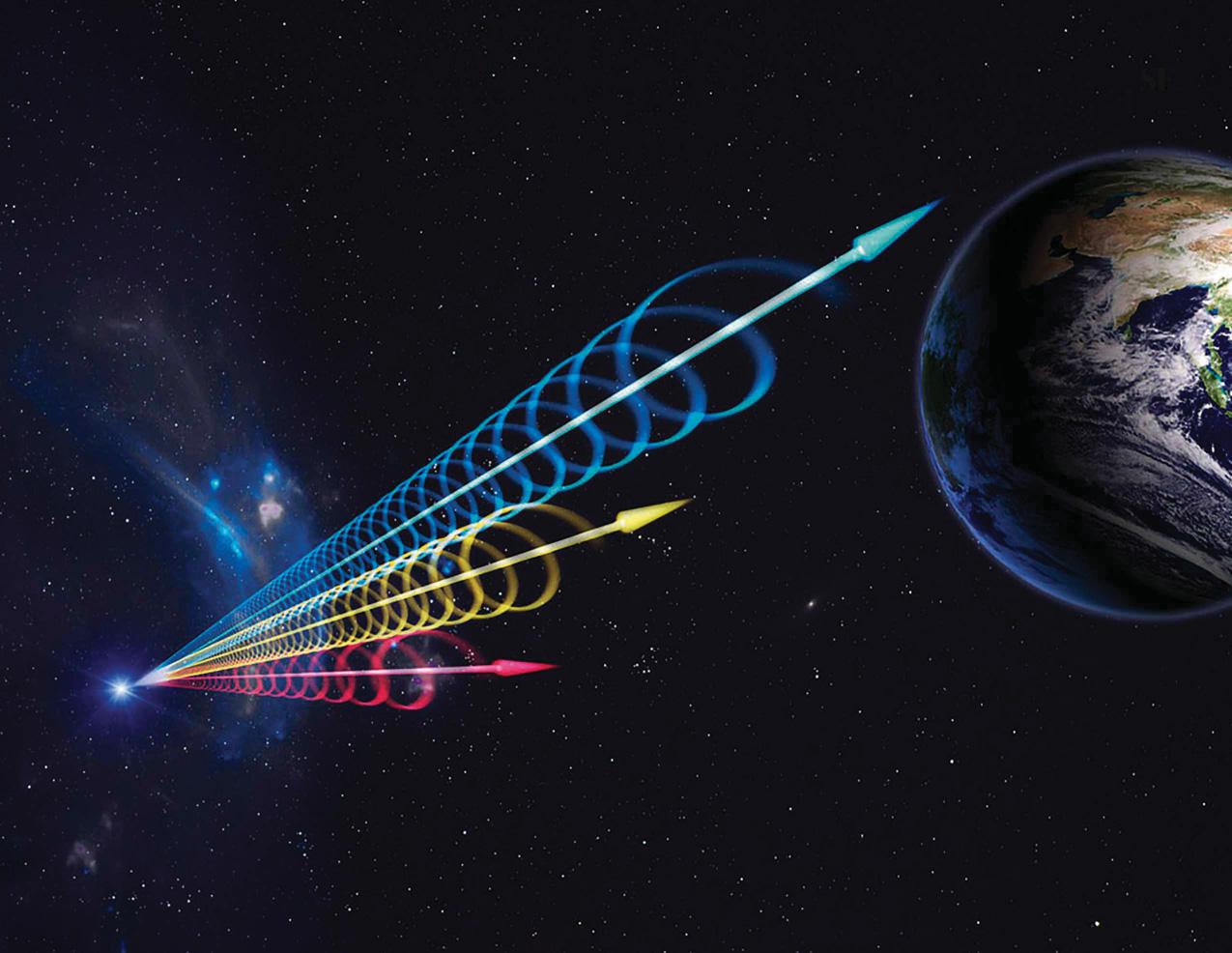
Fast radio bursts (FRBs) are among the greatest cosmic enigmas of our time. First discovered in 2007, these fleeting flashes of radio waves have been puzzling astronomers ever since. Despite detecting thousands of them, we still don't know exactly what causes them, where they come from or why they behave so unpredictably.
Just when scientists thought they were beginning to piece together the puzzle, two new studies, published in January this year, threw a spanner in the works, challenging previous theories and adding new layers of intrigue to the FRB mystery.
"FRBs are one of these mysteries of the Universe that deserves to be solved," says Dr Tarraneh Eftekhari, a radio astronomer at Northwestern University, in the US, and lead author of first of the new papers published in The Astrophysical Journal Letters. A solution may well be long overdue, but the Universe, it seems, isn't giving up its secrets just yet.
WHAT'S SO MYSTERIOUS ABOUT FRBS?
While it wouldn't be quite right to say that FRBs were discovered by accident, it's true that when first spotted, they were buried within data collected for an entirely different purpose: tracking down pulsars.
Pulsars, or 'pulsating radio sources', are a far better understood cosmic phenomenon. They were discovered in 1967 by Prof Jocelyn Bell Burnell and are known to originate from neutron stars – the incredibly dense remnants of massive stars that boast magnetic fields trillions of times stronger than Earth's. These fast-spinning stellar corpses emit regular pulses of radio waves, acting like cosmic lighthouses.
The regularity of the pulses Bell spotted, and the fact they were being emitted at a very specific frequency, hinted that they might be artificially, rather than naturally, generated and led her to nickname that first pulsar “Little Green Man 1”. But while pulsars quickly found their place in the astrophysical playbook, FRBs are a different story.

This story is from the March 2025 edition of BBC Science Focus.
Subscribe to Magzter GOLD to access thousands of curated premium stories, and 10,000+ magazines and newspapers.
Already a subscriber? Sign In
MORE STORIES FROM BBC Science Focus

BBC Science Focus
DOES MY DOG HAVE ADHD?
Officially, Attention-Deficit Hyperactivity Disorder (ADHD) is a human condition. People are diagnosed with it. Dogs are not. Yet many of its core features, including hyperactivity, impulsivity and distractibility, can be found in dogs.

1 min
March 2026

BBC Science Focus
DOES MY BRAIN LIVE A LITTLE IN THE PAST?
Yes, your brain does live a little in the past. It can't help it. The information it receives via your senses is always a little out of date. Whether it's light entering the retinas in your eyes, or sounds vibrating the hairs in your ears, it not only takes time for the data to arrive, but your brain then has to process it.
2 mins
March 2026

BBC Science Focus
ASTRONOMY FOR BEGINNERS
RETURN OF THE EVENING STAR (VENUS)
1 mins
March 2026

BBC Science Focus
CAN YOU STOP YOUR SENSE OF TASTE DULLING AS YOU AGE?
Sometimes I hear people say that food just doesn't taste the same as they get older. It's tempting to blame this on age, but there are other factors at play, too.
1 mins
March 2026

BBC Science Focus
MICROBIOMES OF THE SUPERAGERS
BY STUDYING THE INCREASING NUMBER OF PEOPLE WHO ARE LIVING BEYOND THEIR 100TH BIRTHDAYS, SCIENTISTS ARE DISCOVERING THAT THE SECRET TO REACHING A RIPE OLD AGE IN RUDE HEALTH MIGHT LIE IN OUR GUTS
8 mins
March 2026

BBC Science Focus
HOW BIG WERE MEDIEVAL WAR HORSES?
You might picture knights charging into battle on towering steeds, but medieval horses were typically no bigger than modern-day ponies.
1 min
March 2026

BBC Science Focus
FORCES OF HABIT
Could new research on setting up healthy habits resuscitate those stuttering New Year resolutions?
3 mins
March 2026

BBC Science Focus
5 DANGERS HIDING IN YOUR PROCESSED FOOD
We all know that ultra-processed foods are bad for us, but what ingredients should we particularly try to avoid? And what are they doing to our bodies?
9 mins
March 2026

BBC Science Focus
Mosquitoes are becoming thirstier for human blood
Habitat loss may be pushing mosquitoes towards human hosts with deadly consequences
1 mins
March 2026

BBC Science Focus
HOW CAN I GET OVER MY EX?
Relationship breakups can be brutal, just look at the popularity of songs like 'Someone Like You' by Adele, or all the covers of 'Cry Me a River' by Julie London.
1 mins
March 2026
Listen
Translate
Change font size