
Go Unlimited with Magzter GOLD
Get unlimited access to 10,000+ magazines, newspapers and Premium stories for just
Try GOLD - Free
Engines and timelines drive AMCA forward
Geopolitics
|January 2026
India's Advanced Medium Combat Aircraft (AMCA) programme, the nation's most ambitious indigenous fighter jet initiative, is rapidly coalescing around a propulsion roadmap and development trajectory that could define its strategic airpower for decades. At the heart of the programme are breakthrough propulsion plans that combine international collaboration, deep technology transfer, and future-proof scalability, all aligned with a firm timeline for prototype rollout and maiden flight.
-
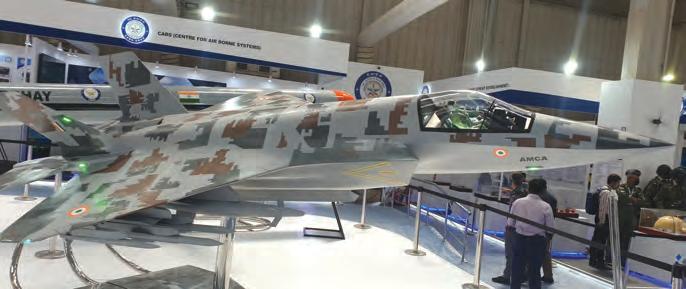
One of the most pivotal aspects of AMCA's maturation has been the engine selection process, a longstanding challenge in India's aerospace story. Early in the decade, India relied on GE Aerospace's F414 engines to power early test airframes and bridge the capability gap. But for a true fifth-generation fighter, featuring sustained super cruise, internal weapons carriage, and advanced sensor suites, indigenous propulsion was nonnegotiable. It is this need that propelled two global engine majors into the fray: Safran and Rolls-Royce.
Safran's joint proposal with the Defence Research and Development Organisation and its Gas Turbine Research Establishment (GTRE) has now gained clear traction. Safran has confirmed that its co-developed turbofan engine for AMCA will be scalable across a thrust envelope of 120-140 kN, with the lower end intended for baseline fighters and the upper tier potentially powering heavier future variants with extended range, larger payloads, and next-generation systems.
This scalable thrust philosophy solves two problems at once: it ensures the core engine can support the AMCA MkII configuration while providing a pathway for future advanced variants that might carry larger internal fuel stores, enhanced electronic warfare suites, or larger internal weapons bays. Highly modular engine architecture also makes room for future upgrades, potentially enabling adaptive or variable-cycle enhancements for sixth-generation combat aircraft.
Behind these propulsion plans lies an intense strategic imperative: to cultivate sovereign jet engine capabilities within India, anchored in deep technology transfer (ToT) agreements. Safran's co-development deal envisages a comprehensive transfer of critical engine technologies, including core hot-section design and manufacturing know-how, allowing India to progressively absorb and eventually master high-temperature materials, advanced turbine geometries, and integrated avionics


This story is from the January 2026 edition of Geopolitics.
Subscribe to Magzter GOLD to access thousands of curated premium stories, and 10,000+ magazines and newspapers.
Already a subscriber? Sign In
MORE STORIES FROM Geopolitics

Geopolitics
IAF seeks Ecuador Jaquar airframes
The Indian Air Force has initiated discussions with the Ecuadorian Air Force to acquire its remaining grounded SEPECAT Jaguar airframes, as part of a broader effort to extend the service life of India's Jaguar strike fleet through 2035.

1 min
January 2026

Geopolitics
INDIA TO LAUNCH INDIGENOUS 6-TONNE HALE UAV
India's effort to build an indigenous High Altitude Long Endurance (HALE) unmanned aerial vehicle has moved into a critical transition stage. The Aeronautical Development Establishment has issued an Expression of Interest to identify a Development-cum-Production Partner for the proposed six-tonne class HALE UAV, while simultaneously preparing to seek cabinet committee on Security approval to formally initiate the development phase.
2 mins
January 2026

Geopolitics
IAF evaluates SPICE 250 for precision strikes
The Indian Air Force is evaluating the SPICE 250 precision-guided munition as part of its effort to strengthen standoff strike capabilities against a wide range of targets in contested environments.
1 min
January 2026
Geopolitics
Russia offers S-350 Vityaz with full tech transfer to India
Russia has renewed its offer to supply the Rundian Armed Forces with the S-350 Vityaz air defence system, positioning it as a complementary layer to India's existing S-400 Triumf regiments.
1 min
January 2026

Geopolitics
India inducts first indigenous Pollution Control Vessel
Defence Minister Rajnath Singh recently commissioned Indian Coast Guard Ship Samudra Pratap, the first of two Pollution Control Vessels, calling it a reflection of India's increasingly mature and capable defence industrial ecosystem.
1 min
January 2026
Geopolitics
DAC clears indigenous EW suite for IAF's Mi-17 V5 fleet
The Defence Acquisition Council has accorded Acceptance of Necessity (AON) for multiple DRDO-developed systems, including an advanced Electronic Warfare (EW) Suite for the Indian Air Force's Mi17 V5 helicopter fleet.
1 min
January 2026

Geopolitics
WHY PSLV-C62 FAILURE WILL BADLY HURT INDIA
In space research, satellite launch failures are not uncommon. Yet the failure of ISRO's PSLV-C62 will hurt India, its space ambitions, and its military capabilities for years to come
5 mins
January 2026

Geopolitics
Prime Toolings targets 10 kN thrust milestone by March
Prime Toolings has reiterated its confidence in achieving a 10 kN thrust benchmark by March 2026, even after recent propulsion trials initially fell short of expectations. The company said the development effort was originally structured around an 8 kN thrust objective, but early test runs stabilised at approximately 6 kN. Rather than treating this outcome as a setback, the company views it as a valuable learning phase inherent to complex propulsion development.
1 min
January 2026
Geopolitics
IRRELEVANT UNITED NATIONS
If anything, the U.S. invasion of Venezuela and the capture of its President Nicolás Maduro, or, for that matter, President Donald Trump's habit of imposing economic sanctions on countries effortlessly, constitute a trend that makes the existence of the United Nations (U.N.) irrelevant in its present form. It is an affront to the world body by undermining the principles of collective security and multilateralism.
4 mins
January 2026

Geopolitics
Indian startup Carbine Systems tests first private DEW prototype
Belgaum-based Carbine Systems has testing of its first directed-energy weapon prototype, H.A.R.A. Mk 1 (Hyper Amplification Radiant Array),. marking a notable milestone for India's indigenous laser-weapons ecosystem.
1 min
January 2026
Listen
Translate
Change font size