The fallacy of chasing sunrise sectors
Business Standard
|October 24, 2025
There is near unanimity that states will play a pivotal role in India’s future economic growth.
For accelerated growth, it’s widely accepted that states will have to push their manufacturing and services sectors by undertaking factor-market reforms — reducing the price of land, ushering in flexible labour laws, among others — and strengthening cities, since agriculture is assumed to be inherently slower-growing.
The performance of fast-growing states like Gujarat and Karnataka, which have grown their real gross domestic product (GDP) in excess of 8 per cent per annum in the last decade, driven by manufacturing and services, further reaffirms this growth paradigm. But this growth template poses a conundrum for the agrarian states: Must they abandon their agricultural strengths and try to create industries and services ecosystems from scratch to grow faster?
This question is even more relevant today, as global trade is more uncertain, making it harder to follow the classic manufacturing-led growth path. Thankfully, multiple growth models exist, at least in the medium term. States like Madhya Pradesh (MP) and the bifurcated state of Andhra Pradesh (AP) have leveraged their agricultural strengths to achieve high growth. Agriculture accounts for 30 per cent of GDP in both states, and grew by 6 per cent and 7.5 per cent, respectively, between 2015 and 2025, with the corresponding GDP growing at 6.2 per cent and 67 per cent during the same period. The argument is not that these states do not need any manufacturing and/or services ever, but that their current mainstay, agriculture, can power growth as they gear up to non-agrarian industries over time.
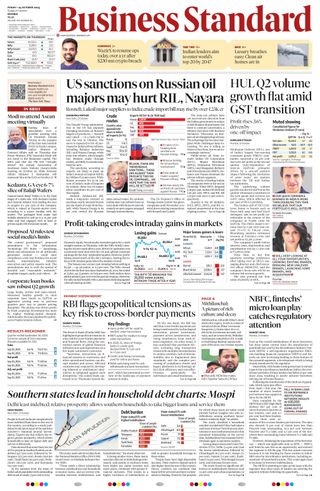

This story is from the October 24, 2025 edition of Business Standard.
Subscribe to Magzter GOLD to access thousands of curated premium stories, and 10,000+ magazines and newspapers.
Already a subscriber? Sign In
MORE STORIES FROM Business Standard
Business Standard
Domestic steel prices likely to rise in March quarter
The Ministry of Finance announced the extension of safeguard duties (SGD) until April 2028, ending policy uncertainty.

3 mins
January 03, 2026
Business Standard
Crackdown on protests: Trump threatens Iran of intervention
US President Donald Trump threatened on Friday to come to the aid of protesters in Iran if security forces fire on them, days into unrest that has left several dead and posed the biggest internal threat to Iranian authorities in years.
1 min
January 03, 2026
Business Standard
Captive, commercial mines drive coal output growth in FY26
Coal output and dispatches from captive and commercial mines rose in December and the third quarter of 2025-26 (Q3FY6), reflecting a steady increase in their contribution to domestic coal supply.
1 min
January 03, 2026
Business Standard
Sebi working on tech road map for stock exchanges, other MIIs
The Securities and Exchange Board of India (Sebi) is planning a working group to develop a technology road map for market infrastructure institutions (MIIs) such as stock exchanges, clearing corporations, and depositories, Chairman Tuhin Kanta Pandey said on Friday.
1 mins
January 03, 2026
Business Standard
Nifty hits new high amid hopes of earnings revival
Indian equities gained, and the benchmark Nifty hit new high amid gains in other peer indices and hopes of corporate earnings revival in the December quarter.
1 mins
January 03, 2026
Business Standard
Deadline for textile PLI scheme applications extended to March 31
The government has further extended the deadline for submission of fresh applications under the production linked incentive (PLI) Scheme for Textiles until March 31.
1 min
January 03, 2026
Business Standard
Biren soars 76% in Hong Kong debut
Shares of Chinese AI chip designer Shanghai Biren Technology closed up 76 per cent in their Hong Kong debut on Friday, the financial hub's first listing of 2026.
1 min
January 03, 2026
Business Standard
FPIs buy ₹7.5K cr domestic debt on Jan 1
This marks highest single-day inflow since May 29, 2025
1 mins
January 03, 2026
Business Standard
Will govern NYC ‘audaciously,’ says Mamdani
Indian-origin politician Zohran Mamdani vowed to govern “expansively and audaciously” and deliver an agenda of affordability for New Yorkers as he thanked his family from “Kampala to Delhi” after being sworn-in as the 112th Mayor of New York City.
1 min
January 03, 2026
Business Standard
‘PRAGATI spurring fresh interest in infra investments’
‘The government has resolved issues impeding 62 mega private investment projects worth about %10.57 trillion, through the ‘Pro-Active Governance And Timely Implementation’ (PRAGATI) platform, which has also helped 3,300 stalled public -sector and public-private partnership (PPP) projects worth over 285 trillion, get off the ground since it was set up in 2015.
3 mins
January 03, 2026
Listen
Translate
Change font size