
Go Unlimited with Magzter GOLD
Get unlimited access to 10,000+ magazines, newspapers and Premium stories for just
10-point guide to Bihar results
Business Standard
|November 15, 2025
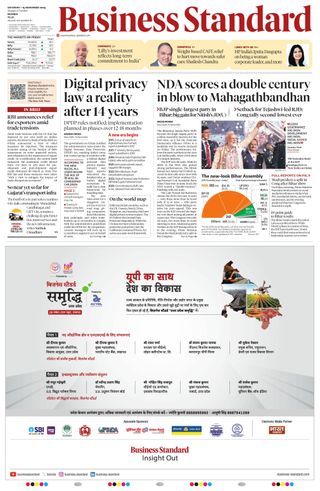
The outcome marks the end of Lalu as a political force. While Nitish’s phase is a matter of time, the BJP has a hawk’s eye. If only they could find some serious local leadership

Here we go with our 10 quick takeaways from this Bihar election result.
The first is that however incredible this landslide might look, the ossified vote banks remain. As fights become more direct, either between two parties or alliances, the gap between a rout and a landslide can be just a few percentage points. The JDU got 15.39 per cent vote in 2020 and it has now gone up by about 4 percentage points to 19.26 (provisional figures at the time of writing). The BJP has risen, but only by a percentage point to 20.11 (provisional figures). Both have contested in a few seats fewer but let’s read that as marginal because these have gone to their allies. The most important ally, the Paswan dynasty’s Lok Janshakti Party (LJP), for example, contested just 29 seats this time, compared to 135 in 2020. Its vote percentage has remained frozen at just over§ percent. It’s evident that in the other constituencies, its tiny vote parcels must've gone to the BJP or JDU.
Now, flip the coin. The Rashtriya Janata Dal’s vote share has remained almost constant at around 23 per cent, as has the Congress’s around 9 per cent. It is clear, therefore, that the two alliance partners have not lost any vote share. It is just that the National Democratic Alliance (NDA) has built a better alliance with the LJP and Jitan Ram Manjhi’s Hindustani Awam Morcha (HAM) to build that additional 5-8 per cent kicker over frozen BJP/JDU votes. That kicker is the difference between a rout and a landslide. This is the central message of this election. The rival cannot take away your committed voters. You have to stitch alliances to bring in the “others”.

This story is from the November 15, 2025 edition of Business Standard.
Subscribe to Magzter GOLD to access thousands of curated premium stories, and 10,000+ magazines and newspapers.
Already a subscriber? Sign In
MORE STORIES FROM Business Standard
Business Standard
Weakness in ₹, broader equity market shrinks India’s billionaire club in 2025
But a robust IPO market leads to emergence of 9 new promoter billionaires

3 mins
January 01, 2026
Business Standard
India Inc expects faster growth, stronger earnings in 2026
Plans to invest and hire more but is concerned about global uncertainty
2 mins
January 01, 2026

Business Standard
Vi to get 5-year lifeline on AGR dues of ₹87.7K cr
Telco has to make repayments from 2031-32 to 2040-41
3 mins
January 01, 2026
Business Standard
Beef import quota breach: China to impose 55% tariff
China will set quotas for beef imports from top suppliers including Brazil and Argentina, and impose tariffs if they are exceeded, in a bid to support the country’s domestic industry.
1 min
January 01, 2026
Business Standard
RBI red-flags bank-NBFC interlink risks
Banks acquiring 80% assets through a limited number of NBFCs
2 mins
January 01, 2026
Business Standard
Northern borders 'stable yet sensitive': Defence ministry
The situation along India’s northern borders “remains stable yet sensitive”, the Ministry of Defence said in a media statement on Wednesday.
1 min
January 01, 2026
Business Standard
Climate analysts mull over El Nino graph in 2026
Year-wise monsoon performance
2 mins
January 01, 2026
Business Standard
Indian pharma sees sharp drop in adverse USFDA findings
The US Food and Drug Administration (USFDA) recorded a significant decline in serious regulatory findings at Indian drug manufacturing facilities between January and December 2025.
2 mins
January 01, 2026
Business Standard
Growing reliance on external funding increases NBFCs' susceptibility to exchange-rate volatility
The Reserve Bank of India (RBI) has cautioned that increasing reliance of non-banking financial companies (NBFC) on external funding has made them susceptible to greater exchange rate volatility.
1 mins
January 01, 2026
Business Standard
2026 to bring data, policy, tax changes
The year 2026 will bring in various new reforms, deadlines, policy and taxation changes ranging from the revision of base year for calculating GDP, IP to European Union’s (EU) Carbon Border Adjustment Mechanism (CBAM) coming into force and the new labour codes, tax reforms getting fully operational.
2 mins
January 01, 2026
Listen
Translate
Change font size