
Go Unlimited with Magzter GOLD
Get unlimited access to 10,000+ magazines, newspapers and Premium stories for just
Rally cry to unite with nature
The Light
|Issue 64, December 2025
Pioneering organic farmer reveals assault on the land
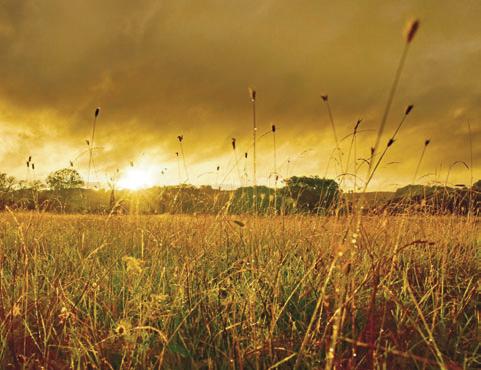
AS the second son of the Baronet of Hardwick House, Sir Julian Rose never expected to inherit the estate, and focused on his dream of becoming an actor.
But in 1964, when he was just 17, his elder brother died, and two years later in 1966, his 54-year-old father also died prematurely, making him the 4th Baronet Rose of Hardwick.
Sir Julian's valiant mother had thus to take on the running of the 900-acre South Oxfordshire estate, and, amid the 60s drive for everything synthetic and chemical, was advised by 'experts' that, without chemicals, herbicides, pesticides and fungicides, nothing would grow on the land apart from some hardy weeds.
Meanwhile, Sir Julian was studying at the Royal Academy of Dramatic Art and working as an actor and assistant director. But in 1975, he returned to Hardwick which, although he said had not yet become a lifeless landmass, had started down the road towards it. He therefore told his mother that he intended to farm without chemicals, and had her full backing.
The years that followed were to transform him into a hands-on organic farmer, author, broadcaster and campaigner of commitment and standing. He established the 'proximity principle' – fresh, local and seasonal food, and distributed locally, himself, his own raw milk and free-range eggs. When Sir Julian spoke at UK Column's conference in October, Hardwick had just celebrated its 50 year anniversary of organic farming.
Sir Julian is a passionate advocate for nature's infinite wisdom, and the earth's capacity to supply man's nutritional and medicinal needs when properly nurtured, free from artificial interference. The relationship between soil health, plant health, animal and human health is, he says, a symbiotic wheel.
On traditional mixed farms, as opposed to large-scale monoculture farming, nutrient-rich plants are eaten by the animals, their manure fertilises the soil, which in turn gives rise to healthy plants.


This story is from the Issue 64, December 2025 edition of The Light.
Subscribe to Magzter GOLD to access thousands of curated premium stories, and 10,000+ magazines and newspapers.
Already a subscriber? Sign In
MORE STORIES FROM The Light
The Light
I fought the law and I won
Whistleblower claims legal system corrupt to the core

4 mins
Issue 64, December 2025
The Light
Our invisible operating system
One world government is already controlling us
3 mins
Issue 64, December 2025

The Light
Truth behind the 'flu season
History shows vaccines causing winter sickness
4 mins
Issue 64, December 2025
The Light
German cities' financial meltdown
Mayor warns democracy under threat if state cannot function
4 mins
Issue 64, December 2025
The Light
Two peace plans for Ukraine
Accusations that Putin dictated terms of Trump's proposal
3 mins
Issue 64, December 2025

The Light
Trump threatens Nigeria military action
Demand for action after 50,000 Christians killed by terrorist groups
3 mins
Issue 64, December 2025

The Light
Do you talk with or at someone?
Understanding and respect come from sharing emotions
3 mins
Issue 64, December 2025
The Light
The architecture of control
How the system manipulates without people knowing
4 mins
Issue 64, December 2025
The Light
Big benefit to drinking raw milk
IN April 1946, Nathaniel Mayer Victor Rothschild rose in the House of Lords on a matter of great import.
3 mins
Issue 64, December 2025
The Light
Rally cry to unite with nature
Pioneering organic farmer reveals assault on the land
4 mins
Issue 64, December 2025
Listen
Translate
Change font size