
Go Unlimited with Magzter GOLD
Get unlimited access to 10,000+ magazines, newspapers and Premium stories for just
Try GOLD - Free
SACRED GAMES
THE WEEK India
|April 20, 2025
The waqf row reveals deeper tensions in BJP’s vision for legal uniformity, and raises fundamental questions about state power and religious autonomy
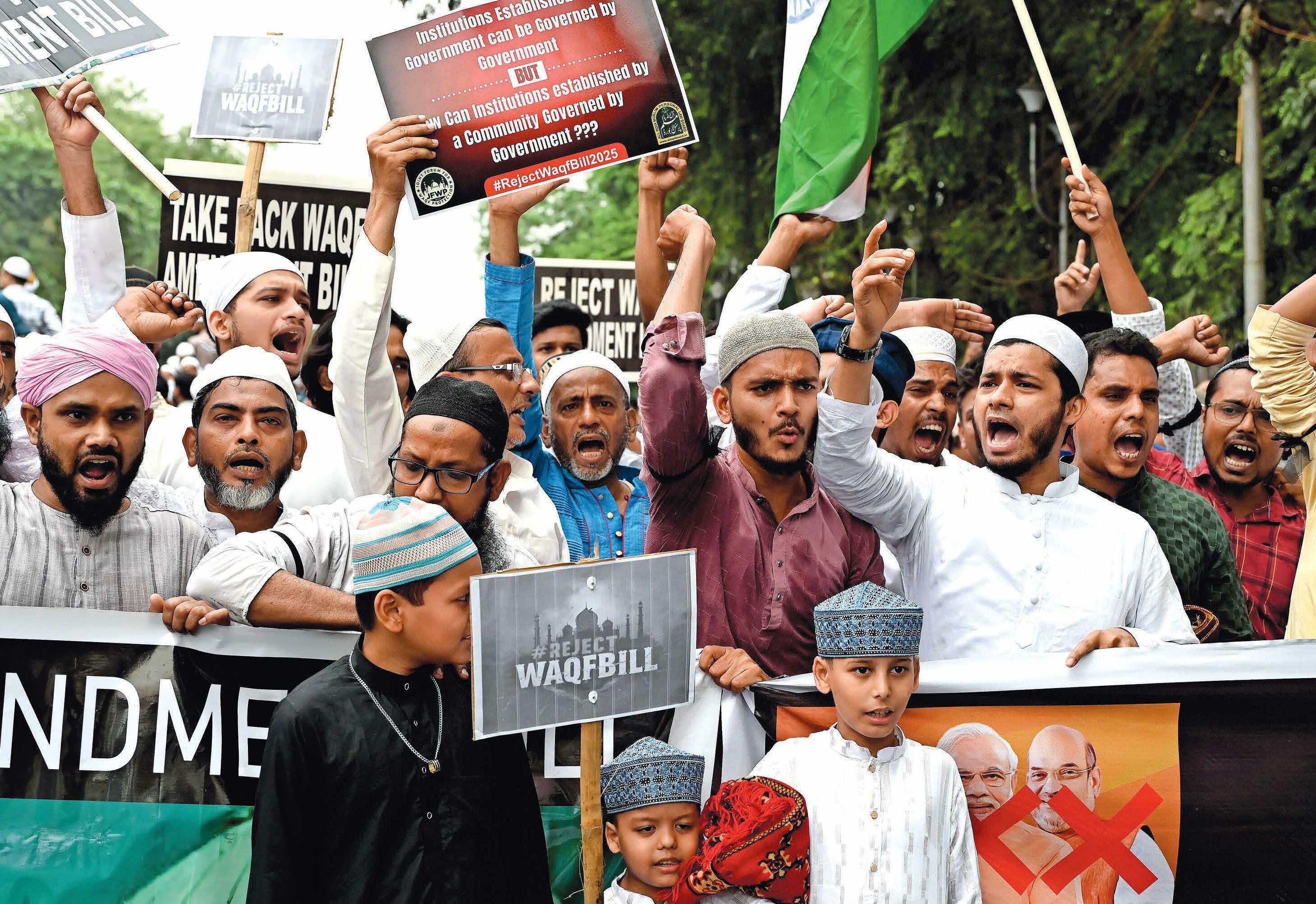
Is the state merely supreme, or is it also sacred? Does it tower above all other social, cultural and religious institutions created by citizens who follow diverse practices and beliefs? In a state governed by laws, do the laws reign supreme, too?
These weighty questions—essentially concerning the supremacy of the Constitution over paralegal religious traditions—are becoming pronounced under the BJP-led Union government, which has in recent years passed legislative reforms that some hail as steps to strengthen secularism by ensuring legal uniformity and others decry as assaults on religious rights and pluralism.
The BJP views legislations like the Citizenship (Amendment) Act and the criminalisation of triple talaq, both passed in 2019, and measures such as ‘One Nation, One Election’ and uniform civil code, as steps to legally unify India’s fragmented secular system. The most recent such milestone is the Waqf (Amendment) Act 2025, passed by Parliament and assented to by President Droupadi Murmu on April 5.
The act amends the Waqf Act, 1995, which governs properties dedicated by Muslims for religious or charitable purposes under Islamic law. With 8.7 lakh properties spanning 9.4 lakh acres across India with an estimated value of ₹1.2 lakh crore, the waqf system is a significant socioeconomic institution. But it has long been viewed as mismanaged, corrupt and non-transparent. The 2025 act introduces key changes: mandatory registration of waqf properties, inclusion of non-Muslim members in waqf boards and the Central Waqf Council, and provisions to ensure women’s representation in waqf administration.

This story is from the April 20, 2025 edition of THE WEEK India.
Subscribe to Magzter GOLD to access thousands of curated premium stories, and 10,000+ magazines and newspapers.
Already a subscriber? Sign In
MORE STORIES FROM THE WEEK India

THE WEEK India
Redefining care through robotics
For a patient preparing for surgery, the central concern is rarely the sophistication of technology in the operating room.

2 mins
May 03, 2026

THE WEEK India
MOTHER LODE
Why Mother Mary is having a moment in pop culture
4 mins
May 03, 2026

THE WEEK India
LECTURES OVER LAGER
What happens when a professor walks into a bar?
4 mins
May 03, 2026

THE WEEK India
Violence has almost disappeared; ideology hasn't vanished
INTERVIEW - B. Shivadhar Reddy director general of police, Telangana
2 mins
May 03, 2026

THE WEEK India
Reserved, yet deferred
The constitutional amendment bill might have given the BJP an immediate campaign issue, but the government will be under pressure. The opposition has tasted blood
5 mins
May 03, 2026

THE WEEK India
PoSH, a question
Serious concerns over corporate India's workplace harassment framework
4 mins
May 03, 2026
THE WEEK India
Her seat at the table
To understand why the women's reservation bill took so long-and why its passage, even in this form, carries genuine weight-one has to begin in 1975
7 mins
May 03, 2026
THE WEEK India
Ladies' seats? Why not from 543?
Sigmund Freud died without answering it.
2 mins
May 03, 2026

THE WEEK India
Healing beyond medicine
At THE WEEK's Ayush conclave, conversations brought about a layered understanding of the opportunities and challenges in integrating traditional knowledge with modern science
10 mins
May 03, 2026

THE WEEK India
Tehran to Delhi—echoes of defiance
Ironic—should I say Iranic—that a country whose language is so sophisticated that it does not even bother with gendered pronouns, referring to everyone (and everything) with the same universal “oo” has become the site of an invasion ostensibly to “save” its women from oppression by the boorish and bumbling west.
2 mins
May 03, 2026
Listen
Translate
Change font size