Try GOLD - Free
The Runaway Groom
Outlook
|April 01, 2024
Tribal communities in the country have had interesting and unique wedding customs, but most have gone extinct with time

MORE than a century ago, in a court in Tura in the northeast Indian state of Meghalaya, a Garo tribal man filed a petition seeking compensation from his prospective father-in-law.
According to Garo customs of the time, when a local woman finalises a man for marriage, her uncles and brothers would abduct him. It was expected that the man would resist fiercely, yell and try to escape. This resistance was seen as a sign that he would be a strong and prosperous husband. If he offered little or weak resistance, it would not impress the woman’s family.
The man followed the tradition by resisting abduction, but was eventually confined to the prospective bride’s home. Tradition also dictated he should attempt to escape, which he did. If caught, he’d be brought back. However, a second escape would signal his unwillingness to marry, leading to the proposal being called off.
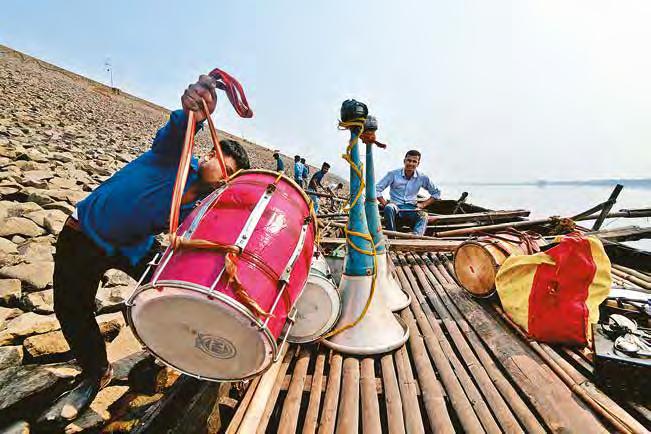
In this case, after the groom-elect escaped from confinement at the bride’s place, no one searched for him. The girl married another man who, according to Major Playfair, then deputy commissioner of Eastern Bengal and Assam, was “less strict in his ideas of Garo etiquette.” Feeling insulted, the original groom-elect petitioned the court, as recounted in Playfair’s 1909 book The Garos.
In Garo society, property is inherited by women. One can, therefore, understand why the wedding ball starts rolling after the girl or woman identifies a prospective groom. It was believed that the whole process spanned a few days to weeks, giving the man sufficient time to decide.
However, by the 1970s, this practice of ‘abduction marriage’, locally called

This story is from the April 01, 2024 edition of Outlook.
Subscribe to Magzter GOLD to access thousands of curated premium stories, and 10,000+ magazines and newspapers.
Already a subscriber? Sign In
MORE STORIES FROM Outlook
Outlook
Goapocalypse
THE mortal remains of an arterial road skims my home on its way to downtown Anjuna, once a quiet beach village 'discovered' by the hippies, explored by backpackers, only to be jackbooted by mass tourism and finally consumed by real estate sharks.

2 mins
January 21, 2026

Outlook
A Country Penned by Writers
TO enter the country of writers, one does not need any visa or passport; one can cross the borders anywhere at any time to land themselves in the country of writers.
8 mins
January 21, 2026

Outlook
Visualising Fictional Landscapes
The moment is suspended in the silence before the first mark is made.
1 mins
January 21, 2026
Outlook
Only the Upper, No Lower Caste in MALGUDI
EVERY English teacher would recognise the pleasures, the guilt and the conflict that is the world of teaching literature in a university.
5 mins
January 21, 2026
Outlook
The Labour of Historical Fiction
I don’t know if I can pinpoint when the idea to write fiction took root in my mind, but five years into working as an oral historian of the 1947 Partition, the landscape of what would become my first novel had grown too insistent to ignore.
6 mins
January 21, 2026

Outlook
Conjuring a Landscape
A novel rarely begins with a plot.
6 mins
January 21, 2026

Outlook
The City that Remembered Us...
IN the After-Nation, the greatest crime was remembering.
1 min
January 21, 2026

Outlook
Imagined Spaces
I was talking with the Kudiyattam artist Kapila Venu recently about the magic of eyes.
5 mins
January 21, 2026

Outlook
Known and Unknown
IN an era where the gaze upon landscape has commodified into picture postcards with pristine beauty—rolling hills, serene rivers, untouched forests—the true essence of the earth demands a radical shift.
2 mins
January 21, 2026

Outlook
A Dot in Soot
A splinter in the mouth. Like a dream. A forgotten dream.
2 mins
January 21, 2026
Listen
Translate
Change font size