Try GOLD - Free
We're as Smart as the Universe Gets
Philosophy Now
|October/November 2024
James Miles argues, among other things, that E.T. will be like Kim Kardashian, and that the real threat of advanced AI has been misunderstood.

In 1995 the English mathematical biologist John Maynard Smith published The Major Transitions in Evolution. Maynard Smith was a co-developer of gene-centred evolutionary biology in the 1960s and the founder of evolutionary game theory in the early 1970s, and what this book was quietly saying about high intelligence can be considered revolutionary, or at least, notably evolutionary. As a result of a paper I wrote about evolution in the journal Philosophy in 1998, I ended up friends for the last decade of his life with the other co-developer of gene-centred evolutionary biology, the American biologist George C. Williams. And like Maynard Smith and the early Darwinians (including Darwin), Williams was fascinated by the so-called ‘high intelligence paradox’ and the evolutionary problems it implies. One of the early Darwinians even turned to philosophy to try to solve the paradox.
Although evolution is predominantly gradual, theoretical biologists recognise a series of major transition events, which involved profound changes in the way information is stored and transmitted between generations. In his Major Transitions, Maynard Smith recognised eight of them across the four billion years of life on this planet, including the early move from an RNA world to DNA, the transition from prokaryotic to eukaryotic cells, and the transition from asexual to sexual reproduction. His seventh major evolutionary transition was the genetic flip-switch that allowed some species to live in large colonies, curing Darwin’s headache about non-reproductive insect castes and sterile workers. High intelligence through language was
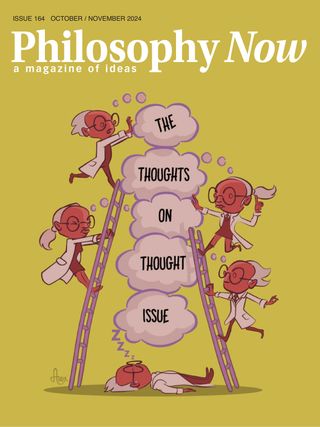

This story is from the October/November 2024 edition of Philosophy Now.
Subscribe to Magzter GOLD to access thousands of curated premium stories, and 10,000+ magazines and newspapers.
Already a subscriber? Sign In
MORE STORIES FROM Philosophy Now
Philosophy Now
Bilbo Theorizes About Wellbeing
Eric Comerford overhears Bilbo and Gandalf discussing happiness.

9 mins
December 2025 / January 2026

Philosophy Now
What Women?
Marcia Yudkin remembers almost choking at Cornell
11 mins
December 2025 / January 2026
Philosophy Now
Islamic Philosophers On Tyranny
Amir Ali Maleki looks at tyranny from an Islamic perspective.
4 mins
December 2025 / January 2026

Philosophy Now
Peter Singer
The controversial Australian philosopher defends the right to choose to die on utilitarian grounds
5 mins
December 2025 / January 2026

Philosophy Now
Another Conversation with Martin Heidegger?
Raymond Tallis talks about communication problems.
7 mins
December 2025 / January 2026

Philosophy Now
Letters
When inspiration strikes, don't bottle it up. Email me at rick.lewis@philosophynow.org Keep them short and keep them coming!
17 mins
December 2025 / January 2026
Philosophy Now
The Philosophy of William Blake
Mark Vernon looks at the imaginative thinking of an imaginative artist.
9 mins
December 2025 / January 2026

Philosophy Now
Philosophical Haiku
Peering through life’s lens God in nature is deduced: The joy of being.
1 mins
December 2025 / January 2026

Philosophy Now
Philosophy Shorts
More songs about Buildings and Food' was the title of a 1978 album by the rock band Talking Heads. It was about all the things rock stars normally don't sing about. Pop songs are usually about variations on the theme of love; tracks like Rose Royce's 1976 hit 'Car Wash' are the exception. Philosophers, likewise, tend to have a narrow focus on epistemology, metaphysics and trifles like the meaning of life. But occasionally great minds stray from their turf and write about other matters, for example buildings (Martin Heidegger), food (Hobbes), tomato juice (Robert Nozick), and the weather (Lucretius and Aristotle). This series of Shorts is about these unfamiliar themes; about the things philosophers also write about.
2 mins
December 2025 / January 2026

Philosophy Now
Hedonic Treadmills in the Vale of Tears
Michael Gracey looks at how philosophers have pursued happiness.
8 mins
December 2025 / January 2026
Listen
Translate
Change font size