Try GOLD - Free
The Philosophy of Work
Philosophy Now
|February/March 2024
Alessandro Colarossi has insights for the bored and understimulated.

If you’ve ever found yourself staring blankly at a spreadsheet or nursing a lukewarm cup of coffee while daydreaming about your next vacation, this is for you. Yes, you, the one who periodically contemplates existential questions between email exchanges and Zoom meetings. If your work feels like a necessary yet uninspiring pursuit, a means to fund your ‘real life’ outside the office, let us delve together into the philosophical underpinnings of work. Who knows, we might find ways to render the banal a little more bearable, or even meaningful.
Aristotle and the Dignity of Work
Aristotle, one of the most influential philosophers in Western thought, had distinctive views on work. He made a clear distinction between chrematistics (wealth acquisition) and oikonomia (household management). In his view, work performed purely for the sake of livelihood, or chrematistics, was not inherently virtuous; it was simply a means to an end. However, work that contributed to the well-being of the community, or oikonomia, was considered virtuous as it served a higher purpose.
Aristotle asserted that work aimed at wealth accumulation (chrematistics) was a practical necessity of life, but not a noble goal. It was essential to fulfill our basic needs such as food, shelter, and clothing. However, when wealth accumulation became the primary aim, it could lead to an unhealthy focus on materialism, potentially degrading societal values and causing imbalance in life.
On the other hand, Aristotle regarded oikonomia as a more virtuous form of work. This was work that concerned the wellbeing and self-sufficiency of the household and, by extension, the community. It involved efficiently managing resources, caring for people’s needs, and contributing to the collective health and prosperity.
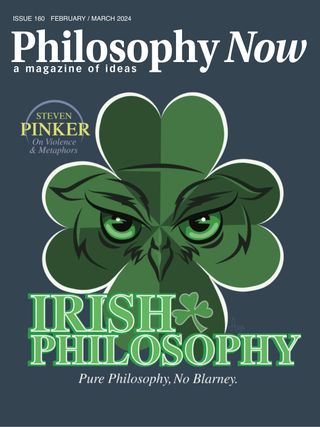

This story is from the February/March 2024 edition of Philosophy Now.
Subscribe to Magzter GOLD to access thousands of curated premium stories, and 10,000+ magazines and newspapers.
Already a subscriber? Sign In
MORE STORIES FROM Philosophy Now

Philosophy Now
Bilbo Theorizes About Wellbeing
Eric Comerford overhears Bilbo and Gandalf discussing happiness.

9 mins
December 2025 / January 2026

Philosophy Now
What Women?
Marcia Yudkin remembers almost choking at Cornell
11 mins
December 2025 / January 2026
Philosophy Now
Islamic Philosophers On Tyranny
Amir Ali Maleki looks at tyranny from an Islamic perspective.
4 mins
December 2025 / January 2026

Philosophy Now
Peter Singer
The controversial Australian philosopher defends the right to choose to die on utilitarian grounds
5 mins
December 2025 / January 2026

Philosophy Now
Another Conversation with Martin Heidegger?
Raymond Tallis talks about communication problems.
7 mins
December 2025 / January 2026

Philosophy Now
Letters
When inspiration strikes, don't bottle it up. Email me at rick.lewis@philosophynow.org Keep them short and keep them coming!
17 mins
December 2025 / January 2026

Philosophy Now
The Philosophy of William Blake
Mark Vernon looks at the imaginative thinking of an imaginative artist.
9 mins
December 2025 / January 2026

Philosophy Now
Philosophical Haiku
Peering through life’s lens God in nature is deduced: The joy of being.
1 mins
December 2025 / January 2026

Philosophy Now
Philosophy Shorts
More songs about Buildings and Food' was the title of a 1978 album by the rock band Talking Heads. It was about all the things rock stars normally don't sing about. Pop songs are usually about variations on the theme of love; tracks like Rose Royce's 1976 hit 'Car Wash' are the exception. Philosophers, likewise, tend to have a narrow focus on epistemology, metaphysics and trifles like the meaning of life. But occasionally great minds stray from their turf and write about other matters, for example buildings (Martin Heidegger), food (Hobbes), tomato juice (Robert Nozick), and the weather (Lucretius and Aristotle). This series of Shorts is about these unfamiliar themes; about the things philosophers also write about.
2 mins
December 2025 / January 2026

Philosophy Now
Hedonic Treadmills in the Vale of Tears
Michael Gracey looks at how philosophers have pursued happiness.
8 mins
December 2025 / January 2026
Listen
Translate
Change font size