
Go Unlimited with Magzter GOLD
Get unlimited access to 10,000+ magazines, newspapers and Premium stories for just
Try GOLD - Free
Metaphors & Creativity
Philosophy Now
|December 2024 / January 2025
Ignacio Gonzalez-Martinez has a flash of inspiration about the role metaphors play in creative thought.
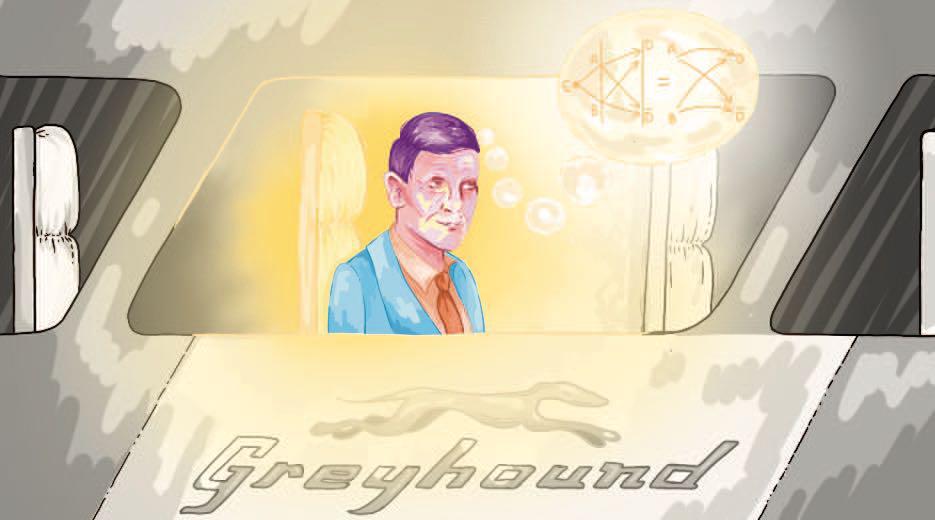
The equivalence between Richard Feynman’s and Julian Schwinger’s distinct formulations of quantum electrodynamics was by no means obvious. The two physicists themselves saw their methods as competing instead of being complementary. However, after becoming familiar with both approaches, Freeman Dyson had a ‘flash of illumination’ about how to reconcile them, while travelling home in a Greyhound bus. Thus it came to pass that Dyson secured yet another place for himself in the history of physics. And in his book The Emperor’s New Mind (1989), Roger Penrose recounts Henri Poincaré’s narrative of the moment when his search for ‘Fuchsian functions’ came to completion while in the middle of a geological expedition. It turned out, exclaimed Poincaré, that “the transformations I had used to define the Fuchsian functions were identical with those of non-Euclidean geometry.” The answer was ‘staring at him in the face all along’, as they say.
Such ‘flash of inspiration’ narratives, in which a coveted creative breakthrough almost violently irrupts into the mind of an ecstatic subject, surely are the archetypal depiction of creativity. This archetype suggests, not particularly subtly, that creative insight is a phenomenon that happens to the subject, not something the subject deliberately produces. Framed in this way, the mystery surrounding creativity becomes, who or what plays the active role in it?
Hypotheses about what lies at the onset of creativity abound. Sometimes people report that ideas ‘come down’ to them, even when they’re not conscious. An example of this is the story told by the German physicist August Kekulé, who claimed to have envisioned the hexagonal structure of the benzene molecule while he was sleeping. In his dream, dancing atoms formed a closed string that subsequently transmuted into a snake eating its own tail.

This story is from the December 2024 / January 2025 edition of Philosophy Now.
Subscribe to Magzter GOLD to access thousands of curated premium stories, and 10,000+ magazines and newspapers.
Already a subscriber? Sign In
MORE STORIES FROM Philosophy Now

Philosophy Now
Nosferatu
Stefan Bolea considers two very different artistic approaches to love and death.

6 mins
April/May 2025

Philosophy Now
Heidegger's Ghost
Raymond Tallis wonders where Heidegger's body went when he was philosophising.
7 mins
April/May 2025

Philosophy Now
Is Comedy Good For Us?
Damaris Stock has a laugh with Plato and friends.
10 mins
April/May 2025
Philosophy Now
In Defense of Idleness
Wendell O'Brien says, 'Just Don't Do It'.
10 mins
April/May 2025
Philosophy Now
Leaving Nothing to Chance by Carl Knight
LEAVING NOTHING TO Chance (2025) by Carl Knight, is an informed, proficient and lucid defence of luck egalitarianism.
3 mins
April/May 2025

Philosophy Now
Star Maker by Olaf Stapledon
THE 1937 SCIENCE FICTION novel Star Maker was written by philosophy professor Olaf Stapledon in the dark days as Europe awaited the onslaught of Nazi Germany. This casts a shadow over the whole book.
6 mins
April/May 2025
Philosophy Now
Love & Emptiness in the Sufi Tradition
Medha Ninad Tambe meditates on Rumi, love and self-negation.
7 mins
April/May 2025

Philosophy Now
The Hedgehog's Dilemma: A Metaphor About the Challenges of Human Intimacy
Krishna Chaubey explains Arthur Schopenhauer's poignant thought experiment.
4 mins
April/May 2025
Philosophy Now
The Mirror & the Flame
Rebwar Fatah imagines Attar's & Hegel's shared path.
4 mins
April/May 2025
Philosophy Now
Free and Equal by Daniel Chandler
DANIEL CHANDLER, AN economist and philosopher based at the London School of Economics, begins Free and Equal: What Would a Fair Society Look Like? (2023) by asking an intriguing question. How is it, he wonders, that the most influential political philosopher of the last century has had almost no practical impact on politics or policy? The philosopher in question is John Rawls, whose magnum opus was A Theory of Justice (1971).
5 mins
April/May 2025
Listen
Translate
Change font size