Try GOLD - Free
Marcus Aurelius's Ten Commandments
Philosophy Now
|December 2025 / January 2026
Massimo Pigliucci studies the Stoic Emperor's to-do list.
Commandments are generally lists of things someone requires someone else to do, usually with the implied threat that something bad will happen if they don’t. In the case of the Stoic philosopher and Roman Emperor Marcus Aurelius (121-180 CE), though, the list we find in section 18 of the 11th book of his Meditations is actually comprised of wise suggestions to himself. Still, they may help us as well:
“Firstly: Consider your relation to humankind and that we came into the world for the sake of one another” (trans. C.R. Haines). According to the Stoics, all human beings are brothers and sisters, members of the cosmopolis, the ‘universal city’ of humanity. Nature put us here to help each other; as is generally the case for highly social species.
“Secondly: Consider what sort of individuals others are at board and in bed and elsewhere. Above all how they are the self-made slaves of their principles, and how they pride themselves on the very acts in question.” One way to be charitable toward others is to remember that many sincerely follow misguided principles; for instance, the notion that owning more things and having more money makes one happier and better than others.
“Thirdly: That if they are acting rightly, there is no call for us to be angry. If not rightly, it is obviously against their will and through ignorance.” Like Plato, the Stoics thought that we do bad things out of a particular kind of ignorance better rendered as ‘unwisdom’. So instead of getting angry with people who err, let us try to teach them the right way.
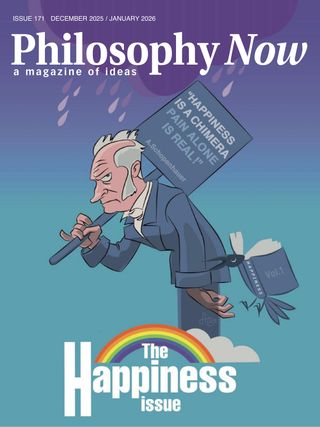

This story is from the December 2025 / January 2026 edition of Philosophy Now.
Subscribe to Magzter GOLD to access thousands of curated premium stories, and 10,000+ magazines and newspapers.
Already a subscriber? Sign In
MORE STORIES FROM Philosophy Now

Philosophy Now
Bilbo Theorizes About Wellbeing
Eric Comerford overhears Bilbo and Gandalf discussing happiness.

9 mins
December 2025 / January 2026

Philosophy Now
What Women?
Marcia Yudkin remembers almost choking at Cornell
11 mins
December 2025 / January 2026

Philosophy Now
Islamic Philosophers On Tyranny
Amir Ali Maleki looks at tyranny from an Islamic perspective.
4 mins
December 2025 / January 2026

Philosophy Now
Peter Singer
The controversial Australian philosopher defends the right to choose to die on utilitarian grounds
5 mins
December 2025 / January 2026

Philosophy Now
Another Conversation with Martin Heidegger?
Raymond Tallis talks about communication problems.
7 mins
December 2025 / January 2026

Philosophy Now
Letters
When inspiration strikes, don't bottle it up. Email me at rick.lewis@philosophynow.org Keep them short and keep them coming!
17 mins
December 2025 / January 2026
Philosophy Now
The Philosophy of William Blake
Mark Vernon looks at the imaginative thinking of an imaginative artist.
9 mins
December 2025 / January 2026

Philosophy Now
Philosophical Haiku
Peering through life’s lens God in nature is deduced: The joy of being.
1 mins
December 2025 / January 2026

Philosophy Now
Philosophy Shorts
More songs about Buildings and Food' was the title of a 1978 album by the rock band Talking Heads. It was about all the things rock stars normally don't sing about. Pop songs are usually about variations on the theme of love; tracks like Rose Royce's 1976 hit 'Car Wash' are the exception. Philosophers, likewise, tend to have a narrow focus on epistemology, metaphysics and trifles like the meaning of life. But occasionally great minds stray from their turf and write about other matters, for example buildings (Martin Heidegger), food (Hobbes), tomato juice (Robert Nozick), and the weather (Lucretius and Aristotle). This series of Shorts is about these unfamiliar themes; about the things philosophers also write about.
2 mins
December 2025 / January 2026

Philosophy Now
Hedonic Treadmills in the Vale of Tears
Michael Gracey looks at how philosophers have pursued happiness.
8 mins
December 2025 / January 2026
Listen
Translate
Change font size