Try GOLD - Free
Heraclitus (c.500 BC)
Philosophy Now
|June/July 2024
Harry Keith lets flow a stream of ideas about permanence and change.

If you've never read Heraclitus's book, then you share something in common with every modern scholar of his work: we only have fragments. Unfortunately, so little of his writing survives that it is difficult to piece together the life and opinions of this intriguing philosopher. This is what makes studying him partly so easy, and partly so difficult: you can read all the surviving fragments in an hour, then puzzle over them for the rest of your life.
We may never understand Heraclitus's philosophy in detail, but I hope by the end of this article to introduce you to some of the themes that survive, to what recent(ish) philosophers have said about them, and to what we can learn from them today.
Life
Most of what we know about Heraclitus's life comes from the biographer of philosophers Diogenes Laertius (not to be confused with the other Diogenes, the urn-dwelling Cynic) who wrote in around 225 AD, more than seven hundred years after Heraclitus's time. Laertius was notorious for regurgitating without critical reflection previous sources, ranging from comic poems, to earlier biographies, to that ever-popular source 'according to some'. Therefore take the following with a large pinch of Ionian sea salt.
Heraclitus was born in the Greek city-state of Ephesus, on the coast of modern-day Turkey, and he flourished around 500 BC, which is about thirty years before Socrates was born. The surviving anecdotes of his life are all rather whacky: the picture we're left with is of an arrogant eccentric who hated common wisdom and the authorities of his time to the point of self-isolation. Despite being born in Ephesus, he seems very critical of the city. After his friend Hermodorus was exiled from it, he claimed that the Ephesians all deserved to die to a man, and ought to leave the city to the young.
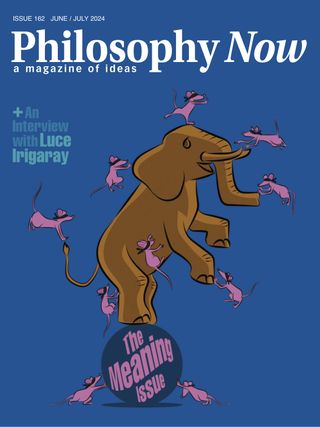

This story is from the June/July 2024 edition of Philosophy Now.
Subscribe to Magzter GOLD to access thousands of curated premium stories, and 10,000+ magazines and newspapers.
Already a subscriber? Sign In
MORE STORIES FROM Philosophy Now

Philosophy Now
Nosferatu
Stefan Bolea considers two very different artistic approaches to love and death.

6 mins
April/May 2025

Philosophy Now
Heidegger's Ghost
Raymond Tallis wonders where Heidegger's body went when he was philosophising.
7 mins
April/May 2025

Philosophy Now
Is Comedy Good For Us?
Damaris Stock has a laugh with Plato and friends.
10 mins
April/May 2025
Philosophy Now
In Defense of Idleness
Wendell O'Brien says, 'Just Don't Do It'.
10 mins
April/May 2025
Philosophy Now
Leaving Nothing to Chance by Carl Knight
LEAVING NOTHING TO Chance (2025) by Carl Knight, is an informed, proficient and lucid defence of luck egalitarianism.
3 mins
April/May 2025

Philosophy Now
Star Maker by Olaf Stapledon
THE 1937 SCIENCE FICTION novel Star Maker was written by philosophy professor Olaf Stapledon in the dark days as Europe awaited the onslaught of Nazi Germany. This casts a shadow over the whole book.
6 mins
April/May 2025
Philosophy Now
Love & Emptiness in the Sufi Tradition
Medha Ninad Tambe meditates on Rumi, love and self-negation.
7 mins
April/May 2025

Philosophy Now
The Hedgehog's Dilemma: A Metaphor About the Challenges of Human Intimacy
Krishna Chaubey explains Arthur Schopenhauer's poignant thought experiment.
4 mins
April/May 2025

Philosophy Now
The Mirror & the Flame
Rebwar Fatah imagines Attar's & Hegel's shared path.
4 mins
April/May 2025
Philosophy Now
Free and Equal by Daniel Chandler
DANIEL CHANDLER, AN economist and philosopher based at the London School of Economics, begins Free and Equal: What Would a Fair Society Look Like? (2023) by asking an intriguing question. How is it, he wonders, that the most influential political philosopher of the last century has had almost no practical impact on politics or policy? The philosopher in question is John Rawls, whose magnum opus was A Theory of Justice (1971).
5 mins
April/May 2025
Listen
Translate
Change font size