Try GOLD - Free
Hot Commodity
New York magazine
|September 23 - October 6, 2024
In Sally Rooney's novels, love is always being bought, sold, or reduced to tropes. But this is also what makes it real.

IT'S THAT TIME AGAIN: Sally Rooney has written a novel. Her books are spoken of in such epochal terms—“the first great millennial novelist,” the New York Times has called her—that one forgets that, until this week, she had written only three: Conversations With Friends, Normal People, and Beautiful World, Where Are You. These are thoughtful, well-written books about young people falling in love, and they have attracted, with the logic of a lightning strike, a degree of mass popularity that is rarely achieved by what is marketed to consumers as “literary fiction.” This feat appears to baffle even the author, a self-described Marxist who believes human existence is being eroded at every level by the “transactional framework of capitalism.” Somewhat unwillingly, Rooney has become an emblem of a (perhaps imaginary) millennial ethos, one in which that generation’s anti-capitalist beliefs sit uneasily alongside its quiet but determined pursuit of a conventional life (traditional marriage, income stability, affordable housing) that appears to be vanishing. This tension seems to be exemplified by Rooney’s own commercial success. The industry will not soon forget the yellow bucket hats that Rooney’s publishers doled out to influencers in 2021 during the publicity campaign for Beautiful World, which also stationed a coffee truck bearing the novel’s cover art outside select New York bookstores.
Unsurprisingly, with the hype has come criticism: that Rooney is writing the same novel over and over; that she is writing the upmarket equivalent of a romance novel; that her prose is too accessible to be the stuff of serious literature; and, above all, that her professed Marxist values, much dwelt on in the press, are at odds with a theme as transparently bourgeois as romantic love.
Now, it is simply untrue that Rooney’s prose resembles that of a commercial romance; her sentences are spare, exact, and disarming.
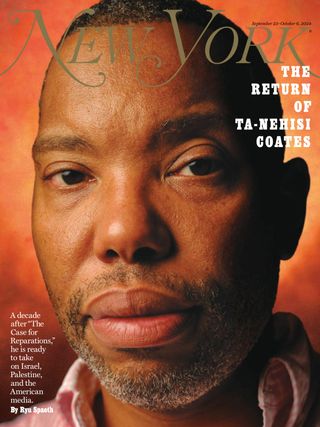

This story is from the September 23 - October 6, 2024 edition of New York magazine.
Subscribe to Magzter GOLD to access thousands of curated premium stories, and 10,000+ magazines and newspapers.
Already a subscriber? Sign In
MORE STORIES FROM New York magazine

New York magazine
Will You Come and Get Me?'
The provocative festival hit The Voice of Hind Rajab reenacts the 5-year-old girl's call to emergency dispatchers in Gaza just before she was killed.

12 mins
December 15-28, 2025

New York magazine
The Eyes Wide Shut Conspiracy
Did Stanley Kubrick warn us about Jeffrey Epstein?
13 mins
December 15-28, 2025

New York magazine
He Just Got It
Robert A.M. Stern embraced New York as a collective project.
5 mins
December 15-28, 2025
New York magazine
REASONS TO LOVE NEW YORK (RIGHT NOW)
OUR 21ST ANNUAL REMINDER OF WHY WE WOULDN'T WANT TO LIVE ANYWHERE ELSE. RENT HIKES, RAT KINGS, AND ALL
7 mins
December 15-28, 2025

New York magazine
The Revenants
Marjorie Prime is a thoughtful, well-wrought play that's cool to the touch
4 mins
December 15-28, 2025

New York magazine
Solo Act
In Pluribus, Rhea Seehorn plays the loneliest woman in the world, a role that creator Vince Gilligan wrote just for her.
7 mins
December 15-28, 2025

New York magazine
The War on Everything Doctrine
Hegseth's deadly missile strikes mirror Trump's domestic priorities.
5 mins
December 15-28, 2025

New York magazine
Kumail Nanjiani Strikes Back
The stand-up manages to come across as relatable—even after years in Hollywood
5 mins
December 15-28, 2025
New York magazine
Where the Wild Chairs Are
A designer’s unconventional furniture upends his traditional prewar apartment.
2 mins
December 15-28, 2025
New York magazine
What We Give Our Children
THERE ARE INFINITE WAYS to delight a child with a gift-and as many ways to miss the mark. Seven Strategist staffers with kids of their own discussed the best presents for all types of little ones, from newborns to hard-to-please tweens, that won't end up in the regift pile.
3 mins
December 15-28, 2025
Listen
Translate
Change font size