Try GOLD - Free
Writing for a Warming World - Imagining the overwhelming, the ubiquitous, the world-shattering.
Writer’s Digest
|July - August 2024
Climate change is one of those topics that can throw novelists—and everyone else—into a fearful and cowering silence. When the earth is losing its familiar shapes and consolations, changing drastically and in unpredictable ways beneath our feet, how can we summon our creative resources to engage in the imaginative world-building required to write a novel that takes on these threats in compelling ways? And how to avoid writing fiction that addresses irreversible climate change without letting our prose get too preachy, overly prescriptive, saturated with despair?

Climate change is one of those topics that can throw novelists—and everyone else—into a fearful and cowering silence. When the earth is losing its familiar shapes and consolations, changing drastically and in unpredictable ways beneath our feet, how can we summon our creative resources to engage in the imaginative world-building required to write a novel that takes on these threats in compelling ways? And how to avoid writing fiction that addresses irreversible climate change without letting our prose get too preachy, overly prescriptive, saturated with despair?
If there is any comfort to be had here, perhaps it lies in the number of novels written over the last several decades that have taken on this immensely challenging subject from such a wide variety of creative angles. Books like Octavia Butler’s Parable of the Sower, in which a family struggles to survive in a ravaged near future America and the young protagonist creates a new community based on principles of sustainability and collective action. Or Kim Stanley Robinson’s Ministry for the Future, a sprawling story of global despair and international cooperation featuring dozens of points of view and showcasing how individual actions and policy changes might intertwine in response to catastrophe. The setting of Téa Obreht’s recently published The Morningside is a reimagined Manhattan devastated by coastal flood yet still thrumming with the mysteries and stories that sustain its thinned-out population.
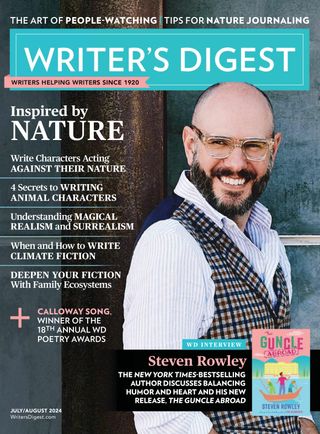

This story is from the July - August 2024 edition of Writer’s Digest.
Subscribe to Magzter GOLD to access thousands of curated premium stories, and 10,000+ magazines and newspapers.
Already a subscriber? Sign In
MORE STORIES FROM Writer’s Digest
Writer’s Digest
100 Best Markets for Writers
A list of print and online publications looking for freelancers to contribute their knowledge on everything from pet care to finance and beyond.

65 mins
Yearbook 2026

Writer’s Digest
Memoir Plus
Add a bonus to your personal narrative for a marketing boost.
8 mins
Yearbook 2026
Writer’s Digest
Surefire Ways to Sell Your Children's Book
In my 28 years editing children's books, I've learned that publishing exists at the intersection of art and commerce.
5 mins
Yearbook 2026
Writer’s Digest
The ABCs of Freelance Success
Many freelance writers, especially those at the beginning of their careers, tend to place almost all of their professional focus on one specific component: craft.
5 mins
Yearbook 2026
Writer’s Digest
How to Write in Different Genres
Emiko Jean and Yulin Kuang share tips and strategies for how they successfully write in different genres and mediums.
8 mins
Yearbook 2026
Writer’s Digest
Small But Mighty
Why small presses might be the perfect home for your book.
8 mins
Yearbook 2026

Writer’s Digest
The Story Behind the Story
What's backstory, and what's it doing here anyway?
6 mins
Yearbook 2026

Writer’s Digest
2025 Year in Review
Publishing expert Jane Friedman recaps the biggest news in the industry.
8 mins
Yearbook 2026

Writer’s Digest
What Is Your Story Question?
When a story isn't working—when you know it's not quite coming together, when beta readers and critique partners confirm your fears but can't put a finger on why, or you're not getting offers from agents or publishers—savvy authors start trying to diagnose the issue by examining its component parts, like characterization, plot, and stakes.
6 mins
Yearbook 2026
Writer’s Digest
Writer's Digest 27th Annual 101 Best Websites for Writers
For the 27th year, Writer's Digest is shining a light on 101 websites with a goal of helping writers in a variety of ways.
26 mins
Yearbook 2026
Listen
Translate
Change font size