
Go Unlimited with Magzter GOLD
Get unlimited access to 10,000+ magazines, newspapers and Premium stories for just
Try GOLD - Free
Long lifespan, recyclability: Can Fe/V flow battery drive transition?
Oil and Gas News
|July 2025
With the cost and efficiency gap with lithium-ion batteries narrowing, the Fe/V flow battery offers a robust, eco-friendly solution to power the world’s sustainable future
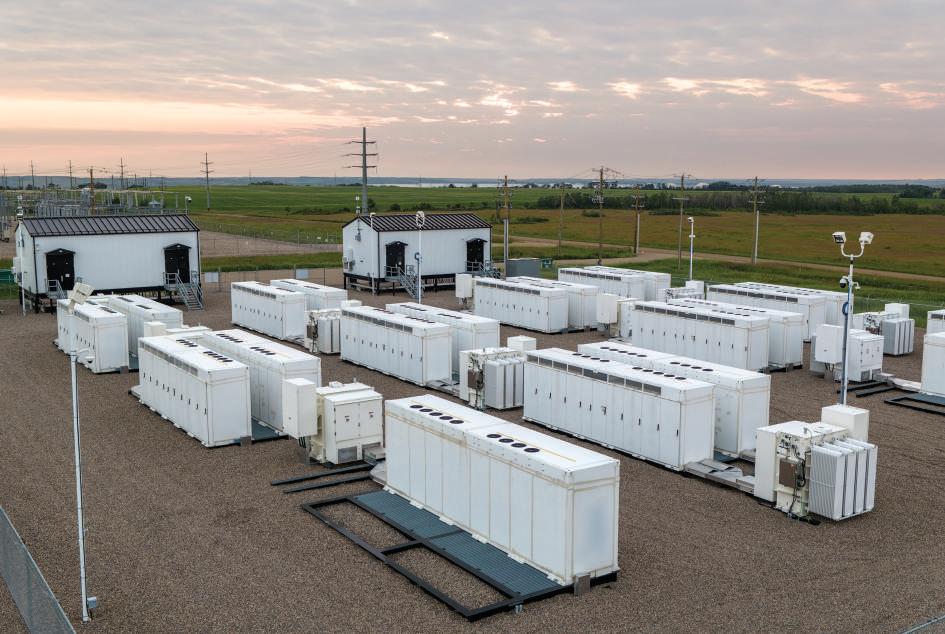
In May 2025, Saudi Aramco achieved a global milestone by commissioning the world’s first megawatt-scale Iron-Vanadium (Fe/V) flow battery in Wa'ad Al-Shamal, powering gas production with solar energy backup.
This pioneering deployment underscores the growing significance of Fe/V flow batteries in sustainable energy storage.
As the world transitions to a low-carbon future, this electrochemical technology offers a compelling alternative to traditional batteries, blending cost-effectiveness, safety, and scalability.
UNDERSTANDING REDOX FLOW BATTERIES & THE FE/V VARIANT
Redox flow batteries (RFBs) are rechargeable energy storage systems that store energy in liquid electrolytes, which flow through electrochemical cells to generate electricity.
Unlike conventional batteries, RFBs separate energy storage (in electrolyte tanks) from power generation (in cell stacks), allowing independent scaling of capacity and output.
This flexibility makes them ideal for large-scale applications like grid storage and renewable energy integration.
The Iron-Vanadium (Fe/V) flow battery is a hybrid RFB that uses iron and vanadium ions as active materials in its electrolytes.
The positive electrolyte (catholyte) typically contains iron ions (Fe2+/Fe3+), while the negative electrolyte (anolyte) employs vanadium ions (V2+/V3+), separated by an ion-exchange membrane.
The Fe/V flow battery operates through redox reactions, where electrons are transferred between the iron and vanadium ions.
During charging, the iron ions in the catholyte are oxidised from Fe2+ to Fe3+, releasing electrons, while vanadium ions in the anolyte are reduced from V3+ to V2+, accepting electrons.
Discharging reverses this process, generating an electric current as the ions return to their original states.
The membrane allows ion exchange to maintain charge balance without mixing the electrolytes.

This story is from the July 2025 edition of Oil and Gas News.
Subscribe to Magzter GOLD to access thousands of curated premium stories, and 10,000+ magazines and newspapers.
Already a subscriber? Sign In
MORE STORIES FROM Oil and Gas News
Oil and Gas News
Baker Hughes to buy Chart
Baker Hughes has announced that shareholders of Chart Industries (Chart)approved its acquisition, expected to finalise in mid-2026 pending regulatory approvals.

1 min
November 2025

Oil and Gas News
Regional summits to enhance skills of maintenance, shutdown professionals
TWO 2025, providing regional events are set to take place in November and December platforms for professionals to enhance their skills, share knowledge, and address current challenges in the fields of maintenance, reliability, shutdowns, and turnarounds.
1 mins
November 2025

Oil and Gas News
AMSG stresses need for African-led exploration, beneficiation
MOSES Engadu, Secretary-General of the Africa Minerals Strategy Group (AMSG), highlighted the urgent need for structural reforms focused on diplomacy, enhanced African capital mobilisation, and the protection of digital sovereignty.
1 min
November 2025

Oil and Gas News
IEA estimates 4,600GW rise in renewables by 2030
RENEWABLE electricity generation is rapidly expanding worldwide, with global capacity projected to more than double by 2030, according to the International Energy Agency (IEA).
1 min
November 2025

Oil and Gas News
Dana Gas, Crescent boost Khor Mor capacity by 50pc
DANA Gas, the Middle East's leading private sector and publicly-listed natural gas company, and Crescent Petroleum, the region's private upstream oil and gas company, have announced the start of commercial gas sales from the KM250 gas expansion project (KM250) at the Khor Mor facility in the Kurdistan Region of Iraq (KRI).
1 min
November 2025

Oil and Gas News
World Utilities Congress 2026 to highlight energy opportunities
THE World Utilities Congress 2026, hosted by TAQA, will address critical challenges and opportunities related to energy transition, water security, and digitalisation.
1 min
November 2025
Oil and Gas News
Cenovus raises offer to acquire MEG Energy
Cenovus Energy has amended its arrangement agreement from August 21, 2025, to acquire MEG Energy.
1 min
November 2025

Oil and Gas News
Can EVs help break Pakistan's dependency on fossil fuel?
The country hopes to increase electric vehicle adoption with its new policy, but a deep dependency on fossil fuels stands in the way, writes Mohammad Bilal for Dialogue Earth
7 mins
November 2025

Oil and Gas News
EU imports $16.9bn green energy products
THE EU imported €11.1 billion ($12.8 billion) in solar panels, €2.9 billion in liquid biofuels, and €0.5 billion in wind turbines from non-EU countries, totalling nearly €14.6 billion ($16.9 billion) in green energy products, as per Eurostat data.
1 min
November 2025
Oil and Gas News
Driving precision in hydrocarbon processing analysers using Beer's Law
Advanced spectrometry ensures precise chemical measurements, enhancing efficiency and output in hydrocarbon processing while minimising emissions in refineries and chemical plants, writes Dr Harry Burton
4 mins
November 2025
Listen
Translate
Change font size