Try GOLD - Free
How lighting boosts greenhouse productivity
Farmer's Weekly
|January 30 - February 06, 2026
Supplemental lighting in hydroponic greenhouse systems can contribute significantly to the quality of produce grown in such systems, but it has to be utilised optimally as it adds significantly to the capital outlay and running expense of such a facility.
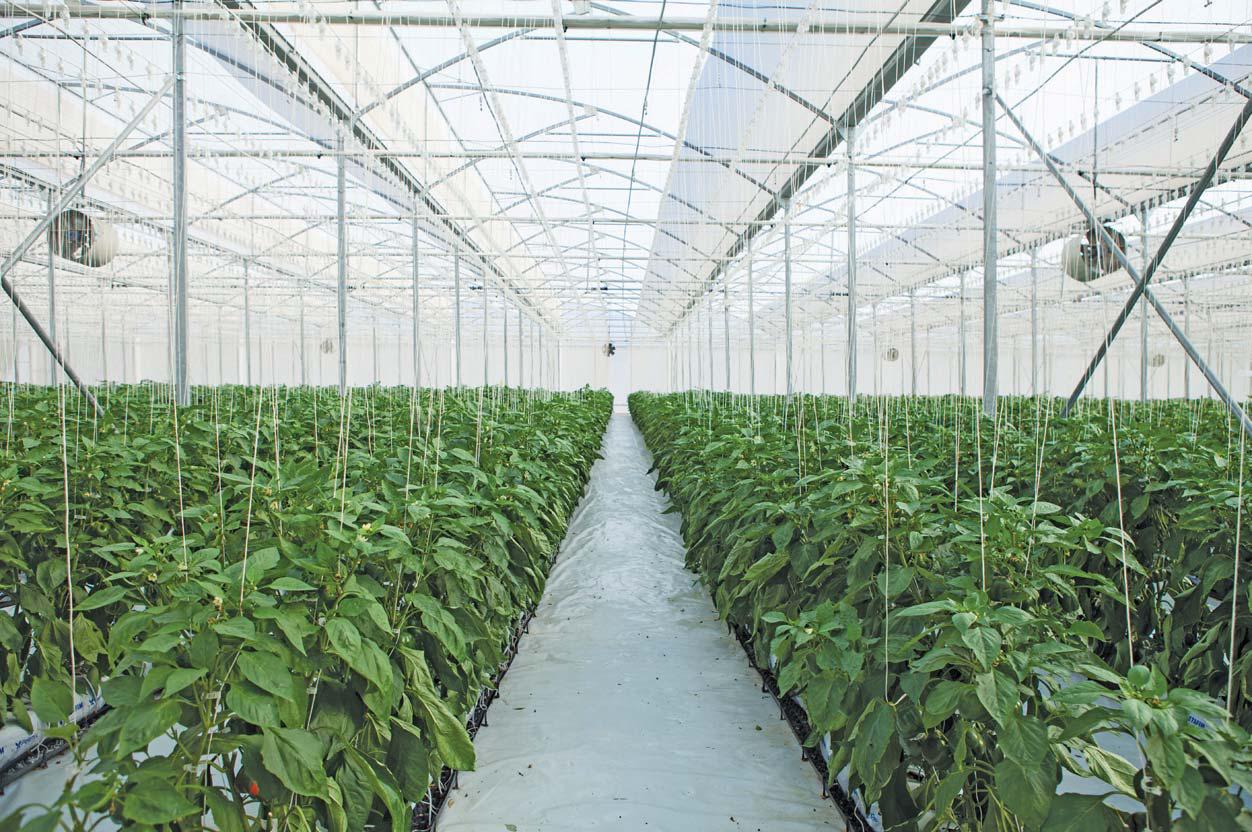
To the uninitiated, it can be difficult to understand the need for lighting in a greenhouse. The bright white plastic and netting used for the flooring, walls and roofs of contemporary plastic greenhouses make the interiors of these structures almost unbearably bright.
“Plants make use of different (light) wavelengths to grow and photosynthesise,” explains Kaylee Smit, chief cultivation officer at Cultura Fresh, a hydroponic vegetable producer supplying national retailers from farms in Klapmuts and Stellenbosch.
“Each growth phase of the plant (germination, seedling, vegetative, flowering or reproductive phase, and the maturation or harvest phase) requires a different light wavelength and a different set of climatic conditions for the plant to thrive,” she says.
While there are indoor farming industries that rely solely on artificial lighting, the establishment and running costs make them prohibitively expensive in South Africa for all but the most high-end horticultural industries, notably cannabis.
“In South Africa we have very good sunlight, so we generally use artificial lighting to supplement sunlight rather than to replace it,” says Jonathan Adams, technical manager at Vegtech Netafim, a designer and builder of greenhouses and provider of greenhouse technology.
“In developed countries, which typically receive less sunlight and have better access to capital and finance, commercial farming exclusively under artificial conditions is more feasible than in South Africa,” he explains.
Modern greenhouses are designed to optimise solar light that plants receive.
“The white polyethelene thermo plastic used on the exterior of greenhouses has good light transmission and diffuses the sunlight, so it spreads evenly to all the leaves without sharp shadows. The white ground cover reflects light to the underside of the leaves and maximises photosynthesis throughout the plant,” adds Adams.


This story is from the January 30 - February 06, 2026 edition of Farmer's Weekly.
Subscribe to Magzter GOLD to access thousands of curated premium stories, and 10,000+ magazines and newspapers.
Already a subscriber? Sign In
MORE STORIES FROM Farmer's Weekly

Farmer's Weekly
Cash flow budgets: keeping farmers in control of liquidity, risk, and their survival
Profit doesn't guarantee a farm's survival - cash does. Cobus du Plessis explains why cash flow budgets are one of the most important yet underused financial tools on South African farms.

5 mins
February 27 - March 06, 2026

Farmer's Weekly
The toast of the Navy
The incredible story of the World War II-era Great Dane dog Nuisance being enlisted in the Royal Navy is well documented. Graham Jooste shared some entertaining anecdotes involving the canine shipmate.
6 mins
February 27 - March 06, 2026
Farmer's Weekly
Healthier soils deter destructive locusts
Locust swarms remain a serious global threat, capable of devastating crops, livelihoods and local economies across vast regions.
1 min
February 27 - March 06, 2026
Farmer's Weekly
Wheat crisis dominates Grain SA regional meetings
As the ongoing wheat crisis continues to erode producers' margins, emotions ran high at Grain SA's regional meeting in Moorreesburg in the Western Cape.
2 mins
February 27 - March 06, 2026
Farmer's Weekly
A FARMER'S EXPERIENCE
Street Wallet has been a game-changer for Mario Athanasopoulos, hydroponic production consultant and owner of Green City Farms.
1 mins
February 27 - March 06, 2026
Farmer's Weekly
Kesieberg Merino Stud Production Sale
The Kesieberg Merino Stud Production Sale was held on the farm Leeuwfontein on 4 February on behalf of Willie and Herman Henning.
1 min
February 27 - March 06, 2026
Farmer's Weekly
Not cheaper, just different: what you should know about farming in Mozambique
Although Mozambique is often viewed as a cheaper, easier farming location than South Africa, cost comparisons tell a more complex story. But while cross-border production presents real challenges, it also offers opportunities for complementary trade, diversification and regional food security, particularly when it comes to subtropical crops such as bananas.
10 mins
February 27 - March 06, 2026

Farmer's Weekly
The all-rounder anchoring South Africa's beef value chain
Louis Steyl, CEO of the Bonsmara Cattle Breeders' Society of South Africa, spoke to Octavia Avesca Spandiel about how the versatile Bonsmara breed anchors the country's beef value chain, delivering balanced performance, reproductive and feed efficiency, and carcass traits across extensive and intensive systems.
6 mins
February 27 - March 06, 2026

Farmer's Weekly
THE HITCHING POST
I'm a 60-year-old white woman who loves camping, animals, the outdoors, and watching sport.
2 mins
February 27 - March 06, 2026
Farmer's Weekly
Foot-and-mouth disease in pigs
Recently, the radio news mentioned an outbreak of foot-and-mouth disease (FMD) in pigs in South Africa.
2 mins
February 27 - March 06, 2026
Listen
Translate
Change font size