Try GOLD - Free
Can Bangladesh Meet Its Renewable Goals?
Energy & Power
|EP_23_08 (Energy & Power Vol 23 Issue 8 October 1, 2025)
After almost 17 years, Bangladesh has unveiled a revised version of its Renewable Energy Policy that aims to ensure that at least 20 percent of the country's total electricity supply comes from renewable energy by 2030 and at least 30 percent by 2040.
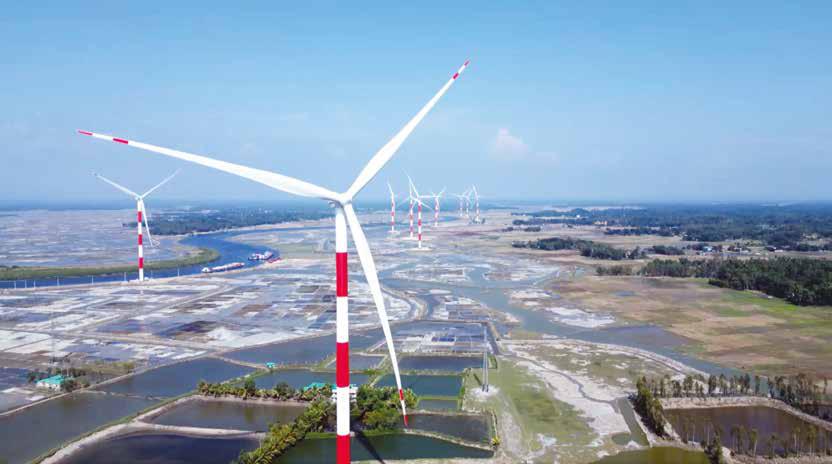
The policy promises many lucrative incentives, including ten years of corporate tax exemptions for both government and private renewable energy producers, followed by five years of half-exemption, and a waiver of import duty on solar equipment. It also allows consumers from all segments (domestic, industrial, and commercial) to install renewable energy systems and sell surplus electricity to the government or individual players under the Net Metering Guidelines 2018.
At a broader level, its vision is to decarbonize the energy sector, reduce reliance on fossil fuels, and create an energy-efficient, low-carbon economy by scaling out technology solutions such as solar, wind, biomass, waste-to-energy, biofuels, geothermal, tidal, hydro, and green hydrogen. The policy additionally encourages innovative solutions such as peer-to-peer energy trading, floating solar projects, solar irrigation, EV charging infrastructure, and Battery Energy Storage Systems for improving grid integration and stability to meet its 6,145 MW renewable capacity target by 2030 and 17,470 MW renewable capacity target by 2041. Despite this renewed ambition, certain issues and gaps exist within the policy design.
The biggest challenge in meeting the renewables target is the financing. According to the Institute for Energy Economics and Financial Analysis (IEEFA), this will cost Bangladesh USD 933-980 million/yr until 2030 and USD 1.37-1.46 billion/yr till 2040. The energy sector had received only 3.6 percent of the funds it needed by 2023, while banks and non-banking financial institutions financed only BDT 742 crore in renewable projects, in contrast to an estimated requirement of BDT 20,500 crore, as per a study by the Bangladesh Institute of Bank Management (BIBM).


This story is from the EP_23_08 (Energy & Power Vol 23 Issue 8 October 1, 2025) edition of Energy & Power.
Subscribe to Magzter GOLD to access thousands of curated premium stories, and 10,000+ magazines and newspapers.
Already a subscriber? Sign In
MORE STORIES FROM Energy & Power

Energy & Power
Centara Advances Climate Action Initiatives in Maldives
Centara Hotels & Resorts reported measurable environmental and community impacts at The Atollia in the Maldives, highlighting progress in renewable energy, waste reduction, and ecosystem protection.

1 min
EP_23_16 (Energy & Power Vol 23 Issue 16 Feb 1, 2026)
Energy & Power
Afghanistan Seeks Azerbaijan's Support for COP31 Participation
Afghanistan is seeking Azerbaijan’s support to help secure its offi cial participation in the upcoming United Nations COP31 global climate change conference, scheduled to be held in Türkiye, as Kabul looks to strengthen its engagement on climate diplomacy and technical cooperation.
1 min
EP_23_16 (Energy & Power Vol 23 Issue 16 Feb 1, 2026)
Energy & Power
Long-Term Energy Strategy Prepared to Ensure Fuel Security: Salehuddin
Finance Adviser Dr Salehuddin Ahmed recently said the government has a long-term prepared energy strategy recognizing fuel security as one of Bangladesh's challenges.
1 min
EP_23_16 (Energy & Power Vol 23 Issue 16 Feb 1, 2026)
Energy & Power
Power Division Seeks Tk 24.48b in Urgent Subsidy
The Division Power has urgently sought Tk 24.48 billion in subsidies against tariff deficit as letter of credit (LC) complexities are disrupting coal and fuel imports, say sources.
1 min
EP_23_16 (Energy & Power Vol 23 Issue 16 Feb 1, 2026)

Energy & Power
68% of Global Oil Production Concentrated in Countries Exposed to US Pressure
A new analysis by 350.org and Zero Carbon Analytics finds that 68% of global oil production is impacted by US aspirations to dominate the world's oil and gas markets.
1 min
EP_23_16 (Energy & Power Vol 23 Issue 16 Feb 1, 2026)
Energy & Power
Norway Adds 117 MW of Solar in 2025
Norway installed 117 MW of solar in 2025, according to figures published by the Norwegian Water Resources and Energy Directorate (NVE).
1 min
EP_23_16 (Energy & Power Vol 23 Issue 16 Feb 1, 2026)
Energy & Power
Efforts Underway to Meet Addl Power Demand During Coming Irrigation Season
The government has started taking measures to ensure uninterrupted power supply for the coming irrigation season as the power consumption during the boro cultivation jumps up to additional 5,000MW.
1 min
EP_23_16 (Energy & Power Vol 23 Issue 16 Feb 1, 2026)

Energy & Power
Empowering Communities Sustainable Progress Innovation
Summit Power International is transforming Bangladesh's infrastructure with innovative solutions across sectors. Backed by global partnerships and foreign investments, we set new standards in development. At Summit, we empower communities and build a stronger, more prosperous future.
16 mins
EP_23_16 (Energy & Power Vol 23 Issue 16 Feb 1, 2026)
Energy & Power
As Japan Declares Snap Elections, 350.org Calls for Progress on Climate Measures
Japanese Prime Minister Sanae Takaichi recently dissolved the House of Representatives and announced that snap elections will be held on February 8.
1 min
EP_23_16 (Energy & Power Vol 23 Issue 16 Feb 1, 2026)
Energy & Power
Heavy Dependence on Imported Fossil Fuels Driving Economic Risks: Study
Bangladesh's heavy dependence on imported fossil fuels is driving significant economic risks, including reduced GDP and heightened inflation, while disproportionately impacting the country's poorest households, according to a year-long research study.
1 min
EP_23_16 (Energy & Power Vol 23 Issue 16 Feb 1, 2026)
Listen
Translate
Change font size