
Go Unlimited with Magzter GOLD
Get unlimited access to 10,000+ magazines, newspapers and Premium stories for just
The Net Result Of Bonn Is Lukewarm At Best
Down To Earth
|December 01, 2017
The recently-concluded COP delivered little considering what the world has witnessed in terms of climate-induced loss in 2017

THE 23RD session of the Conference of Parties (cop), hosted by Fiji (the first island state to preside cop) and held in Bonn from November 6-17, 2017, was largely-anticipated to be a technical one to continue the progress on making the “rulebook” for the implementation of the Paris Agreement, which becomes operational by 2020. It was also the first cop since the Donald Trump administration announced its intention to withdraw from the Paris Agreement. The Paris Agreement has a lock-in period of four years and the US technically cannot leave the process before 2020. Besides, in his typical style, President Trump is yet to submit the instrument of withdrawal to the UN to formally kickstart the process, evidently to try and renegotiate the terms of the agreement.
The US’ desire to pull out of the Paris Agreement had no legal or political bearing in the cop negotiations. Civil society groups like the Pan African Climate Justice Alliance objected to US presence in the negotiations, the objections nevertheless were marginalised. It was business as usual in the negotiations as far as the US was concerned. By the end, it had become clear that the US would be impeding consensus in several issues including the critical one of finance and financial accounting of commitments.
Developing countries, on their part, asserted the inaction in the pre-2020 commitments on the part of developed countries in terms of emission reductions and financial assistance of US $100 billion by 2020, including their non-ratification of the Doha Amendment—which was signed in 2012 for raising the ambition of emission cuts but is yet to come into force as 60 signatures are still pending—of Kyoto Protocol. However, the US and the EU jointly opposed the inclusion of pre-2020 climate actions in the Agenda and successfully managed to delay any meaningful conversation until next year.
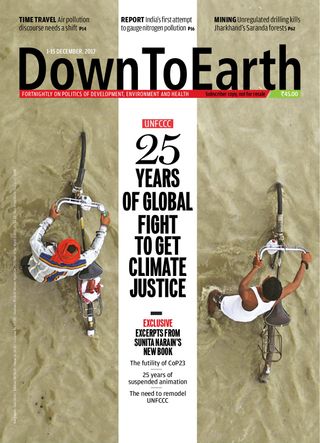

This story is from the December 01, 2017 edition of Down To Earth.
Subscribe to Magzter GOLD to access thousands of curated premium stories, and 10,000+ magazines and newspapers.
Already a subscriber? Sign In
MORE STORIES FROM Down To Earth

Down To Earth
KING OF BIRDS
Revered for centuries, western tragopan now needs protection as its forests shrink, human pressures mount

3 mins
December 16, 2025

Down To Earth
WHISKERS ALL AQUIVER
Climate change threatens creatures that have weathered extreme environments for thousands of years
2 mins
December 16, 2025

Down To Earth
GOLDEN SPIRIT
Survival of the shy primate is closely tied to the health of Western Ghats
3 mins
December 16, 2025

Down To Earth
RINGED EYES IN THE CANOPY
Rapid habitat destruction forces arboreal langur to alter habits
2 mins
December 16, 2025

Down To Earth
HANGING BY THE CLIFF
The Himalaya's rarest wild goat is on the brink of local extinction
2 mins
December 16, 2025

Down To Earth
ANGEL OF THE BEAS
Conservation reserves, citizen science, and habitat protection give the Indus River dolphin a fighting chance in India
2 mins
December 16, 2025

Down To Earth
UNDER MOONLIT SCRUB
Survival of this hidden guardian tells us whether our scrublands still breathe
2 mins
December 16, 2025

Down To Earth
SYMBOL OF SILENT VALLEY
Lion-tailed macaque remains vulnerable despite past victories
2 mins
December 16, 2025

Down To Earth
THE APE IN OUR STORIES
India's only non-human ape species is a cultural icon threatened by forest fragmentation
2 mins
December 16, 2025

Down To Earth
SENTINEL OF THE HIGH COLD DESERT
The bird's evocative call may not continue to roll across the cold desert valley for long
3 mins
December 16, 2025
Translate
Change font size