Try GOLD - Free
THE OTHER PLAGUE
Down To Earth
|June 16, 2020
Locusts have returned to India in just two months and are spreading to new territories. Has climate change added another layer of stress and uncertainty?

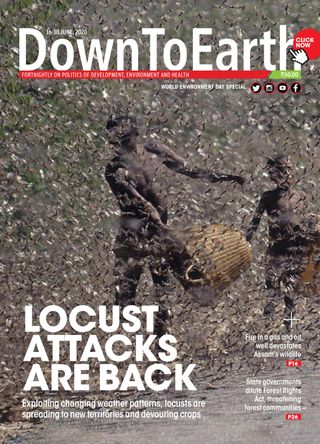
IT’S MAY 27. A few minutes past 11 am. Down To Earth reporters had just arrived in Pachgaon village, Dholpur district, Rajasthan, to enquire about desert locusts that are crossing over to India way ahead of the monsoon rain and invading new areas. As if on cue, a huge swarm, resembling a long rust-colored low cloud, appeared from nowhere. It quickly swelled forward, taking over the sky and nearly obliterating the desert sun. Bewildered, the residents ran out of their homes and gathered in the open. But before they could get a grasp on the situation, millions of locusts started falling like hail and clung to everything that looked green. Within no minutes, the trees and bushes turned into ragged mounds of glistening brown. Some leaned over to touch the ground—tropical grasshoppers weigh about 2-2.5 gram. A few youngsters took photographs as the others stood motionless.
It was for the first time the residents had seen something like this. Soon the severity of the situation dawned on them. Some residents fetched their utensils and started beating and banging them. Ram Babu, a farmworker in his 60s, rushed to his farm to scare away the pests with a piece of cloth. He repeated the exercise for almost an hour in the 46 o Cheat. “I saw on the news yesterday about locust attacks in Jaipur, but did not think they would attack our village too,” he said, trying to call the landowner to inform him about the attack.
The nervous clamour of people did not let the swarm stay in the village for more than 40 minutes. But during that short period, Babu lost almost one-fourth of his pumpkin crop planted on 3.5 bigha (0.3 ha) land. Peepul, babool and keekar (Prosopis juliflora) trees looked queer with almost bare branches and punctured leaves.

This story is from the June 16, 2020 edition of Down To Earth.
Subscribe to Magzter GOLD to access thousands of curated premium stories, and 10,000+ magazines and newspapers.
Already a subscriber? Sign In
MORE STORIES FROM Down To Earth
Down To Earth
Popular distrust
THE WORLD seems to be going through a period of stasis despite facing an unfathomable polycrisis.

2 mins
February 01, 2026

Down To Earth
CONSERVE OR PERISH
Periyar Tiger Reserve has rewritten Indian conservation by turning poachers into protectors and conflict into coexistence
5 mins
February 01, 2026

Down To Earth
'Rivers need to run free'
From Tibet to West Bengal, the Brahmaputra is the pulse of communities and ecosystems along its course. But what are the risks the river faces through human interventions, particularly dams, discusses journalist, author and filmmaker SANJOY HAZARIKA in his new book, River Traveller.
4 mins
February 01, 2026

Down To Earth
India is facing up to its innovation lag
There are signs now that India is acknowledging the superior strides made by China in a frontier technology like Al
4 mins
February 01, 2026

Down To Earth
Competing concerns
What are the repercussions of the EU-Mercosur pact that have made European farmers protest against the free trade agreement?
4 mins
February 01, 2026

Down To Earth
From fryer to flight
Sustainable fuel made from used cooking oil can play a pivotal role in helping India achieve its aviation emission reduction goals. Measures to collect this oil must be revamped
4 mins
February 01, 2026

Down To Earth
ACCESS OPEN
An amendment to India's nodal forest conservation law opens up forests across India to commercial exploitation by the paper industry
6 mins
February 01, 2026
Down To Earth
DRINK FROM TAP CAN BE A REALITY
As cities across India struggle to supply safe piped water, Odisha offers a success story
2 mins
February 01, 2026

Down To Earth
GREAT DRYING
The Earth is hotter than at any point in the past 100,000 years, with 2023-25 becoming the warmest three-year period on record and also breaching the 1.5°C threshold for the first time. One fallout is dwindling freshwater.
22 mins
February 01, 2026

Down To Earth
Green redemption
Restoration of grasslands of Kerala's Pampadum Shola National Park, once dominated by invasive Australian wattles, see a return of streams and native species
1 mins
February 01, 2026
Translate
Change font size