
Go Unlimited with Magzter GOLD
Get unlimited access to 10,000+ magazines, newspapers and Premium stories for just
Try GOLD - Free
Remodeling The Climate Negotiations
Down To Earth
|December 01, 2017
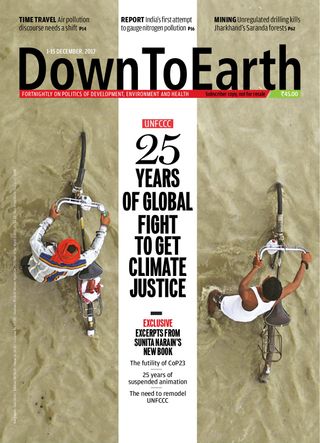
After 25 years of its existence, UNFCCC has not been able to address the complex realities of climate change. It's time that we remodeled the UN climate convention for deep emission cuts and for saving the lives and livelihoods of vulnerable populations

THIS IS a landmark year. It is the 30th anniversary of the Montreal Protocol and the 25th anniversary of UNFCCC. At this juncture, it is important to assess what these two most important Multilateral Environmental Agreements (meas) have delivered. The learnings are extremely important to reshape the multilateralism for the next 25 years.
On delivery, it is generally believed that the Montreal Protocol has delivered on its objectives of significantly reducing ozone depleting substances, despite few mncs peddling patented intermediary substitutes when environment friendly alternatives were available. The overall picture is that the ozone hole is showing signs of healing. In addition, it is estimated that while eliminating ozone depleting substances like CFCs and HCFCS, Montreal Protocol has led to the reduction of 130-135 billion tonnes of CO2 equivalent (CO2e) emissions. UNFCCC on the other hand has little to show. In fact, the total greenhouse gas (ghg) emission reduction from selling carbon credits under the Clean Development Mechanism totaled just 1.9 billion tonnes CO2e—65 times less than Montreal Protocol.
Seven years before UNFCCC, in 1985, the Vienna Convention for the Protection of the Ozone layer was signed. Montreal Protocol was signed in 1987, a full 10 years before the first protocol of UNFCCC—Kyoto Protocol—was signed. Since then, Montreal Protocol has survived. It has gone through multiple amendments to phase-out different kinds of ozone-depleting substances, the last one being in 2016 called the Kigali amendment to phase-down hfcs, a potent ghg. In comparison, Kyoto Protocol is more or less dead. Instead, there has been a Cancun Agreement and then a Paris Agreement to “replace” the Kyoto Protocol.

This story is from the December 01, 2017 edition of Down To Earth.
Subscribe to Magzter GOLD to access thousands of curated premium stories, and 10,000+ magazines and newspapers.
Already a subscriber? Sign In
MORE STORIES FROM Down To Earth

Down To Earth
THINK TWICE BEFORE FELLING SAL TREES
Many trees considered to be affected by sal borer in the 1990s are still alive today

1 mins
February 16, 2026

Down To Earth
EDGE OF SURVIVAL
Caste divides deny marginalised communities land, resources and essential aid, leaving them more vulnerable to climate disasters
6 mins
February 16, 2026

Down To Earth
A WISH LIST?
Union Budget for 2026-27 conveys the impression of a roll-call of intentions and ambitious proposals, with little detail on their formulation
6 mins
February 16, 2026
Down To Earth
Break down the gender wall
THE RULING National Democratic Alliance (NDA) government has been heavily invested in the goal to make India a developed economy by 2047.
2 mins
February 16, 2026

Down To Earth
MENSTRUAL HEALTH, NOW A FUNDAMENTAL RIGHT
In a landmark judgement, the Supreme Court has recognised menstrual health and hygiene as a fundamental right under Article 21 of the Constitution of India, which guarantees the right to life and dignity.
8 mins
February 16, 2026

Down To Earth
Of devolution and new disasters
The 16th Finance Commission pushes for changes in view of new fiscal and climatic conditions
11 mins
February 16, 2026
Down To Earth
Rising risks of plastics
NEGATIVE IMPACTS on human health due to emissions linked to the plastic lifecycle could double by 2040, according to a study published in The Lancet Planetary Health in January.
1 min
February 16, 2026

Down To Earth
GAP BETWEEN EPIDEMICS NARROWING
A watershed-based and landscape-level approach is needed to address forest degradation
2 mins
February 16, 2026

Down To Earth
WAITING TO STRIKE
Sal heartwood borer is considered the biggest threat to forestry in India, especially to the sal tree, where it lives and breeds.
11 mins
February 16, 2026

Down To Earth
A SPRING DELIGHT
Mustard flowers are not meant only for the eyes. Invite them to your plate once in a while
3 mins
February 16, 2026
Translate
Change font size