
Go Unlimited with Magzter GOLD
Get unlimited access to 10,000+ magazines, newspapers and Premium stories for just
Try GOLD - Free
HERO HERB
Down To Earth
|October 16, 2021
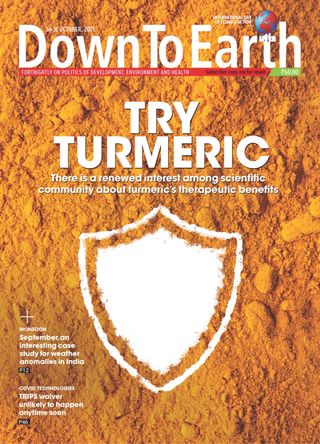
The pandemic years have witnessed a boom in the production and export of the humble underground stem called turmeric, along with a renewal of interest among the scientific community in the spice’s therapeutic qualities, especially against COVID-19. VIBHA VARSHNEY reports why inclusion of the household herb in our daily diet is a healthy idea

THERE IS no disease against which turmeric has not been tested,” says G Padmanaban, former director of Indian Institute of Science, Bengaluru. The spice used in households across the subcontinent is the only natural source of curcumin—the compound that gives turmeric its golden hue and its fabled healing qualities. Turmeric (Curcuma longa), native to India, has been studied extensively for its effects against viral diseases in recent decades, but the covid-19 pandemic has renewed interest in the spice and in curcumin, both of which have been tested as a treatment for the viral disease, with encouraging results. Sample these:
In a covid-19 hospital in Maharashtra, patients who received a combination of 525 mg of curcumin and 2.5 mg of piperine (naturally occurring complex organic molecules containing nitrogen) twice a day, recovered faster from symptoms such as fever, cough, sore throat, and breathlessness. They were able to maintain oxygen saturation above 94 per cent on ambient air, and had better clinical outcomes compared to control group members who received a probiotic instead. The treatment also reduced the duration of hospitalisation and resulted in fewer deaths, researchers report in the journal Frontiers in Pharmacology published on May 28, 2021. In another study, researchers in Iran observed the efficacy of curcumin in the form of nanoparticles on 21 patients. The results showed that most of the common symptoms of covid-19 resolved significantly faster in the curcumin group. The treatment group did not need as much oxygen supplementation and had reduced stays in the hospital compared to the control group. Patients in the treatment group did not experience deterioration of infection during the follow-up period, while 40 per cent of the control group did, the researchers report in the journal Phytotherapy Research on January 3, 2021.

This story is from the October 16, 2021 edition of Down To Earth.
Subscribe to Magzter GOLD to access thousands of curated premium stories, and 10,000+ magazines and newspapers.
Already a subscriber? Sign In
MORE STORIES FROM Down To Earth

Down To Earth
THINK TWICE BEFORE FELLING SAL TREES
Many trees considered to be affected by sal borer in the 1990s are still alive today

1 mins
February 16, 2026

Down To Earth
EDGE OF SURVIVAL
Caste divides deny marginalised communities land, resources and essential aid, leaving them more vulnerable to climate disasters
6 mins
February 16, 2026

Down To Earth
A WISH LIST?
Union Budget for 2026-27 conveys the impression of a roll-call of intentions and ambitious proposals, with little detail on their formulation
6 mins
February 16, 2026
Down To Earth
Break down the gender wall
THE RULING National Democratic Alliance (NDA) government has been heavily invested in the goal to make India a developed economy by 2047.
2 mins
February 16, 2026

Down To Earth
MENSTRUAL HEALTH, NOW A FUNDAMENTAL RIGHT
In a landmark judgement, the Supreme Court has recognised menstrual health and hygiene as a fundamental right under Article 21 of the Constitution of India, which guarantees the right to life and dignity.
8 mins
February 16, 2026

Down To Earth
Of devolution and new disasters
The 16th Finance Commission pushes for changes in view of new fiscal and climatic conditions
11 mins
February 16, 2026
Down To Earth
Rising risks of plastics
NEGATIVE IMPACTS on human health due to emissions linked to the plastic lifecycle could double by 2040, according to a study published in The Lancet Planetary Health in January.
1 min
February 16, 2026

Down To Earth
GAP BETWEEN EPIDEMICS NARROWING
A watershed-based and landscape-level approach is needed to address forest degradation
2 mins
February 16, 2026
Down To Earth
WAITING TO STRIKE
Sal heartwood borer is considered the biggest threat to forestry in India, especially to the sal tree, where it lives and breeds.
11 mins
February 16, 2026
Down To Earth
A SPRING DELIGHT
Mustard flowers are not meant only for the eyes. Invite them to your plate once in a while
3 mins
February 16, 2026
Translate
Change font size