Try GOLD - Free
Farm Raiders
Down To Earth
|February 01, 2020
Western India is facing its most fierce locust attack in nearly three decades, the origins of which lie outside the country and were triggered by weather events attributable to climate change

ON DECEMBER 26 last year, Jugta Ram, a farmer in Barmer, Rajasthan, saw something that freaked him out. “There was a swarm of millions of locusts. It looked like a fast-moving rainy cloud and cast a shadow on a 10 km by 5 km landscape, completely eclipsing the winter sun,” he says. “We tried to scare them away by using traditional methods like making noise by banging empty metallic utensils and creating smoke, but these were ineffective.” The insects attacked his 12-hectare farmland in Tardo Ka Taal village which cost Ram his standing crop of cumin and castor—a loss of R4 lakh, he says. The entire village and a dozen others in the district lost all crops in a day.
What Ram saw was a swarm of the desert or yellow locusts (Schistocerca gregaria). He identifies the pest. “It is not the first time I had seen them,” he says, “but the swarm size was mind-boggling, not to mention the time of the attack.”
Yellow locusts from Pakistan raid Rajasthan and Gujarat every year. The insect has a lifespan of 90 days. It arrives in July, breeds, and the new generation leaves for Pakistan-Iran by October. The swarms chase greenery and raid regions that have just had monsoon because that is the best time to find food and breed. Usually, India faces less than 10 swarm attacks annually, but in 2019 there were over 200, says a scientist at the Union government’s Locust Watch Centre (IWC) in Jodhpur, requesting anonymity. There is no official declaration on the number of attacks so far. Apart from the spike in the number of attacks, the size of the swarms was more than twice the usual, say eyewitnesses.
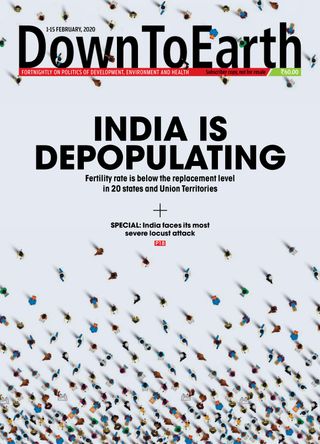

This story is from the February 01, 2020 edition of Down To Earth.
Subscribe to Magzter GOLD to access thousands of curated premium stories, and 10,000+ magazines and newspapers.
Already a subscriber? Sign In
MORE STORIES FROM Down To Earth

Down To Earth
THINK TWICE BEFORE FELLING SAL TREES
Many trees considered to be affected by sal borer in the 1990s are still alive today

1 mins
February 16, 2026

Down To Earth
EDGE OF SURVIVAL
Caste divides deny marginalised communities land, resources and essential aid, leaving them more vulnerable to climate disasters
6 mins
February 16, 2026

Down To Earth
A WISH LIST?
Union Budget for 2026-27 conveys the impression of a roll-call of intentions and ambitious proposals, with little detail on their formulation
6 mins
February 16, 2026
Down To Earth
Break down the gender wall
THE RULING National Democratic Alliance (NDA) government has been heavily invested in the goal to make India a developed economy by 2047.
2 mins
February 16, 2026

Down To Earth
MENSTRUAL HEALTH, NOW A FUNDAMENTAL RIGHT
In a landmark judgement, the Supreme Court has recognised menstrual health and hygiene as a fundamental right under Article 21 of the Constitution of India, which guarantees the right to life and dignity.
8 mins
February 16, 2026

Down To Earth
Of devolution and new disasters
The 16th Finance Commission pushes for changes in view of new fiscal and climatic conditions
11 mins
February 16, 2026
Down To Earth
Rising risks of plastics
NEGATIVE IMPACTS on human health due to emissions linked to the plastic lifecycle could double by 2040, according to a study published in The Lancet Planetary Health in January.
1 min
February 16, 2026

Down To Earth
GAP BETWEEN EPIDEMICS NARROWING
A watershed-based and landscape-level approach is needed to address forest degradation
2 mins
February 16, 2026

Down To Earth
WAITING TO STRIKE
Sal heartwood borer is considered the biggest threat to forestry in India, especially to the sal tree, where it lives and breeds.
11 mins
February 16, 2026

Down To Earth
A SPRING DELIGHT
Mustard flowers are not meant only for the eyes. Invite them to your plate once in a while
3 mins
February 16, 2026
Translate
Change font size