Try GOLD - Free
An unusual contest
Down To Earth
|February 01, 2022
Rajasthan's state bird, the great Indian bustard, might lose its last natural habitat to wind and solar power plants

IT IS a January afternoon, but it feels like peak summer. A mild breeze makes up for the shards of winter, caressing the face as the eyes narrow under the glare of the sun. Birds chirp in the trees, and as far as the eye can see, there is nothing but a few hundred camels happily grazing away on the thorny bushes in the Degrai oran, a sacred grove, in Jaisalmer, Rajasthan. The windmills, visible at a distance, tower over everything else in the vicinity.
“This is the largest and one of the last orans in the area,” says Masinga Ram, a camel handler from Sanwata village, adjoining the oran. For centuries, the trees in the oran, spread over 60,000 bighas (approximately 100 sq km), have remained untouched by the people in the villages. “It is more than 600 years old and was declared a protected area by ruler Vikramdev in the 15 th century. Felling of trees is forbidden in the area. We just collect the dead branches on the ground and pluck ripened fruits for ourselves, the rest is all for the animals and birds,” says Shivdan Singh Bhati, a farmer and a member of the Degrai Mata Trust, which looks after the temple inside the oran. It is in the middle of a 13,000 sq km wide biodiversity-rich land that is among the last natural habitats of Rajasthan's state bird, the great Indian bustard (gib), listed under the “critically endangered” category by the International Union for Conservation of Nature in 2011 (see 'Net loss', p46).

An open stretch of land with long hours of sunlight, high-speed winds and large plains, the area has become a hub of green energy. Windmills and solar plants are a part of the landscape. More solar plants and transmission towers are under construction.
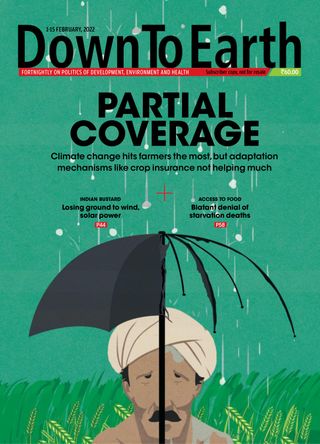

This story is from the February 01, 2022 edition of Down To Earth.
Subscribe to Magzter GOLD to access thousands of curated premium stories, and 10,000+ magazines and newspapers.
Already a subscriber? Sign In
MORE STORIES FROM Down To Earth

Down To Earth
Bitter pill
THE WEB SERIES PHARMA EXPOSES HARSH TRUTHS OF THE PHARMACEUTICAL INDUSTRY, WHERE PROFIT OFTEN BECOMES MORE IMPORTANT THAN HUMAN HEALTH

3 mins
January 16, 2026
Down To Earth
CHAOS IN-DEFINITION
The Aravallis are perhaps India's most litigated hill range. More than 4,000 court cases have failed to arrest their destruction. The latest dispute concerns a narrow legal definition of this geological antiquity, much of which has been obliterated by mining and urban sprawl. While the Supreme Court has stayed its own judgement accepting that definition, it must see the underlying reality and help reconcile development and national security with conservation.
19 mins
January 16, 2026
Down To Earth
BITS: INDIA
Indore has recorded 16 deaths and more than 1,600 hospitalisations between December 24 and January 6.
1 min
January 16, 2026
Down To Earth
GUARANTEE EXPIRES
India's rural employment guarantee law is replaced with a centrally controlled, budget-capped scheme. Is this an attack on the right to work?
3 mins
January 16, 2026
Down To Earth
BLOOM OR BANE
Surge of vibrant pink water lilies in Kuttanad, Kerala, provides socio-economic benefits, but the plant's ecological impacts must be understood
4 mins
January 16, 2026
Down To Earth
INVISIBLE EMPLOYER
Field and academic evidence shows sharp falls in casual agricultural employment at places where groundwater access declines
3 mins
January 16, 2026

Down To Earth
Schemed for erasure
Does the VB-G RAMG Act address structural weaknesses long observed in MGNREGA's implementation?
10 mins
January 16, 2026

Down To Earth
School of change
An open school in Panagar, Madhya Pradesh, aims to protect children of tribal settlements from falling into the trap of addiction
2 mins
January 16, 2026

Down To Earth
PULSE OF RESILIENCE
As a climate-ready crop, cowpea shows potential for widespread use in India
3 mins
January 16, 2026
Down To Earth
BITS GLOBAL
Britain recorded its hottest and sunniest year ever in 2025, the country's meteorological office said on January 2.
1 min
January 16, 2026
Translate
Change font size