Try GOLD - Free
A Self-created Quagmire
Down To Earth
|June 1, 2017
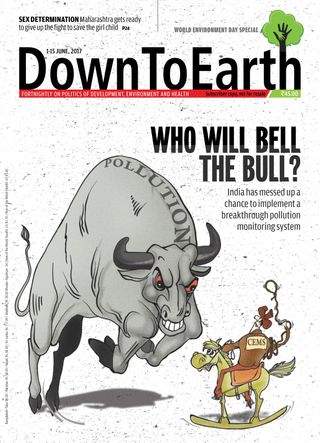
How the authorities messed up implementing the breakthrough system.
-

CEMS AND CEQMS have been in place in most of the developed world, which include the US, the UK, France and Germany, since the 1970s. Countries that followed suit and enforced these systems include China, South Africa and Saudi Arabia. These mechanisms have made their compliance and enforcement systems more transparent, standardised, and have encouraged their industries to adopt a self-monitoring and control regime.
For instance, between 2005 and 2015, the US reduced oxides of nitrogen (NOx) emissions by 62 per cent and sulphur dioxide (SO2) emissions by 78 per cent, by implementing a pollution trading system based on the data generated through CEMS. The improved quality of monitoring has not only enabled these countries to drastically reduce pollution levels, but have provided regulatory certainty to the businesses as discretionary powers of the regulators have been reduced.
CEMS primarily monitors air pollutants such as particulate matter (PM), SO2, NOx, whereas CEQMS monitors biochemical oxygen demand (BOD), chemical oxygen demand (COD), total suspended solids and total dissolved solids. These pollutants not only cause long-term harm to the populations in the vicinity of the industrial units, but also damage the local ecology irreparably. So putting in place a new regulatory system to continuously monitor and control emissions would have gone a long way to streamline India’s environmental governance. What has gone wrong?
The pilot's taking a nap
It all began in 2003, when pollution regulators along with industry representatives came up with a charter on Corporate Responsibility for Environmental Protection (CREP) and decided to install CEMS. Since this was a voluntary move, regulators never checked the status of implementation.

This story is from the June 1, 2017 edition of Down To Earth.
Subscribe to Magzter GOLD to access thousands of curated premium stories, and 10,000+ magazines and newspapers.
Already a subscriber? Sign In
MORE STORIES FROM Down To Earth

Down To Earth
THINK TWICE BEFORE FELLING SAL TREES
Many trees considered to be affected by sal borer in the 1990s are still alive today

1 mins
February 16, 2026

Down To Earth
EDGE OF SURVIVAL
Caste divides deny marginalised communities land, resources and essential aid, leaving them more vulnerable to climate disasters
6 mins
February 16, 2026

Down To Earth
A WISH LIST?
Union Budget for 2026-27 conveys the impression of a roll-call of intentions and ambitious proposals, with little detail on their formulation
6 mins
February 16, 2026
Down To Earth
Break down the gender wall
THE RULING National Democratic Alliance (NDA) government has been heavily invested in the goal to make India a developed economy by 2047.
2 mins
February 16, 2026

Down To Earth
MENSTRUAL HEALTH, NOW A FUNDAMENTAL RIGHT
In a landmark judgement, the Supreme Court has recognised menstrual health and hygiene as a fundamental right under Article 21 of the Constitution of India, which guarantees the right to life and dignity.
8 mins
February 16, 2026

Down To Earth
Of devolution and new disasters
The 16th Finance Commission pushes for changes in view of new fiscal and climatic conditions
11 mins
February 16, 2026
Down To Earth
Rising risks of plastics
NEGATIVE IMPACTS on human health due to emissions linked to the plastic lifecycle could double by 2040, according to a study published in The Lancet Planetary Health in January.
1 min
February 16, 2026

Down To Earth
GAP BETWEEN EPIDEMICS NARROWING
A watershed-based and landscape-level approach is needed to address forest degradation
2 mins
February 16, 2026

Down To Earth
WAITING TO STRIKE
Sal heartwood borer is considered the biggest threat to forestry in India, especially to the sal tree, where it lives and breeds.
11 mins
February 16, 2026

Down To Earth
A SPRING DELIGHT
Mustard flowers are not meant only for the eyes. Invite them to your plate once in a while
3 mins
February 16, 2026
Translate
Change font size