Try GOLD - Free
5G And The Fear Of Radiation
Down To Earth
|April 01, 2019
Radiation fears mount as the world gets ready to embrace the networkintensive 5G

Just a decade ago, 4G, the fourth generation wireless network, shook up the world speeding up data transfer and ensuring superior and uninterrupted mobile and internet connectivity. Now, the world is gearing up for 50 times faster 5G that will make wireless digital communication near seamless. The US and South Korea have already rolled out the network on a trial basis. In May 2018, five Nordic countries— Sweden, Norway, Denmark, Finland, and Iceland—announced their plan to create the world’s first interconnected 5G region. India, which lagged in the implementation of earlier networks, has set up a high-level forum to establish the vision for 5G in the country and plans to begin trials by 2020. The euphoria around 5G is for a reason.
A host of industries have been waiting for the arrival of 5G for quite some time now. Development of Artificial Intelligence (AI)-based technologies and Internet of Things (which includes smart wearables and virtual reality headsets) has been slow due to lack of superfast data transfer. One example is autonomous vehicles. Automakers have already developed driverless smart cars. They can become usable only if they communicate with other cars and traffic signals. This requires superfast data transfer with minimal delay (a latency as low as 1 millisecond). 5G is being architected to support all such low-latency applications, including industrial robots to remote surgery (‘Brace for 5th...’)
The new technology “will move us closer to everything, everywhere and at all times, and enable inter-working of different technologies and networks,” says Rita Rinaldo, head of institutional projects, European Space Agency. “Integration of satellites in 5G networks will allow for new applications in domains such as agriculture, health and emergency response for communities living in rural areas,” she says.
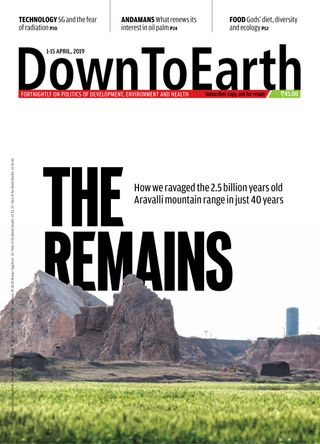

This story is from the April 01, 2019 edition of Down To Earth.
Subscribe to Magzter GOLD to access thousands of curated premium stories, and 10,000+ magazines and newspapers.
Already a subscriber? Sign In
MORE STORIES FROM Down To Earth

Down To Earth
BEYOND COLLATERAL DAMAGE
Recent geopolitical conflicts are urging a reconsideration of what constitutes environmental harm in war and the limits of existing legal frameworks

3 mins
April 01, 2026

Down To Earth
Masterstroke
Residents of a small Kerala town reject an inadequate state-led development blueprint and create their own master plan that prioritises protection of historic water systems and urban commons
4 mins
April 01, 2026

Down To Earth
Rethinking E20
It is pertinent to explore potential of ethanol as high-value industrial feedstock
4 mins
April 01, 2026
Down To Earth
Food in the age of climate change
WHEN WE eat, we contribute to climate change. But food is also about livelihoods, about nutrition and about nature.
3 mins
April 01, 2026

Down To Earth
FADING WINTER
India's winters are warming, becoming shorter, shifting and spilling beyond their traditional bounds. The consequences are already evident in meltwater availability, forest-fire intensity and changes in flowering cycles and insect behaviour.
20 mins
April 01, 2026
Down To Earth
War on Iran strikes India's pharmaceuticals sector
Shortages of critical raw materials and rising input costs for the drug industry will have global consequences
4 mins
April 01, 2026

Down To Earth
POWER IN AN AGE OF INSECURITY
Energy transition is no longer solely about emission reduction but also about energy security
3 mins
April 01, 2026
Down To Earth
Re-discovery of fuelwood
THE WEST Asia conflict has made visible a multi-billion dollar energy market in India.
2 mins
April 01, 2026

Down To Earth
A CASE THAT RESHAPED INDIA'S ENVIRONMENT
The case of MC Mehta v Union of India stands as proof that a proactive judiciary can accelerate action even when the executive drags its feet
4 mins
April 01, 2026
Down To Earth
FOREVER DEPENDENT
India depends on global fertiliser supply chains for 70 per cent of its needs, leaving its food security exposed to geopolitical disruptions
6 mins
April 01, 2026
Translate
Change font size