Try GOLD - Free
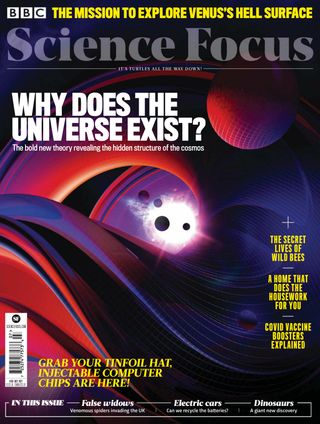
Why Does The Universe Exist?
BBC Focus - Science & Technology
|July 2021
Stephen Wolfram is trying to find a rule that dictates the Universe. And in doing so, he might even become the first person to finally devise a complete, fundamental theory of physics. Elegant, or what?

Back in the plague year of 1665-1666, Isaac Newton changed the scientific world, discovering the universal law of gravity and the mathematics of calculus. Now, in the plague year of 2020-2021, is history about to repeat itself? Stephen Wolfram thinks so. The British-born scientist, who lives in the US, claims he has found a route to a fundamental theory of physics that answers some of the biggest questions, such as what is space? What is time? And why does the Universe exist?
“To be fair, a lot of the work was done in 2019 and we were about to start speaking about it in March 2020, but everything locked down for COVID,” says Wolfram. “But it is true to say that we have made more progress towards finding a fundamental theory of physics than I dared believe was possible.”
Wolfram’s starting point was to ask: What is space? “Physicists don’t often ask this question,” he says. “They merely think of space as the backdrop against which the events of the Universe play out.”
According to Wolfram, space is made of a network of ‘nodes’, which are connected to each other. The nature of the connections – how each node is linked to nearby and faraway nodes – can create a space of any dimension. So if the number of nodes increases as the square of the distance from any given node – like the surface area of a sphere – the network has the properties of familiar 3D space. “I actually believe the Universe started out with infinitely many dimensions and gradually cooled down to the three we have today,” says Wolfram. “But I don’t yet know why there are precisely three.”

This story is from the July 2021 edition of BBC Focus - Science & Technology.
Subscribe to Magzter GOLD to access thousands of curated premium stories, and 10,000+ magazines and newspapers.
Already a subscriber? Sign In
MORE STORIES FROM BBC Focus - Science & Technology

BBC Science Focus
DOES MY DOG HAVE ADHD?
Officially, Attention-Deficit Hyperactivity Disorder (ADHD) is a human condition. People are diagnosed with it. Dogs are not. Yet many of its core features, including hyperactivity, impulsivity and distractibility, can be found in dogs.

1 min
March 2026

BBC Science Focus
DOES MY BRAIN LIVE A LITTLE IN THE PAST?
Yes, your brain does live a little in the past. It can't help it. The information it receives via your senses is always a little out of date. Whether it's light entering the retinas in your eyes, or sounds vibrating the hairs in your ears, it not only takes time for the data to arrive, but your brain then has to process it.
2 mins
March 2026

BBC Science Focus
ASTRONOMY FOR BEGINNERS
RETURN OF THE EVENING STAR (VENUS)
1 mins
March 2026

BBC Science Focus
CAN YOU STOP YOUR SENSE OF TASTE DULLING AS YOU AGE?
Sometimes I hear people say that food just doesn't taste the same as they get older. It's tempting to blame this on age, but there are other factors at play, too.
1 mins
March 2026

BBC Science Focus
MICROBIOMES OF THE SUPERAGERS
BY STUDYING THE INCREASING NUMBER OF PEOPLE WHO ARE LIVING BEYOND THEIR 100TH BIRTHDAYS, SCIENTISTS ARE DISCOVERING THAT THE SECRET TO REACHING A RIPE OLD AGE IN RUDE HEALTH MIGHT LIE IN OUR GUTS
8 mins
March 2026

BBC Science Focus
HOW BIG WERE MEDIEVAL WAR HORSES?
You might picture knights charging into battle on towering steeds, but medieval horses were typically no bigger than modern-day ponies.
1 min
March 2026

BBC Science Focus
FORCES OF HABIT
Could new research on setting up healthy habits resuscitate those stuttering New Year resolutions?
3 mins
March 2026

BBC Science Focus
5 DANGERS HIDING IN YOUR PROCESSED FOOD
We all know that ultra-processed foods are bad for us, but what ingredients should we particularly try to avoid? And what are they doing to our bodies?
9 mins
March 2026

BBC Science Focus
Mosquitoes are becoming thirstier for human blood
Habitat loss may be pushing mosquitoes towards human hosts with deadly consequences
1 mins
March 2026

BBC Science Focus
HOW CAN I GET OVER MY EX?
Relationship breakups can be brutal, just look at the popularity of songs like 'Someone Like You' by Adele, or all the covers of 'Cry Me a River' by Julie London.
1 mins
March 2026
Translate
Change font size