Try GOLD - Free
Eating Contests: Is There A Limit To How Much You Can Consume In One Go?
BBC Focus - Science & Technology
|September 2020
This summer, the world record for the ‘sport’ of hotdog speed-eating was broken for the third time in five years. Are we approaching peak performance?

Who would you pick as the world’s greatest-ever athlete? Usain Bolt, Serena Williams, Muhammad Ali, Tiger Woods, Roger Federer, or Michael Phelps? No doubt they have all dominated their sports at various times, but what about Joey Chestnut? Most people have probably never heard of him, but for the two million viewers who tune in to what must be the weirdest event of the US sporting calendar, Joey ‘Jaws’ Chestnut is a bona fide legend.
Chestnut is the undisputed champion of competitive eating and has utterly dominated the hundred-year-old ‘Nathan’s Famous Fourth of July International Hot Dog Eating Contest’ – an event that has become the must-see event for fans of Major League Eating everywhere (yes, seriously). Every summer, frankfurter-guzzling heavyweights fly in from all corners of the globe to stuff themselves silly for 10 minutes in front of a crowd of 40,000 screaming spectators, with each competitor hoping to return home with the victor’s Mustard Belt. Chestnut, a 104kg (230lb) food hoover has been toppled only once since 2007. He has broken more world records than any other competitor, and in this year’s low-key socially distanced event, he broke his own world record (again) by ingesting a gut-busting 75 hotdogs (buns included) in 10 minutes – a staggering 33 more than the next best competitor.
BINGE TO WIN
You might scoff at the idea that this grotesque gladiatorial spectacle could be considered the world’s fastest-growing ‘sport’, but this rapidly ballooning industry has just birthed some serious and thought-provoking science research. An investigation recently published in the respected academic journal
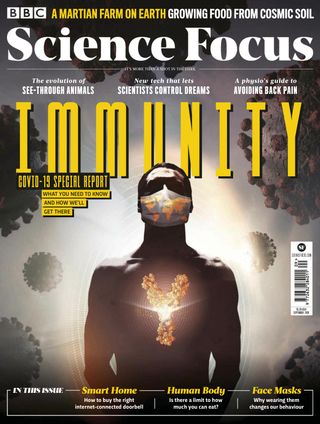

This story is from the September 2020 edition of BBC Focus - Science & Technology.
Subscribe to Magzter GOLD to access thousands of curated premium stories, and 10,000+ magazines and newspapers.
Already a subscriber? Sign In
MORE STORIES FROM BBC Focus - Science & Technology

BBC Science Focus
HEALTH: Eating oats could lower your cholesterol in just two days
The health benefits of a two-day porridge diet lasted for weeks afterwards

1 mins
April 2026

BBC Science Focus
Most people are too sure they can identify fake human faces
Even 'super recognisers' struggle with the challenge. Can you do better?
1 min
April 2026

BBC Science Focus
WHAT'S THE WORST THING YOU CAN DO FOR THE PLANET ONLINE?
Human beings can barely move a muscle without some kind of deleterious effect on the environment around us.
2 mins
April 2026

BBC Science Focus
A bug in the system
The complex arrangement of equipment you see here is part of a particle accelerator.
1 min
April 2026

BBC Science Focus
Snug as a bug in a rug
At first glance, you might feel envious of this little leafhopper, swaddled beneath the folds of what appears to be a luxurious fur blanket.
1 min
April 2026

BBC Science Focus
WHY DO WE ROOT FOR THE VILLAIN IN MOVIES?
Whether it's Darth Vader or Cruella de Vil, we all have a favourite movie villain.
1 mins
April 2026

BBC Science Focus
A TURN TO DISPERSE
Why a fart walk after dinner does more than release your gas
3 mins
April 2026

BBC Science Focus
Hatching a nebula
Welcome to the Egg Nebula, an enigmatic structure formed by ejected stardust in the Cygnus constellation around 1,000 light-years from Earth.
1 min
April 2026

BBC Science Focus
7 TIMES AI GOT IT SPECTACULARLY WRONG
For the past four years, AI has been reshaping how we work and live. But its failures are proving just as transformative as its triumphs
8 mins
April 2026

BBC Science Focus
CHARLES ADCOCK, VIA EMAIL: COULD DARK MATTER BE ALL AROUND PLANET EARTH BUT UNDETECTABLE?
Astronomers have gathered overwhelming evidence that 80 per cent of all matter in the Universe is invisible.
1 min
April 2026
Translate
Change font size