Try GOLD - Free
No Direction Home
The Caravan
|July 2019
How the world’s largest democracy treats the world’s most persecuted minority.

{ONE}
Fifteen kilometres from the headquarters of the United Nations High Commission for Refugees, located in the posh south-Delhi neighbourhood of Vasant Vihar, lie the dusty lanes of the industrial district of Okhla. Near the banks of the Yamuna, the neighbourhood of Madan Khadar houses Muslim migrant communities that provide cheap labour for Okhla’s furniture, sugar and leather factories.
Here, in a neat row of tenements that the locals call Darul Hijrat—abode of the migrant—Mohammad Salimullah’s wife, Fatima Begum, was brewing tea in a five-by-six-foot grocery store. It was December 2017. In the lane outside, the children were concluding their evening games in the mud, singing the popular Rohingya song “Arakan desher Rohingya jaati”—The Rohingya from the country of Arakan.
Salimullah left Myanmar in 2002, fleeing what the United Nations describes as a genocide. His first stop was Cox’s Bazar, the district in Bangladesh that borders the Arakan and today houses the largest refugee camp in the world. Five years later, he pushed further west, into India, drawn by the ideals historically attached to the world’s largest democracy: secularism, peace and prosperity. India, he was sure, would shelter him and his fellow countrymen.
After an itinerant existence spent doing odd jobs in different Indian cities, Salimullah settled in Delhi. Between 2012 and 2017, he started the grocery store, enrolled his three children in government schools and even sent a nephew to university. An uncanny placidity characterised his life in India, a luxury he had not known in Myanmar.
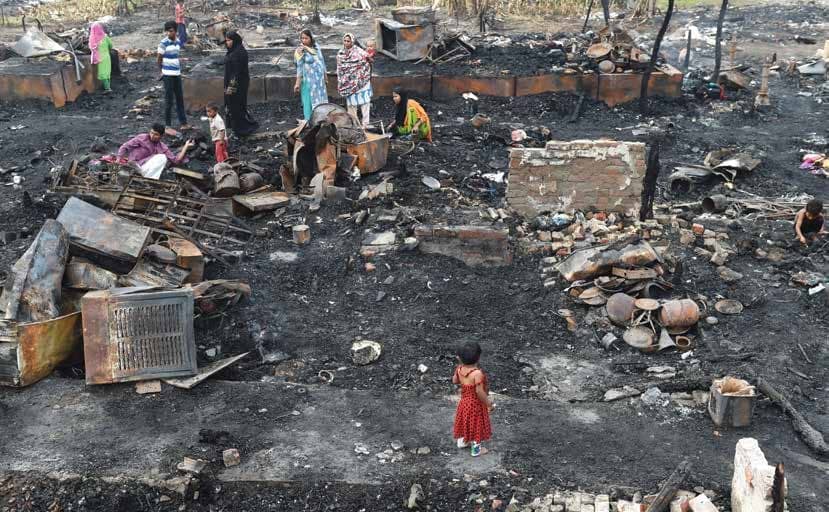
On 9 August 2017
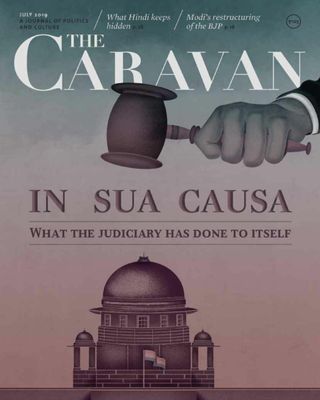

This story is from the July 2019 edition of The Caravan.
Subscribe to Magzter GOLD to access thousands of curated premium stories, and 10,000+ magazines and newspapers.
Already a subscriber? Sign In
MORE STORIES FROM The Caravan
The Caravan
ANY RESEMBLANCE TO ACTUAL EVENTS IS NOT COINCIDENTAL
INTERFAITH ROMANCE FICTION IN THE ERA OF LOVE JIHAD

31 mins
December 2025
The Caravan
Manufacturing Legitimacy
How a Washington Post columnist laundered the Sangh's violent history
7 mins
December 2025

The Caravan
DEATH of REPORTAGE
THE DISMANTLING OF OUTLOOK'S LEGACY
32 mins
December 2025
The Caravan
FOG LIGHT
Samayantar's two-and-half-decade fight against the shrinking of Hindi's world
22 mins
December 2025
The Caravan
THE FINE PRINT
ON 19 MARCH 2005, thousands came out on the streets of Udupi, in coastal Karnataka, to protest a gruesome incident that had shaken the region a week earlier.
23 mins
December 2025

The Caravan
CHARACTER BUILDING
The enduring language of Indian streets
5 mins
December 2025
The Caravan
THE CONVENIENT EVASIONS OF RAJDEEP SARDESAI
DRESSED IN A turban and white kurta pyjama, Narendra Modi sat in the passenger seat of a van crossing the Patan district of Gujarat, in September 2012. Next to him sat Rajdeep Sardesai, the founder-editor of the news channel CNN-IBN.
63 mins
December 2025

The Caravan
Ahmed Kamal Junina: “Every class we hold is a defiant refusal to surrender”
A professor in Gaza on teaching during a genocide / Conflict
11 mins
December 2025

The Caravan
Bangla Pride, Urdu Prejudice
The language wars have primed West Bengal for the RSS
8 mins
November 2025

The Caravan
THE INTERVIEW
\"The people are naked before the government but the government is opaque to them\"
16 mins
November 2025
Translate
Change font size