Try GOLD - Free
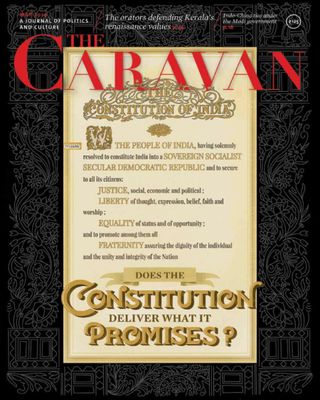
Does The Constitution Keep Its Promises?
The Caravan
|May 2019
What makes India so distinct?

No other country matches the scale of its religious, linguistic and ethnic diversity. India’s racial heterogeneity is exceeded by only a handful of West European and New World countries—the result of, among other factors, colonial-era experiences of conquest, the slave trade and resettlements, as well as post-colonial migrations from the global South to the North. But while systems of exclusion predicated on notions of purity and impurity have been widespread across societies—solidified through kinship networks, status hierarchy and endogamy—nowhere else in the world does there exist a system of such extreme gradations of human worth as the caste system.
India was not the only former colonial country that opted for a liberal-democratic political set-up following Independence. Even so, the enormity of its territorial expanse, population, social diversity and economic backwardness made it unique among democratic states. In the West, universal suffrage was extended to women and all races long after large-scale industrial and economic advancement had taken place. India, under vastly different circumstances, erected a political framework based on democratic principles—and barring the 21-month Emergency, it has sustained this framework so far. It is part of the reason why the Constitution, since its promulgation in 1950, commands such widespread admiration.
But now, almost seventy years later, the country is in the midst of a general election that threatens to return to power an organ of the Sangh Parivar—a group that has, in word and deed, demonstrated its antipathy to the progressive elements that exist in the Constitution. In light of this, it is time to open a more critical debate on the foundational charter of the republic.

This story is from the May 2019 edition of The Caravan.
Subscribe to Magzter GOLD to access thousands of curated premium stories, and 10,000+ magazines and newspapers.
Already a subscriber? Sign In
MORE STORIES FROM The Caravan
The Caravan
ANY RESEMBLANCE TO ACTUAL EVENTS IS NOT COINCIDENTAL
INTERFAITH ROMANCE FICTION IN THE ERA OF LOVE JIHAD

31 mins
December 2025
The Caravan
Manufacturing Legitimacy
How a Washington Post columnist laundered the Sangh's violent history
7 mins
December 2025

The Caravan
DEATH of REPORTAGE
THE DISMANTLING OF OUTLOOK'S LEGACY
32 mins
December 2025
The Caravan
FOG LIGHT
Samayantar's two-and-half-decade fight against the shrinking of Hindi's world
22 mins
December 2025
The Caravan
THE FINE PRINT
ON 19 MARCH 2005, thousands came out on the streets of Udupi, in coastal Karnataka, to protest a gruesome incident that had shaken the region a week earlier.
23 mins
December 2025
The Caravan
CHARACTER BUILDING
The enduring language of Indian streets
5 mins
December 2025
The Caravan
THE CONVENIENT EVASIONS OF RAJDEEP SARDESAI
DRESSED IN A turban and white kurta pyjama, Narendra Modi sat in the passenger seat of a van crossing the Patan district of Gujarat, in September 2012. Next to him sat Rajdeep Sardesai, the founder-editor of the news channel CNN-IBN.
63 mins
December 2025

The Caravan
Ahmed Kamal Junina: “Every class we hold is a defiant refusal to surrender”
A professor in Gaza on teaching during a genocide / Conflict
11 mins
December 2025
The Caravan
Bangla Pride, Urdu Prejudice
The language wars have primed West Bengal for the RSS
8 mins
November 2025

The Caravan
THE INTERVIEW
\"The people are naked before the government but the government is opaque to them\"
16 mins
November 2025
Translate
Change font size