Try GOLD - Free
Top Of The Heap
THE WEEK
|October 21, 2018
Gita Gopinaths journey from a middle-class Indian girl to the IMFs chief economist is a saga of hard work and grit, breeding intellectual leadership

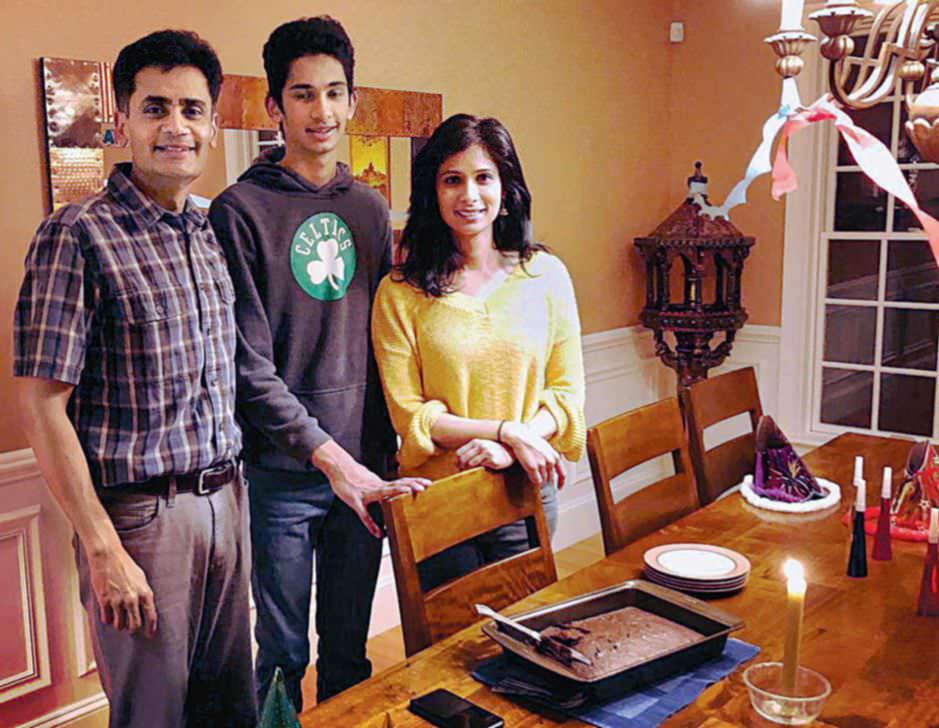
SHE WAS BARELY seven when her enthusiastic father arranged vegetables on a table in groups, to help her understand the concept of multiplication. Today, what she brings to the table will impact the world economy.
The appointment of India-born Gita Gopinath as International Monetary Fund’s chief economist has made Indians proud. The 46-year-old’s journey from a middle-class Mysuru girl to a world-class economist is a saga of hard work, focus and grit, breeding intellectual leadership.
Her parents’ residence in Mysuru is teeming with people, as her well-wishers troop into the verandah overlooking the well-manicured lawns. Gita’s father, T.V. Gopinath, gets emotional recalling his daughter’s journey. “It is no small achievement. We are grateful to god,” says Gopinath, who heads Raita Mitra, a farmers’ collective. He is home from his farm in Bilikere village near Mysuru city to handle the stream of visitors.
Gita’s mother, V.C. Vijayalakshmi, who ran a very popular playhouse for 35 years, says, “My daughter is only my baby, although the world sees her as a celebrity today. In spite of her tight schedule, she calls me every evening. What more can I ask for?”
Currently, the John Zwaanstra professor of international studies and economics at Harvard University, Gita was born on December 8, 1971, in Calcutta, during the Bangladesh war. “In 1980, we came to Mysore. Gita was nine, and joined Nirmala Convent in class four. I had quit my job to take care of my ailing mother,” says Gopinath.

This story is from the October 21, 2018 edition of THE WEEK.
Subscribe to Magzter GOLD to access thousands of curated premium stories, and 10,000+ magazines and newspapers.
Already a subscriber? Sign In
MORE STORIES FROM THE WEEK

THE WEEK India
WEIGHT AND WATCH
India stands at the epicentre of parallel epidemics: obesity, diabetes and heart disease, each fuelling the other and blurring the line between lifestyle and disease. But there is hope-GLP-1 therapies are transforming the treatment landscape

17 mins
January 11, 2026

THE WEEK India
Bliss and the body
Humans have been using cannabinoids—the active compounds found in the cannabis plant—for medicinal and ritual purposes for at least 5,000 years, with some archaeological evidence suggesting an even longer relationship with the plant.
1 mins
January 11, 2026

THE WEEK India
THE SILENT CRISIS CANCER IN THE ELDERLY DEMANDS OUR ATTENTION
The greying of India is accelerating, expected so with regards to longevity. Current estimates suggest nearly 140 million Indians are aged above 60, a figure set to double within three decades. With advancing age comes increased cancer risk, yet specialised geriatric oncology [Specialty care for elderly cancer patients] services remain conspicuously absent across most Indian healthcare settings.
1 mins
January 11, 2026

THE WEEK India
Writing our own destiny
As the field of epigenetics advances, we are stepping into a new era of medicine, where health and even destiny become choices we can shape
3 mins
January 11, 2026

THE WEEK India
Just Pakistan, everywhere
Gadar, Veer-Zaara, Bajrangi Bhaijaan, Raazi, Uri, Gadar 2, Dhurandhar—the list of successful Hindi films featuring Pakistan is long and varied. Romance, comedy, drama and war: stories from almost every genre, unfolding in cinematic stand-ins for 'Karachis,' NWFPs' and ‘Lahores’ routinely play out on Indian screens to packed houses.
2 mins
January 11, 2026

THE WEEK India
New Year, new resolve, new you
A New Year always brings me back to the same realisation. Good health does not flourish through one dramatic commitment. It grows through the quiet courage to care for oneself, every single day.
2 mins
January 11, 2026
THE WEEK India
Ms. Multani notes that India's growth increasingly depends on robust healthcare, with hospitals emerging as key drivers of productivity and future competitiveness
Why Health Infrastructure Matters More Than EverA 2024 meta-review found that improvements in public health consistently contribute to higher GDP per capita growth, especially in developing countries undergoing demographic transition. Good health enables a workforce that is more productive, less prone to absenteeism, and capable of longer, healthier working lives. For India, with a median age under 30 and a workforce numbering over 500 million, the stakes are enormous. A healthy working-age population today is the real capital for the India of 2030-2040.
1 mins
January 11, 2026
THE WEEK India
HELP...
India's mental health crisis must not be hijacked by those with dubious methods
4 mins
January 11, 2026

THE WEEK India
BOLLYWOOD BLUES
The Hindi film industry needs an urgent revamp. Here's what needs to be done
4 mins
January 11, 2026

THE WEEK India
For folk's sake
In Rajasthan's musical communities, forming a band is unconventional. The three-member SAZ is breaking convention in more ways than one, preserving and reimagining folk music along the way
4 mins
January 11, 2026
Translate
Change font size