Try GOLD - Free
Why We (Still) Shouldn't Censor Misinformation
Reason magazine
|April 2021
Trump’s loss in 2020, a majority of his supporters believed the election had been rigged. Some adopted wild conspiracy theories involving Chinese supercomputers, Hugo Chavez, and state-level Republican officials. These beliefs culminated in an attack on the U.S. Capitol that left five people dead. To make sense of these events, many officials have argued that platforms such as Facebook and Twitter allowed conspiracy theories to spread unimpeded, leading to erroneous beliefs and deadly behaviors. In other words, they blame misinformation for the violence.

AFTER PRESIDENT DONALD
But it strains credulity to believe random tweets can lead otherwise normal people to drive across the country and stage an insurrection. That places an undue focus on misinformation itself, rather than on the people and institutions sharing it and on the people who choose to access and believe it. It also seems odd to call for more government intervention into our information ecosystem when government officials—the president, members of Congress—were, in this instance, the biggest purveyors of misinformation.
Since he became a candidate in 2015, Trump and his high-profile supporters in Congress and the media have repeatedly claimed that elections are rigged. Since his loss last year, he has become only more vociferous about this. It should come as no surprise that the person with the biggest bully pulpit in the world was able to convince some voters he was cheated. This is what politicians do: They build and mobilize coalitions. On the other side of the ledger, electoral losers are naturally prone to believing they were cheated, and Trump’s claims only exacerbated this tendency among his core supporters.
Once we account for the influence that politicians have, as well as the dispositions of core audiences, the role of misinformation and mediums of communication in fomenting events like the Capitol riot become highly conditional and much smaller than many are arguing.
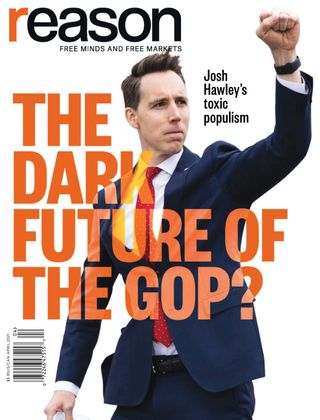

This story is from the April 2021 edition of Reason magazine.
Subscribe to Magzter GOLD to access thousands of curated premium stories, and 10,000+ magazines and newspapers.
Already a subscriber? Sign In
MORE STORIES FROM Reason magazine

Reason magazine
Does AI Know How You Will Die?
HOW HIGH IS your risk of developing pancreatic cancer or suffering a heart attack in the next 20 years? A new generative artificial intelligence system called Delphi-2M aims to answer that question and offer personalized forecasts of your long-term health trajectory.

1 mins
February/March 2026
Reason magazine
SOUTH PARK
The animated TV comedy South Park continues to do the impossible: stay punchy and relevant after decades on the air. The latest five-episode season, streaming on Paramount+, once again follows the fourth-graders of South Park Elementary as they navigate a world increasingly obsessed with technology and everything political.
1 min
February/March 2026

Reason magazine
WILL MAMDANI DEFUND THE POLICE?
THE NEW MAYOR IS KEEPING POLICE COMMISSIONER JESSICA TISCH ON THE JOB, BUT THEY MIGHT HAVE A CONTENTIOUS RELATIONSHIP.
3 mins
February/March 2026

Reason magazine
MAMDANI'S EDUCATION AGENDA FOR LESS LEARNING
NEW YORK SCHOOLS NEED MORE CHOICE AND BETTER CURRICULA, BUT THE CITY'S NEW MAYOR WANTS TO TAKE CHOICES AWAY.
8 mins
February/March 2026
Reason magazine
THE TWO FACES OF ZOHRAN MAMDANI
MAMDANI ACTUALLY WANTS MORE HOUSING TO BE BUILT.
3 mins
February/March 2026

Reason magazine
The Long Road Home
The Wounded Generation examines the aftermath of the “good war.”
5 mins
February/March 2026

Reason magazine
How the FCC Became the Speech Police
THE CONSTITUTIONALLY ANOMALOUS STATUS OF BROADCASTING INVITES GOVERNMENT MEDDLING.
21 mins
February/March 2026

Reason magazine
MAMDANI CAN'T RAISE YOUR KIDS
THE MORE THE GOVERNMENT INTERVENES IN THE MARKET, THE MORE NEW YORK PARENTS PAY FOR CHILD CARE.
10 mins
February/March 2026

Reason magazine
Ayn Rand, the Video Game
\"WHAT DOES COMPLETELY, COMPLETELY UNREGULATED COMMERCE LOOK LIKE?\" KEN LEVINE'S BIOSHOCK WILL TELL YOU.
14 mins
February/March 2026
Reason magazine
DEATH BY LIGHTNING
Mike Makowsky opens Death by Lightning, a four-part miniseries he wrote and produced, with a chilling line: “This is a true story about two men the world forgot. One was the 20th president of the United States. The other shot him.” Yet this drama about President James Garfield and assassin Charles Guiteau reminds us that we should wish for more forgettable presidents.
1 min
February/March 2026
Translate
Change font size