
Go Unlimited with Magzter GOLD
Get unlimited access to 10,000+ magazines, newspapers and Premium stories for just
SLOW DRIVE IN FAST TEST LANE
Outlook
|April 13, 2020
India has one of the lowest testing rates in the world. Will new, locally made kits change its programme?

A Bangalore-based executive will complete his 14-day home quarantine this week. He is in a dilemma, though. Ever since he returned from an overseas business trip, he has been cooped up in a room in his home, peeking at his family only through a window. The solitary spell has been quite an experience. Initially, he grappled with anxiety as news of the novel coronavirus exploded. Days later, there was a visit from local health authorities, who stamped a quarantine seal on his hand—an event that piqued neighbours’ curiosity. From time to time, he got an IVR call: “If you have no symptoms, press 1. If you have cough, fever or breathing difficulty, press 2.” He has not gone beyond 1. Yet, knowing that people can be asymptomatic and still be infected with the virus leaves him with a nagging question as the quarantine comes to an end—is it safe to meet his family again? “The only way to know is by testing,” he says.
Facilities have indeed been ramped up and more people are being tested now—nearly 18,000 tests were conducted last week across the country, which was double the cumulative figure until March 22. In all, over 47,000 people had been tested by midweek (April 1). But the approach, however, is still calibrated. The Indian Council of Medical Research (ICMR) recommends only symptomatic people in quarantine, health workers and the contacts of laboratory-confirmed positive cases be tested. Besides this, hospitalised patients with severe respiratory illnesses are being tested as a COVID-19 surveillance measure. Overall, testing figures are still low compared to other countries and the available capacity—the utilisation rate stood at 38 per cent by midweek.
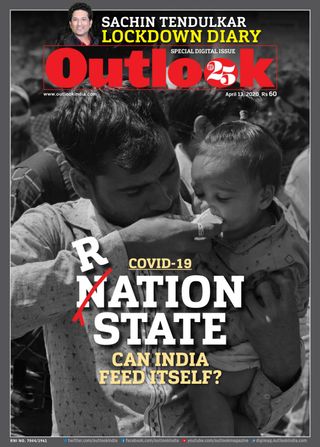

This story is from the April 13, 2020 edition of Outlook.
Subscribe to Magzter GOLD to access thousands of curated premium stories, and 10,000+ magazines and newspapers.
Already a subscriber? Sign In
MORE STORIES FROM Outlook

Outlook
The Big Blind Spot
Caste boundaries still shape social relations in Tamil Nadu-a state long rooted in self-respect politics

8 mins
December 11, 2025

Outlook
Jat Yamla Pagla Deewana
Dharmendra's tenderness revealed itself without any threats to his masculinity. He adapted himself throughout his 65-year-long career as both a product and creature of the times he lived through
5 mins
December 11, 2025

Outlook
Fairytale of a Fallow Land
Hope Bihar can once again be that impossibly noisy village in Phanishwar Nath Renu's Parti Parikatha-divided, yes, but still capable of insisting that rights are not favours and development is more than a slogan shouted from a stage
14 mins
December 11, 2025

Outlook
The Lesser Daughters of the Goddess
The Dravidian movement waged an ideological war against the devadasi system. As former devadasis lead a new wave of resistance, the practice is quietly sustained by caste, poverty, superstition and inherited ritual
2 mins
December 11, 2025

Outlook
The Meaning of Mariadhai
After a hundred years, what has happened to the idea of self-respect in contemporary Tamil society?
5 mins
December 11, 2025

Outlook
When the State is the Killer
The war on drugs continues to be a war on the poor
5 mins
December 11, 2025

Outlook
We Are Intellectuals
A senior law officer argued in the Supreme Court that \"intellectuals\" could be more dangerous than \"ground-level terrorists\"
5 mins
December 11, 2025

Outlook
An Equal Stage
The Dravidian Movement used novels, plays, films and even politics to spread its ideology
12 mins
December 11, 2025
Outlook
The Dignity in Self-Respect
How Periyar and the Self-Respect Movement took shape in Tamil Nadu and why the state has done better than the rest of the country on many social, civil and public parameters
5 mins
December 11, 2025

Outlook
When Sukumaar Met Elakkiya
Self-respect marriage remains a force of socio-political change even a century later
7 mins
December 11, 2025
Translate
Change font size