Try GOLD - Free
How Patidars Found Merit In Reservation
Outlook
|October 31, 2016
All along, the Patels of Gujarat had stood in opposition to caste quotas. That did not work, so they have started demanding OBC status.

Last year in August, when Hardik Patel first marshalled Patidars to fight for reservation under the Other Backward Classes (OBC) quota, the agitation was vilified as a ruse to frustrate the government into reviewing and finishing off reservation. A year later, the Patidars have not turned tail; in fact, they have started joining hands with other intermediate castes eyeing reservation. Pundits, therefore, are scrying to understand why Patidars, who decades ago fought to end reservations, are jostling for a share of the quota pie.
It’s partly rooted in identity, partly economics. Some cite jealousy towards castes in the OBC list that now hold bureaucratic clout, the frustration of being pushed to the fag end of the shrinking queue for jobs, or a desire for a new kind of mobility to reclaim their dominant position in society that has been “upset by reservation”. Some still argue it is designed to end reservation quota to the backward classes.
The name Patidars (literally titleholders) refers to landowners who were originally of the Kanbi caste, claimed to be descendants of the north Indian Kurmis. Sociologists say they were part of the Shudra varna. The British system of collecting fixed revenue from communities empowered the Patidars, giving them control over finance and also turning some of them into moneylenders. This power let them assume the title of Patel, meaning village headman.
The four subgroups of Patidars are the Kadva and Leuva Patels —both are agitating for reservation—and the Kachia Patels (vegetable sellers) and Anjana Patels (who claim descent from Kshatriyas and Jats), both of whom are part of the OBC list.
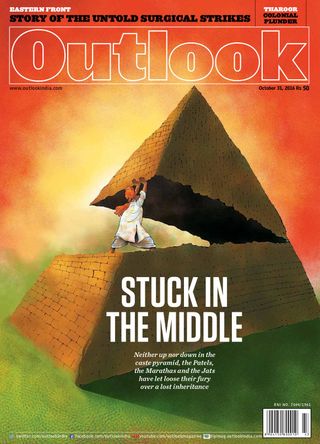

This story is from the October 31, 2016 edition of Outlook.
Subscribe to Magzter GOLD to access thousands of curated premium stories, and 10,000+ magazines and newspapers.
Already a subscriber? Sign In
MORE STORIES FROM Outlook

Outlook
Hating Dating
For many women, dating in their 30s and 40s is defined less by romance than by exhaustion, confusion and a sense of emotional attrition

2 mins
February 21, 2026

Outlook
Rage of Betrayals
THIS is a popular poem often shared when anyone talks of the 4B movement in South Korea. The women in this movement boycott the world of men; boycott heterosexual marriage, relationships, sex, and giving birth.
2 mins
February 21, 2026

Outlook
Class and Caste
Caste hierarchies continue to exist in everyday life and across campuses. Due to the persistence of caste in schools and colleges, long believed to be places for upward mobility and rational thought, these institutions end up becoming spaces where questions of \"merit\", cultural capital, language and access-or the lack of thereof-are highlighted and ridiculed. The discrimination persists from Kashmir to Kerala. From delayed degrees and stalled promotions to verbal abuse, professional isolation, and sometimes death, these case studies underscore not isolated instances but a pattern
18 mins
February 21, 2026

Outlook
The Misuse Myth
A close look at reported cases over the past ten years shows that there is no pattern of rampant misuse of the SC/ST Act in universities or higher education institutions
6 mins
February 21, 2026
Outlook
The Higher, The Lower
What is clear is that the entrenched caste hierarchy feels that power is slipping out from their grasp
6 mins
February 21, 2026
Outlook
Writing is Acting by Another Name
My wife spots him first while my attention is focused on the bucket of theatre popcorn (medium, salt and caramel mix). I look up and there he is. Pico Iyer, great travel writer, essayist, novelist, columnist, humanist, and in recent years, friend and correspondent. While the rest gasp when Timothee Chalamet appears in Marty Supreme, we gasp when Pico does.
3 mins
February 21, 2026

Outlook
Sins of Savarnatva
The upper castes believe that the UGC regulations are a death knell to their own existence
6 mins
February 21, 2026

Outlook
Invisible Labour, Visible Costs
Women shoulder disproportionate emotional and domestic work, shaping how they view intimacy and relationships
2 mins
February 21, 2026

Outlook
Between textbooks and court orders
From first choice to uncertainty as HIMSR-Jamia Hamdard dispute leaves students stranded
5 mins
February 21, 2026

Outlook
Aggressive Victimhood Versus Predictable Protests
The current controversy around the UGC regulations is meant neither to promote social justice and equity nor hurt the interests of the dominant castes. It's meant for the two to be at loggerheads and further consolidate their support behind the BJP-RSS combine
5 mins
February 21, 2026
Translate
Change font size