
Go Unlimited with Magzter GOLD
Get unlimited access to 10,000+ magazines, newspapers and Premium stories for just
How Many Acres Of Print Does A Baron Need?
Outlook
|March 02, 2020
TRAI called for curbs on media ownership and control by a few, demanding full disclosure of facts. Those three reports lie ignored.

In August 2014, the Telecom Regulatory Authority of India (TRAI) gave wide-ranging suggestions to transform the country’s media landscape. The aim was to impose restrictions on media ownership and prevent dominance by a few media houses. It was the third time— first in 2008, then in 2012—that the regulator made the effort. For over a decade, four regimes refused to accept or reject them.
The reasons were obvious. Some of the views went against politicians and parties which owned media in several states. Some went against large media companies owned by big business houses, as also media houses that had ventured into non-media areas. Media, thus, was against TRAI. In addition, as media itself became fragmented and polarised, there were not enough voices to push through the decisions.
However, TRAI’s conclusions highlighted negative trends in media, especially those related to ownership. Both political and corporate ownership was up and needed to be curbed. There was a lack of mandatory disclosures. Cross-media ownership had expanded. There were no laws to prevent horizontal integration—across genres like print, TV, cable, digital, etc.
Experts agree with TRAI on political ownership. “Recent research shows examples of major media groups’ connections with politicians and political groups,” says Marius Dragomir, director, Center for Media, Data and Society, Hungary-based Central European University.
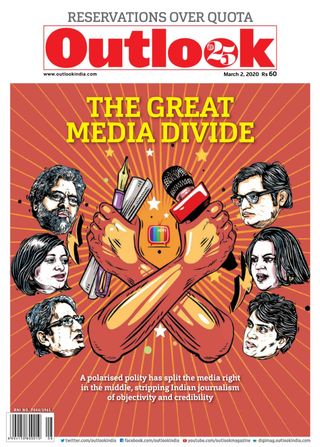

This story is from the March 02, 2020 edition of Outlook.
Subscribe to Magzter GOLD to access thousands of curated premium stories, and 10,000+ magazines and newspapers.
Already a subscriber? Sign In
MORE STORIES FROM Outlook

Outlook
The Big Blind Spot
Caste boundaries still shape social relations in Tamil Nadu-a state long rooted in self-respect politics

8 mins
December 11, 2025

Outlook
Jat Yamla Pagla Deewana
Dharmendra's tenderness revealed itself without any threats to his masculinity. He adapted himself throughout his 65-year-long career as both a product and creature of the times he lived through
5 mins
December 11, 2025

Outlook
Fairytale of a Fallow Land
Hope Bihar can once again be that impossibly noisy village in Phanishwar Nath Renu's Parti Parikatha-divided, yes, but still capable of insisting that rights are not favours and development is more than a slogan shouted from a stage
14 mins
December 11, 2025

Outlook
The Lesser Daughters of the Goddess
The Dravidian movement waged an ideological war against the devadasi system. As former devadasis lead a new wave of resistance, the practice is quietly sustained by caste, poverty, superstition and inherited ritual
2 mins
December 11, 2025

Outlook
The Meaning of Mariadhai
After a hundred years, what has happened to the idea of self-respect in contemporary Tamil society?
5 mins
December 11, 2025

Outlook
When the State is the Killer
The war on drugs continues to be a war on the poor
5 mins
December 11, 2025

Outlook
We Are Intellectuals
A senior law officer argued in the Supreme Court that \"intellectuals\" could be more dangerous than \"ground-level terrorists\"
5 mins
December 11, 2025
Outlook
An Equal Stage
The Dravidian Movement used novels, plays, films and even politics to spread its ideology
12 mins
December 11, 2025
Outlook
The Dignity in Self-Respect
How Periyar and the Self-Respect Movement took shape in Tamil Nadu and why the state has done better than the rest of the country on many social, civil and public parameters
5 mins
December 11, 2025

Outlook
When Sukumaar Met Elakkiya
Self-respect marriage remains a force of socio-political change even a century later
7 mins
December 11, 2025
Translate
Change font size