
Go Unlimited with Magzter GOLD
Get unlimited access to 10,000+ magazines, newspapers and Premium stories for just
Try GOLD - Free
Change or Perish
Outlook
|June 29, 2020
The immediate need for infrastructure and a credible military ecosystem is all very well. But the PLA’s ability to fight a transformational, algorithm war—non-kinetic and non-contact—is the danger in the future.

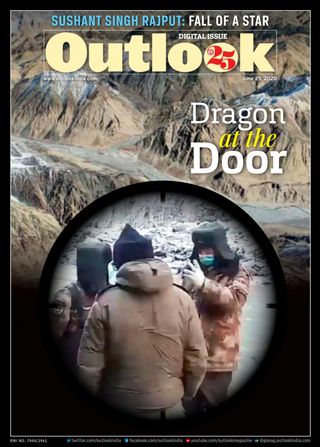
NEVER short of dramatic threats and flamboyant rhetoric, Prime Minister Narendra Modi’s statement on the brutal killing of Indian soldiers on the night of June 15 by the People’s Liberation Army (PLA) in the Galwan valley of Ladakh, was subdued and passive. “India wants peace,” he said. “But when provoked, it is capable of giving a fitting reply.” He didn’t explain what would qualify as a provocation.
The PLA had, in a premeditated assault, lynched unarmed Indian soldiers with iron rods, rocks, and nail-studded clubs. Unopposed, it changed facts on the ground by building permanent defenses deep inside India’s perception of the 1993 Line of Actual Control (LAC), reportedly capturing 60 sq km of Indian territory. It occupied all-dominating heights in hitherto undisputed Galwan valley, overlooking the 225 km-long and operationally critical Darbuk-Shyok Daulat Beg Oldi (DSDBO) road, India’s sole round-the-year road lifeline meant to rush reinforcements to militarily vulnerable north Ladakh, where the possibility of a two-front war (with Pakistan in Siachen glacier and PLA in sub-sector north) stares in the face. It unilaterally rubbished all five mutually agreed on peace agreements of 1993, 1996, 2005, 2012, and 2013 since the 1962 war by asserting its November 7, 1959 claim line made by Premier Zhou Enlai to PM Nehru. It demanded India stop feeder road construction leading to DSDBO forthwith. The Western Theatre Command (WTC), responsible for war with India, issued belligerent statements, warning Indian troops to stop provoking the PLA. It did all this because it knows what Indians don’t: Indian military is completely unprepared for an escalation whose ascendant ladder, the PLA, being the militarily stronger side, would control.

This story is from the June 29, 2020 edition of Outlook.
Subscribe to Magzter GOLD to access thousands of curated premium stories, and 10,000+ magazines and newspapers.
Already a subscriber? Sign In
MORE STORIES FROM Outlook

Outlook
Hating Dating
For many women, dating in their 30s and 40s is defined less by romance than by exhaustion, confusion and a sense of emotional attrition

2 mins
February 21, 2026

Outlook
Rage of Betrayals
THIS is a popular poem often shared when anyone talks of the 4B movement in South Korea. The women in this movement boycott the world of men; boycott heterosexual marriage, relationships, sex, and giving birth.
2 mins
February 21, 2026

Outlook
Class and Caste
Caste hierarchies continue to exist in everyday life and across campuses. Due to the persistence of caste in schools and colleges, long believed to be places for upward mobility and rational thought, these institutions end up becoming spaces where questions of \"merit\", cultural capital, language and access-or the lack of thereof-are highlighted and ridiculed. The discrimination persists from Kashmir to Kerala. From delayed degrees and stalled promotions to verbal abuse, professional isolation, and sometimes death, these case studies underscore not isolated instances but a pattern
18 mins
February 21, 2026
Outlook
The Misuse Myth
A close look at reported cases over the past ten years shows that there is no pattern of rampant misuse of the SC/ST Act in universities or higher education institutions
6 mins
February 21, 2026
Outlook
The Higher, The Lower
What is clear is that the entrenched caste hierarchy feels that power is slipping out from their grasp
6 mins
February 21, 2026
Outlook
Writing is Acting by Another Name
My wife spots him first while my attention is focused on the bucket of theatre popcorn (medium, salt and caramel mix). I look up and there he is. Pico Iyer, great travel writer, essayist, novelist, columnist, humanist, and in recent years, friend and correspondent. While the rest gasp when Timothee Chalamet appears in Marty Supreme, we gasp when Pico does.
3 mins
February 21, 2026

Outlook
Sins of Savarnatva
The upper castes believe that the UGC regulations are a death knell to their own existence
6 mins
February 21, 2026

Outlook
Invisible Labour, Visible Costs
Women shoulder disproportionate emotional and domestic work, shaping how they view intimacy and relationships
2 mins
February 21, 2026

Outlook
Between textbooks and court orders
From first choice to uncertainty as HIMSR-Jamia Hamdard dispute leaves students stranded
5 mins
February 21, 2026

Outlook
Aggressive Victimhood Versus Predictable Protests
The current controversy around the UGC regulations is meant neither to promote social justice and equity nor hurt the interests of the dominant castes. It's meant for the two to be at loggerheads and further consolidate their support behind the BJP-RSS combine
5 mins
February 21, 2026
Translate
Change font size