Try GOLD - Free
Dear Reader
New Zealand Listener
|October 13 - 19 2018
Our brain development is being put at risk by the sheer volume of reading we are doing online and on digital devices.

Your brain has been in training for 6000 years to read this article. It was then, about six millennia ago, reports neuroscientist Maryanne Wolf, that the acquisition of literacy demanded the development of new brain circuitry. Since then, that new wiring has evolved from being able to perform simple decoding steps, such as being able to count goats in a herd, into the present sophisticated reading brain.
As a species, we are not natural-born readers. As Wolf noted in her 2007 book Proust and the Squid, the act of learning to read “added an entirely new circuit to our hominid brain’s repertoire. The long developmental process of learning to read deeply, and well, changed the very structure of that circuit’s connections, which rewired the brain, which transformed the nature of human thought.”
Now these “deep-reading” processes – the ability to apply critical analysis, empathy and imagination, to discern truth, gauge inference and appreciate beauty – are under threat. As Wolf writes in her evocatively titled new book Reader, Come Home: The Reading Brain in a Digital World, the greatest explosion of creativity, invention and discovery in our history, our almost complete transition to a digital culture, is changing the way we absorb and retain information in ways we never imagined.
“When we are reading in print, we have time to allocate to those kinds of cognitive processes,” she tells the Listener from her office at the University of California, Los Angeles, where she is a visiting professor. “By and large, reading on a screen encourages multitasking, a different form of attention, a different speed of processing.”
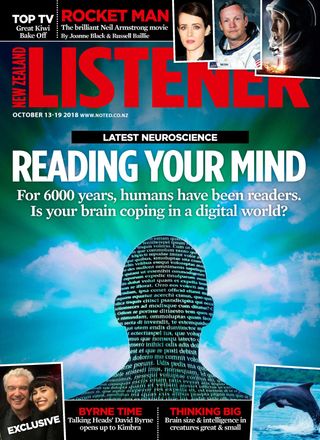

This story is from the October 13 - 19 2018 edition of New Zealand Listener.
Subscribe to Magzter GOLD to access thousands of curated premium stories, and 10,000+ magazines and newspapers.
Already a subscriber? Sign In
MORE STORIES FROM New Zealand Listener
New Zealand Listener
Driven to distraction
The car door closes with the gentlest of clicks, the vacuum-like silence entombing them a welcome relief from the relentless roar of the wind outside.

5 mins
December 27 2025 - January 9 2026
New Zealand Listener
Hatches and despatches
Commentary - The Good Life
3 mins
December 27 2025 - January 9 2026

New Zealand Listener
Best local laughs
Unforgettable sitcoms on the telly.
1 mins
December 27 2025 - January 9 2026

New Zealand Listener
The wives of Tamanuitera
Ma lives in Raumati, a 45-minute drive from the city.
6 mins
December 27 2025 - January 9 2026

New Zealand Listener
Racing a deadline
A transition plan for the end to greyhound racing in New Zealand has yet to emerge, raising fears for the future of the dogs.
8 mins
December 27 2025 - January 9 2026

New Zealand Listener
A spinning world
Watching icebergs can not only send imaginations off on tangents, it once set in motion a whole new science.
5 mins
December 27 2025 - January 9 2026

New Zealand Listener
Best on telly
From sweeping epics to domestic nightmares, the year in television didn't lack for big ideas or ways to rattle viewer expectations. Here, RUSSELL BAILLIE and RUSSELL BROWN offer their picks for the top 10 dramas, along with the best in local comedy and documentaries.
5 mins
December 27 2025 - January 9 2026

New Zealand Listener
Best of the big screen
Listener film reviewers SARAH WATT and RUSSELL BAILLIE name their top 10 of the year, with a guide to where you can find them.
4 mins
December 27 2025 - January 9 2026

New Zealand Listener
ADORABLE BIG FRUIT LOOP
Auckland author and Listener contributor Nicky Pellegrino on her rescue greyhound, Harry.
3 mins
December 27 2025 - January 9 2026

New Zealand Listener
Up onto the roof and down again
Each summer, we commission nine of Aotearoa’s finest writers to tell us a short tale. This year’s theme is distraction. Here are the first three.
5 mins
December 27 2025 - January 9 2026
Translate
Change font size