
Go Unlimited with Magzter GOLD
Get unlimited access to 10,000+ magazines, newspapers and Premium stories for just
Try GOLD - Free
Nirbhaya Case: Of Juveniles And Justice
FRONTLINE
|January 22, 2016
The passage of the Juvenile Justice (Care and Protection of Children) Bill, 2015, in Parliament exposes the vulnerability of the system in the wake of a misinformed and hysterical campaign for legislative changes to punish juveniles committing heinous crimes as adults.

Political maturity is considered to be an attribute of Members of the Rajya Sabha. Indirectly elected, they are expected to keep a distance from the compulsions of electoral politics while deliberating on key legislation. More importantly, as members of the second chamber, they are supposed to give due weight to reason rather than let themselves be swayed by emotions.
On December 22, however, this theoretical understanding of the Council of States came under severe test when the Upper House debated the Juvenile Justice (Care and Protection of Children) Bill, 2015, which was already passed by the Lok Sabha on May 7. Like the Lok Sabha, the Rajya Sabha, too, passed the Bill with a voice vote, overlooking serious concerns expressed by some members over certain provisions that made a mockery of the government’s intent to fulfil certain objectives of the Bill.
It was obvious that the Bill’s hasty passage in the Rajya Sabha was a surrender to the public pressure mounted against the release of the juvenile who was convicted in the case of the gang rape and murder of 23-year-old “Nirbhaya” in the capital on December 16, 2012. The juvenile, now 21, was released on December 20, three years after his conviction and sentencing, under the Juvenile Justice Act, 2000. He was taken to an undisclosed destination to protect him from public fury. To many observers, the public anger had more to do with inadequate punishment to the juvenile under the old Act rather than with the absence of legal provisions to send a juvenile committing a heinous offence to an adult prison. Seen in this light, even the 2015 Bill appeared to be a disproportionate response to the prevailing public sentiment.
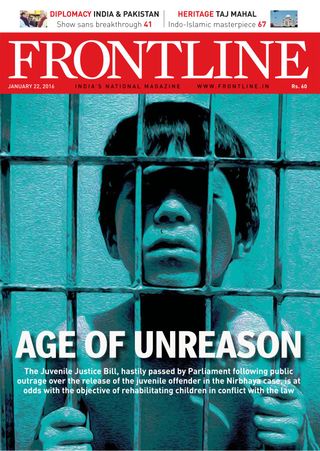

This story is from the January 22, 2016 edition of FRONTLINE.
Subscribe to Magzter GOLD to access thousands of curated premium stories, and 10,000+ magazines and newspapers.
Already a subscriber? Sign In
MORE STORIES FROM FRONTLINE

FRONTLINE
How Not To Handle An Epidemic
The lockdowns were meant to buy time to put in place appropriate health measures and contain the coronavirus’ spread, but they have failed to achieve the objective and heaped immense misery on the marginalised sections of society. India is still in the exponential phase of the COVID-19 infection and community transmission is a reality that the government refuses to accept.

9 mins
June 5, 2020
FRONTLINE
Tragedy on foot
As the COVID-19-induced lockdown cuts the ground beneath their feet in Tamil Nadu, thousands of migrant workers are trudging along the highway to the relative safety of their upcountry homes.
11 mins
June 5, 2020

FRONTLINE
Sarpanchs as game changers
Odisha manages to keep COVID-19 well under control because of the strong participation of panchayati raj institutions and the community at the grass-roots level under the leadership of Chief Minister Naveen Patnaik.
7 mins
June 5, 2020

FRONTLINE
Scapegoating China
As the COVID-19 death rate spikes and the economy tanks in the United States, Donald Trump and his advisers target China and the World Health Organisation with an eye to winning the forthcoming presidential election.
10 mins
June 5, 2020

FRONTLINE
New worries
Kerala’s measured approach to the pandemic and lockdown has yielded results. But it still has to grapple with their huge economic impact on its economy, which it feels the Centre’s special financial relief package does little to alleviate.
9 mins
June 5, 2020
FRONTLINE
No love lost for labour
Taking advantage of the lockdown and the inability of workers to organise protests, many State governments introduce sweeping changes to labour laws to the detriment of workers on the pretext of reviving production and boosting the economy.
8 mins
June 5, 2020
FRONTLINE
Capital's Malthusian moment
In a world that needs substantial reorienting of production and distribution, Indian capital is resorting to a militant form of moribund neoliberalism to overcome its current crisis. In this pursuit of profit, it is ready and willing to throw into mortal peril millions whom it adjudicates as not worth their means—an admixture of social Darwinism born of capital’s avarice and brutalism spawned by Hindutva. .
14 mins
June 5, 2020

FRONTLINE
Understanding migration
When governments and their plans are found to be blatantly wanting in addressing reverse migration, exercises such as the Ekta Parishad’s survey of migrant workers throughout India can be useful to work out creative long-lasting solutions.
10 mins
June 5, 2020

FRONTLINE
Waiting for Jabalpur moment
The Supreme Court’s role in ensuring executive accountability during the ongoing lockdown leaves much to be desired. Standing in shining contrast is the record of some High Courts.
15 mins
June 5, 2020

FRONTLINE
An empty package
The Modi regime, which has been unable to control the COVID-19 infection, restore economic activity and provide relief to millions exposed to starvation, trains its sights on Indian democracy, making use of the panic generated by fear and a lockdown that forecloses paths of resistance.
17 mins
June 5, 2020
Translate
Change font size