
Go Unlimited with Magzter GOLD
Get unlimited access to 10,000+ magazines, newspapers and Premium stories for just
The Best and Worst Presidents for Stocks
Kiplinger's Personal Finance
|January 2021
Presidents don’t make or break the market by themselves, but they do have an impact.

MOUNT RUSHMORE features massive, 60-foot-tall busts of celebrated presidents George Washington, Thomas Jefferson, Abraham Lincoln and Theodore Roosevelt, each chosen for his respective role in preserving or expanding the Republic. But if you were to make a Mount Rushmore for presidents based on stock market performance, none of these men would make the cut. There really was no stock market to speak of during the Washington, Jefferson and Lincoln administrations, and Teddy Roosevelt does not make the grade— at least as far as Wall Street is concerned.
It’s certainly true that the person in the White House isn’t the only factor moving the market, or even the most important one. But as we inaugurate a new president this month amid tumultuous times and a volatile stock market, it’s worth looking back at how share prices have fared under past presidents.
Below are the top five and bottom five presidents, returnwise. Note that returns listed track share prices only, and they are annualized. Leaving out dividends tends to favor more recent presidents, because over the past half-century dividends have become a smaller portion of total returns. Nor are returns adjusted for inflation, which tends to favor presidents during inflationary eras (Nixon, Carter and Ford, for example) and punish those holding office during disinflationary times (FDR, George W. Bush, Obama). Presidents from Hoover to Trump are ranked using the S&P 500 index; earlier presidents are ranked using the Dow Jones industrial average.
FIVE BEST
Calvin Coolidge
President: August 2, 1923 – March 4, 1929
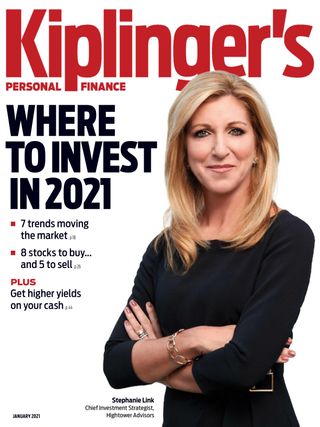

This story is from the January 2021 edition of Kiplinger's Personal Finance.
Subscribe to Magzter GOLD to access thousands of curated premium stories, and 10,000+ magazines and newspapers.
Already a subscriber? Sign In
MORE STORIES FROM Kiplinger's Personal Finance

Kiplinger's Personal Finance
A Helping Hand for the Homeless
This nonprofit offers shelters, job programs, support in finding a home and more.

2 mins
January 2026

Kiplinger's Personal Finance
Downsizing Advice, Part II
My column on downsizing (see “Living in Retirement,” Oct.) struck a chord with readers. I heard from many who offered advice on successfully culling clutter.
2 mins
January 2026
Kiplinger's Personal Finance
WHY COMPANY GUIDANCE MATTERS
Understanding how corporate profit forecasts affect analysts' estimates and stock ratings can help you make investment decisions.
4 mins
January 2026

Kiplinger's Personal Finance
WHAT SCIENCE REVEALS ABOUT MONEY AND A HAPPY RETIREMENT
Whether you're still planning or already retired, these research-based insights point the way to your best post-work life.
12 mins
January 2026

Kiplinger's Personal Finance
WHAT TO KNOW ABOUT FLOOD INSURANCE
Even if your home is outside a high-risk area, you may want to purchase coverage.
2 mins
January 2026

Kiplinger's Personal Finance
My Retirement Learning Curve
THE NEW WORLD OF RETIREMENT
2 mins
January 2026
Kiplinger's Personal Finance
CREATE A FINANCIAL PLAN WITH THESE TOOLS
Online programs for do-it-yourselfers are better than ever-and they're affordable, too.
9 mins
January 2026

Kiplinger's Personal Finance
2026 MONEY CALENDAR
These key dates and tips will help you make the most of your money in the new year.
7 mins
January 2026
Kiplinger's Personal Finance
Should You Renew Your CD?
AFTER you put money in a certificate of deposit, you can sit back while it collects interest over its term. Once it reaches maturity, you'll face a decision: renew it or withdraw the funds.
1 mins
January 2026

Kiplinger's Personal Finance
GIVING THE BULL THE BENEFIT OF THE DOUBT
KIPLINGER: What do you see ahead for financial markets in 2026? Do you have a target price for the S&P 500?
5 mins
January 2026
Translate
Change font size