Try GOLD - Free
The Emperor Strikes Back
BBC Wildlife
|July 2019
Once thought extinct in many areas, purple emperors are now turning up everywhere, even in supermarkets.
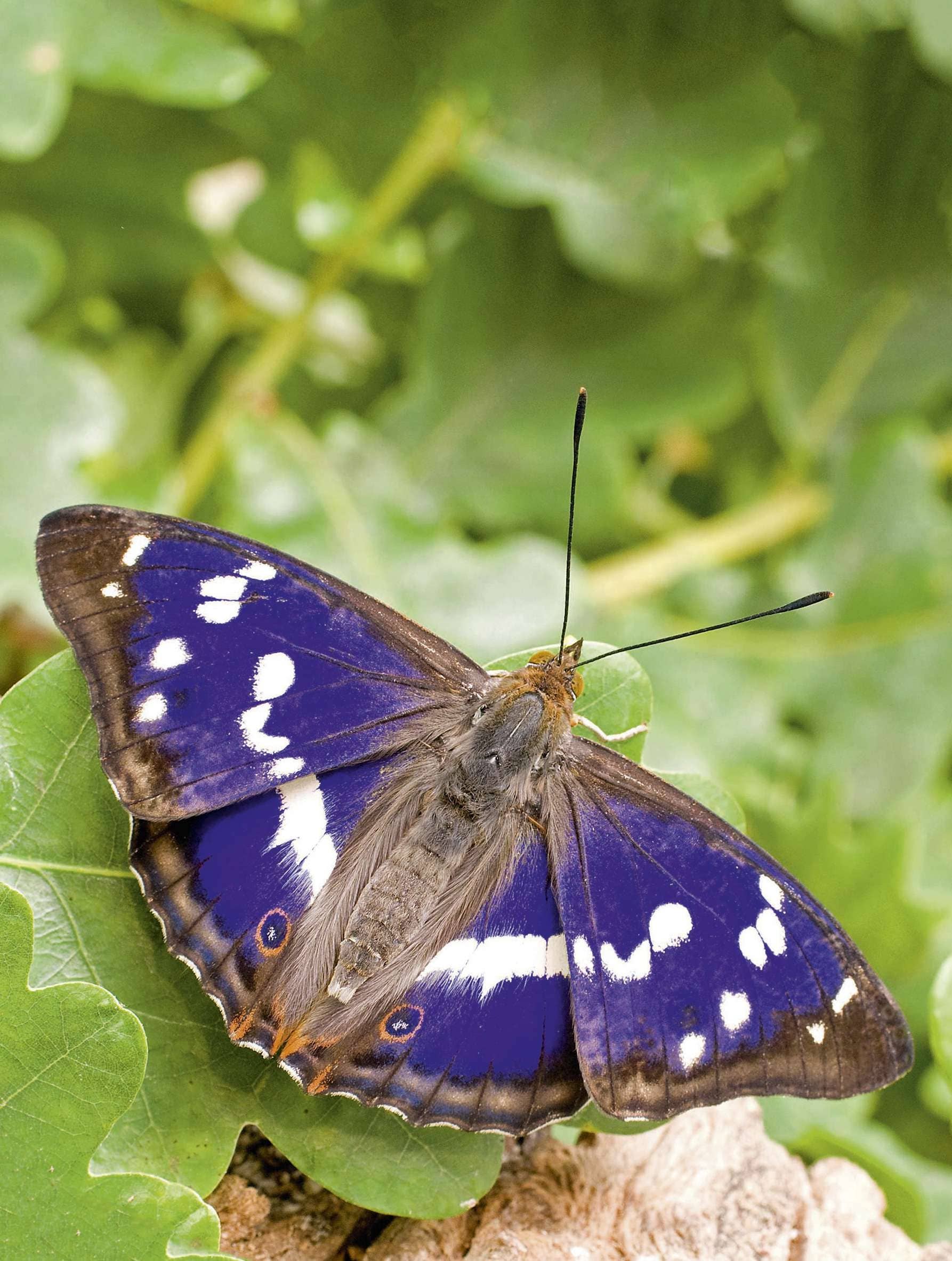
Though most of our UK butterflies have suffered horrific declines in recent decades, a brave few are bucking the trend. None more so than the purple emperor, Apatura iris, long regarded as a rare denizen of southern oak woods – even though its essential requirement is the humble sallow bush, the caterpillar’s foodplant.
The State of the UK’s Butterflies 2015, a review produced by Butterfly Conservation and the Centre for Ecology and Hydrology, shows that during the 10 years leading up to 2014, the purple emperor increased its distribution by a staggering 135 per cent. Its closest rival was the silver-washed fritillary, another showy butterfly, which expanded its range by 55 per cent during that time. The next review, likely to be published late next year, should show the continuation of that positive trend.
In recent years, individuals of this distinctive butterfly have turned up in an impressive range of unlikely situations, which is not surprising, as it has eccentric tendencies and pushes limits – all limits. Purple emperors have been seen in several supermarkets (mainly Tesco, but also Sainsbury’s and Waitrose), two nursing homes, two public schools, a hospital, a borstal, a prison, a trout farm, an ammunition dump, a crematorium, the national film archive at Berkhampsted, outside the Royal Courts of Justice in central London, and, best of all, the departures lounge at Gatwick Airport. Most of these were dispersing males.

This story is from the July 2019 edition of BBC Wildlife.
Subscribe to Magzter GOLD to access thousands of curated premium stories, and 10,000+ magazines and newspapers.
Already a subscriber? Sign In
MORE STORIES FROM BBC Wildlife
BBC Wildlife
"I was terrified the elephant would ram us"
African elephant in Kenya

2 mins
January 2026
BBC Wildlife
ALL YOU EVER NEEDED TO KNOW ABOUT THE Fennec fox
THE FENNEC FOX IS THE SMALLEST fox in the world, with a body length that can be as little as 24cm.
3 mins
January 2026
BBC Wildlife
INTO THE PLASTISPHERE
A unique synthetic ecosystem is evolving in our oceans – welcome to the plastisphere
7 mins
January 2026
BBC Wildlife
“More than half of all animal life exists in a parasitic relationship, and all life lives in symbiosis”
Our survival depends on species evolving to live together - but some relationships take dark turns
7 mins
January 2026
BBC Wildlife
Are animals able to dream?
SLEEP IS A MYSTERIOUS THING. FOR A long time, we weren't sure why we do it.
1 mins
January 2026
BBC Wildlife
Does a cuckoo know it's a cuckoo?
ABSURD LITTLE BIRDS ACROSS THE world lay their eggs in the nests of other species, leaving the hapless parents to raise a changeling at the expense of their own offspring.
2 mins
January 2026
BBC Wildlife
Orcas killing young sharks
Juvenile great whites are easy prey for orca pod
1 mins
January 2026
BBC Wildlife
Ocean goes on tour
Acclaimed film touring the UK, backed by live orchestra and choir
1 min
January 2026
BBC Wildlife
Feisty bats hunt like lions
Winged mammals use a 'hang and wait' strategy to take down large prey
1 mins
January 2026

BBC Wildlife
SNAP-CHAT
Richard Birchett on magical merlins, wily coyotes and charging deer
2 mins
January 2026
Translate
Change font size