Try GOLD - Free
Cuba's “Maximum Leader”
The Week UK
|December 03 2016
With his olive fatigues, straggly beard and giant cigars, Fidel Castro was one of the most recognisable political figures of the 20th century. He was also one of the most extraordinary, said The Guardian. Having led a revolution in Cuba in 1959, he set about establishing a Marxist-Leninist state, just 90 miles from the US mainland. Billing himself as a defiant David to the US’s Goliath, he became a giant on the world stage himself. He negotiated on level terms with successive leaders of the two superpowers at the height of the Cold War, and helped bring them to the brink of nuclear war; he outlasted ten US presidents (despite repeated attempts to assassinate him). He inspired revolutions in Latin America, backed liberation movements in Africa, and became a potent symbol of rebellion for left-wingers everywhere. The likes of Jean-Paul Sartre revered him; and for years, his poster adorned thousands of student bedrooms.
-

At home, Castro was widely loathed for his brutal repression of dissent, and economic mismanagement. Hundreds of thousands of Cubans fled into exile during the five decades of his rule; many died trying to cross the sea to Florida. But the “Maximum Leader” (as he was officially known) was loved too: a master of oration (he could talk for six hours without pause), he persuaded many of his people that only he could protect them from their enemy across the water; and even after communism began to collapse in the USSR, he clung on. In the second decade of the new millennium, US-Cuban relations finally started to thaw. But Castro – by then retired – never let his hatred for America waver. “We don’t need the empire to give us anything,” he declared earlier this year.
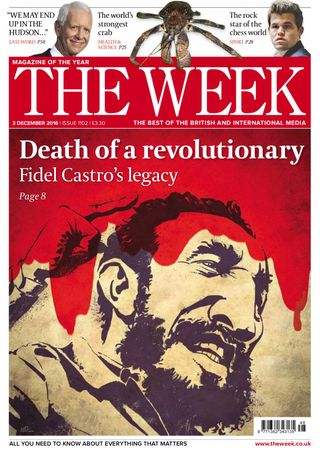

This story is from the December 03 2016 edition of The Week UK.
Subscribe to Magzter GOLD to access thousands of curated premium stories, and 10,000+ magazines and newspapers.
Already a subscriber? Sign In
MORE STORIES FROM The Week UK

The Week UK
His Only Crime Was Coming Home
As Western-backed forces push Islamic State out of Mosul, its militants are laying minefields in their wake – aimed not at soldiers but at ordinary people who have come back to rebuild their lives. Colin Freeman went on a tour of Iraq’s new killing fields

9 mins
March 11 2017

The Week UK
The Modest Dutch Designer Who Made Millions From Miffy
Dick Bruna, who has died aged 89, created one of the most instantly recognisable characters in children’s literature, said The New York Times: the sparsely drawn white rabbit known in English as Miffy.
3 mins
March 11 2017

The Week UK
Trump's conflict of interest: how will he deal with it?
Donald Trump ran, and won, on a promise to “drain the swamp” of Washington corruption, said Eugene Robinson in The Washington Post. But so far, he seems intent on deepening it. The president-elect owns or has stakes in around 500 companies, at least 111 of which do business overseas. This creates a massive and unprecedented conflict of interest. One of Trump’s biggest lenders, for example, is Germany’s Deutsche Bank, currently negotiating a multibillion-dollar settlement with the Justice Department over abuses that contributed to the 2008 market crash.
2 mins
December 03 2016

The Week UK
What the scientists are saying...
What the scientists are saying...
3 mins
December 17 2016

The Week UK
Cricket: Kohli hammers England
The end was “swift” and brutal, said Vic Marks in The Guardian. On the final morning of the fourth Test, in Mumbai, India needed less than half an hour to take England’s last four wickets. They thrashed the visitors by an innings and 36 runs to seal a 3-0 series victory, with the fifth Test still to be played.
2 mins
December 17 2016

The Week UK
Keeping The Press Under Control
Press freedom is under threat – at least according to recent newspaper reports. What are they so worried about?
4 mins
January 21 2017

The Week UK
The Society Photographer Who Married A Princess
The Earl of Snowdon 1930-2017.
5 mins
January 21 2017

The Week UK
Exhibition Of The Week War In The Sunshine, The British In Italy 1917-18
For most of us, the story of the First World War is defined by the “mud, gas and trenches” of the Western Front, said Waldemar Januszczak in The Sunday Times.
2 mins
January 28 2017

The Week UK
Rock ‘n' Roll Superstar Who Caught the Teen Spirit
Chuck Berry didn’t invent rock ’n’ roll – no one person could claim credit for that.
5 mins
March 25 2017

The Week UK
The Ruthless Ira Commander Who Helped Broker Peace
On 27 August 1979, the Provisional IRA murdered Lord Mountbatten while he was on a family holiday in Sligo, said Henry McDonald in The Guardian.
5 mins
March 25 2017
Translate
Change font size