Try GOLD - Free
New Age.
Stereophile
|July 2017
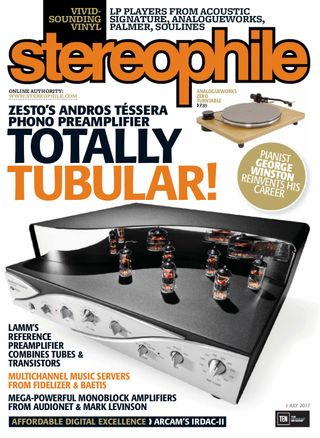
Having Survived Cancer And New Age, The Solo Pianist Climbs Aboard His Carousel

Most of it was acoustic. While there were vocals here and there, much of it featured instrumentalists playing solo or in groups. Some of it was meant to alleviate stress. Some of it was marginally connected to a similarly named movement in spirituality. Environmentalism and respect for nature were constant themes. Some New Age artists created moody, ambient sounds that were intended as background music, to promote healing and relaxation.
As the genre grew, some might say by attracting marginally talented musicians who were searching for musical direction, record labels specializing in New Age, such as Windham Hill, Narada, and Private Music, appeared on the scene and made stars of such diverse musical talents as harpist Andreas Vollenweider, native American flutist R. Carlos Nakai, saxophonist Paul Winter, keyboardist Kitaro, and guitarist Michael Hedges. Hedges, a huge talent, called his music “Heavy Mental.” In its heyday, New Age sold a lot of records, some of them well recorded and aimed at the audiophile market. The Wikipedia entry for New Age may have caught the essence of the music best: “intended to promote serenity.”
For a couple of years in the early 1980s, no one was bigger in the touchy-feely, sometimes sleepy, sometimes downright boring musical world of New Age than pianist George Winston. The eastern Montana native’s string of hit albums in that decade—Autumn (1980), Winter into Spring (1982), and December (1982)—all ranked high on the New Age charts, and even climbed into the top 20 of the Billboard U.S. Jazz charts. Depending on who’s doing the judging, each is filled with pleasantly meandering solo-piano explorations that Winston has always referred to as “folk piano.”

This story is from the July 2017 edition of Stereophile.
Subscribe to Magzter GOLD to access thousands of curated premium stories, and 10,000+ magazines and newspapers.
Already a subscriber? Sign In
MORE STORIES FROM Stereophile
Stereophile
Buzz Me In
If you like 1970s rock music, particularly hard rock music, something you love was recorded or mixed in a Record Plant studio.

3 mins
January 2026

Stereophile
NuPrime MCX-800AD
IMMERSIVE AUDIO PROCESSOR
11 mins
January 2026
Stereophile
Shanachie Records
The term 'sales' is an anachronism. Today, it's about streaming and ancillary income.\"
3 mins
January 2026
Stereophile
Advance Paris X-CD9
CD PLAYER
11 mins
January 2026
Stereophile
T+A Symphonia for phono; a new NAD M10
Out of the box, the T+A Symphonia streaming integrated amplifier Rogier van Bakel reviewed in the November 2025 issue¹ has two pairs of single-ended analog line inputs.
20 mins
January 2026

Stereophile
Why the Music We Love Feels Different Now
There's a scene in the 2002 movie The Pianist in which Adrien Brody's character, the Polish-Jewish pianist Władysław Szpilman, is hiding in the ruins of a Warsaw villa.
3 mins
January 2026
Stereophile
A tale of two Walters
Acommon theme in this space in Stereophile is the need to reach new audiences and generate broader interest in the hi-fi hobby.
3 mins
January 2026
Stereophile
Eversolo Play CD Edition
ALL-IN-ONE STREAMING PLAYER
12 mins
January 2026

Stereophile
Timeless flights
How many adventurous rock’n’roll bands forged in the late-’60s/early-’70s would have been left by the wayside—or relegated to languish in perpetual cutout-bin purgatory—had it not been for the wide-open programming M.O. of stereo-loving FM radio stations? The Moody Blues could very easily have been one of those sidelined, notched-cover footnotes, but they altered their gameplan when guitarist/vocalist Justin Hayward and bassist/vocalist John Lodge joined the fold a few years after the chart success of “Go Now” in 1964.¹
3 mins
January 2026
Stereophile
You still believe in me
One of my foundational memories of becoming an audiophile was waiting to listen to a pair of speakers at Sound by Singer in Manhattan.
12 mins
January 2026
Translate
Change font size