Try GOLD - Free
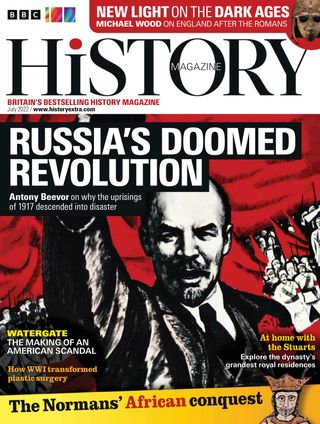
RUSSIA'S DOOMED REVOLUTION
BBC History UK
|July 2022
With the world's attention fixed firmly on the invasion of Ukraine, Antony Beevor's new history of Russia's 1917 revolutions and subsequent civil war is especially timely. He explains to Rob Attar how the fall of the last tsar launched a chain of events leading to millions of deaths and one of history's most brutal dictatorships

IN CONTEXT
REVOLUTION AND CIVIL WAR
The Russian Revolution was actually two revolutions. The first began when the last tsar, Nicholas II, was toppled in March 1917, brought down by a combination of food shortages, Russia's disastrous performance in the First World War and his personal failings. With his fall, Russia seemed set for a democratic future but, until elections could be held, the country was ruled by a Provisional Government dominated by liberals from the tsarist-era Duma (parliament).
The Provisional Government, its effectiveness hampered by a lack of legitimacy, faced a powerful rival in the shape of the socialist-led Petrograd Soviet that ruled the country's then-capital city (now called St Petersburg). The Bolsheviks, led by Vladimir Lenin, sought to undermine the Provisional Government, which itself made a series of missteps notably continued failures in the war against Germany and Austria-Hungary.
Capitalising on these weaknesses, the Bolsheviks under Lenin and Leon Trotsky launched a coup d'état, the so-called October Revolution, seizing power with relative ease. Consolidating that power proved far more difficult, as a combination of opponents-ranging from former tsarist generals to other leftwing political groups who distrusted the Bolsheviks - took up arms against them.
The stage was set for a civil war between the Bolshevik Red Army and their "White" enemies that devastated the country and led to millions of deaths. Several international powers also contributed troops and supplies to the conflict, predominantly to the Bolsheviks' opponents. In 1919, White armies led by Generals Kolchak and Denikin launched offensives that seemed set to destroy the fledgling communist regime, but

This story is from the July 2022 edition of BBC History UK.
Subscribe to Magzter GOLD to access thousands of curated premium stories, and 10,000+ magazines and newspapers.
Already a subscriber? Sign In
MORE STORIES FROM BBC History UK
BBC History UK
Royal progress
Alice Loxton's new book begins with a compelling premise.

1 mins
January 2026

BBC History UK
"Leaving Muslim contributions out of European history has allowed Islamophobic sentiment to flourish"
THARIK HUSSAIN speaks to Danny Bird about the long but often overlooked and distorted history of Muslims in Europe - and the enduring resistance to its reappraisal
9 mins
January 2026
BBC History UK
7 UNMISSABLE TRIPS IN 2026
With new routes, big anniversaries and fresh ways of discovering familiar favourites, TOM HALL highlights historical destinations to explore this year
4 mins
January 2026

BBC History UK
SOPHIE SCHOLL
Novelist Simon Scarrow chooses
2 mins
January 2026
BBC History UK
Portrait of the artists
TRACY BORMAN is enraptured by a beautifully written and richly illustrated exploration of early modern English art
2 mins
January 2026
BBC History UK
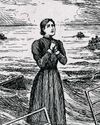
Humble heroes
Statues celebrate monarchs, rulers and conquerors - but who remembers the brave folk who gave their lives to save others? Anna Maria Barry recounts stories of selfsacrificing but otherwise ordinary people from the 19th and 20th centuries who are commemorated in one London park.
9 mins
January 2026
BBC History UK
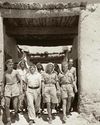
BACK FROM THE DEAD
Britain’s War Office thanked the SAS for its remarkable efforts in WW2 by abolishing it – yet soon realised the error of its ways. Gavin Mortimer tells the story of how the elite unit reinvented itself to confront the challenges of the postwar world
8 mins
January 2026
BBC History UK
Q&A - A selection of historical conundrums answered by experts
Were Roman gladiators vegetarian?
8 mins
January 2026
BBC History UK
Martha McGill on a pioneering study of folk beliefs in early modern England
I was recently chatting with a handful of early modernists about the history book we'd take to a desert island.
1 min
January 2026
BBC History UK
Independent empires
Viewing the British empire through an American lens provides an intriguing alternative perspective on the 'Land of the Free', says DAVID ARMITAGE
4 mins
January 2026
Translate
Change font size