
Go Unlimited with Magzter GOLD
Get unlimited access to 10,000+ magazines, newspapers and Premium stories for just
Try GOLD - Free
WAR WITHOUT END
BBC History Magazine
|June 2022
The Soviet invasion of Afghanistan in 1979 is widely viewed through the prism of the great Cold War confrontation between east and west. Yet, writes Elisabeth Leake, the occupation also ignited a tinderbox of local grievances that continue to torment the country to this day

Afghan fighters on top of a destroyed Soviet helicopter, 1980. The arrival of Soviet forces in Afghanistan the previous year had complicated an already volatile situation
On 3 August 1978, the central council of the Islamic Society of Afghanistan (Jamiati-Islami) wrote an impassioned plea to Kurt Waldheim, secretary-general of the United Nations. In their letter, they decried Afghanistan's political leaders, the People's Democratic Party of Afghanistan (PDPA), as a "power-thirsty gang" intent on destroying Afghanistan's political and social fabric and lacking any respect for humanitarian norms or human rights. The Council demanded UN intercession, warning that "the continued survival of this group will endanger the peace of this region of the world".
This warning soon came true. On 24 December 1979, the Soviet Politburo issued a public directive justifying the deployment of Soviet troops into Afghanistan to support their allies, the same PDPA. The Soviets, the Politburo claimed, sought "to give international aid to the friendly Afghan people" and to prevent "anti-Afghan actions from neighbouring countries". Within days, 50,000 Soviet troops were on the ground in Afghanistan. They would remain there for almost a decade as part of Soviet efforts to keep their local allies in power.
The Soviet invasion of Afghanistan was one of the moments that defined the 1980s. It took place against the backdrop of the global Cold War, in which the Soviet Union and the United States (as well as China) vied for supremacy. Indeed, so international was the Cold War during the 1970s and early 1980s that, while US and Soviet leaders pursued talks on limiting strategic arms and the balance of power in Europe, Soviet forces backed independence movements in southern and eastern Africa as American troops withdrew from Vietnam.

This story is from the June 2022 edition of BBC History Magazine.
Subscribe to Magzter GOLD to access thousands of curated premium stories, and 10,000+ magazines and newspapers.
Already a subscriber? Sign In
MORE STORIES FROM BBC History Magazine

BBC History UK
On the skids
Richard Rodgers and Oscar Hammerstein II's smash musical Oklahoma! opened on Broadway on 31 March 1943.

1 min
Christmas 2025

BBC History UK
Small pleasures
Memory is imperfect, but what if you could get a professional model maker to recreate a moment from the past?
1 min
Christmas 2025

BBC History UK
Bath in five places
In the Georgian era, Bath became arguably Britain's most fashionable destination. KIRSTEN ELLIOTT promenades five historic highlights
3 mins
Christmas 2025
BBC History UK
End times
Why do civilisations that dominated their epoch fail? In an era of autocracy, climate change, the rise of Al and a first-hand understanding of how deadly pandemics can be, it's a question that seems pertinent.
1 min
Christmas 2025
BBC History UK
What are the origins of the Yule Lads?
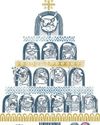
To learn about the Jólasveinar (Yule Lads), we must start with their mother, the terrifying ogress Grýla. Her name appeared in Icelandic texts as early as the 13th century, although it wasn’t until later that those 13 mischievous lads became associated with her. Folk tales and poems tell how she descends from the mountains with an empty sack to stuff full of children. Grýla owns the monstrous Jólaköttur (Yule Cat), which roams the countryside on Christmas Eve, searching for children to gobble up if they're not wearing new clothes.
1 mins
Christmas 2025
BBC History UK
Santa Claus v Father Christmas
The true identity of the white-bearded, red-robed figure who fills children's stockings at Christmas has long been debated. Thomas Ruys Smith sizes up the merry contenders
8 mins
Christmas 2025

BBC History UK
Frontier friction
Set in Washington Territory in 1854, The Abandons is a Western that's unusual for having two matriarchs, women whose lives become entangled, at its centre.
1 min
Christmas 2025

BBC History UK
The Last Days of Pompeii: The Immersive Experience
Delve into the culture of daily Roman life, witness the momentous eruption of Mount Vesuvius, and follow its fallout in Immerse LDN's new exhibition. In a blend of cutting-edge technology and vivid storytelling, this exhibition launches visitors into Pompeii's rich history with recreations of the ancient city's beautiful pre-eruption landscape, a 360-degree virtual reality Roman amphitheatre experience, and a digital metaverse recreating Pompeii's 'Villa of Mysteries'.
1 min
Christmas 2025

BBC History UK
Elizabeth Marsh The corsair's captive
Taken hostage by a Barbary ship's captain in the 18th century, a young Englishwoman found herself fighting for her freedom in Marrakech. ADAM NICHOLS introduces a brave captive who later wrote a book about her dramatic experiences
6 mins
Christmas 2025
BBC History UK
29 DECEMBER 1170: Thomas Becket is murdered in Canterbury
Knights loyal to Henry II rid him of the “low-born cleric”
2 mins
Christmas 2025
Translate
Change font size