Try GOLD - Free
A Sylk Road Renaissance
Archaeology
|July/August 2020
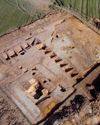
Excavations in Tajikistan have unveiled a city of merchant princes that flourished from the fifth to the eighth century A.D.

THE SILK ROAD, the vast network of trade routes that connected China to the rest of Eurasia from roughly the first century B.C. to A.D. 1400, was justly famous in the West for the rich silk textiles it carried to the Mediterranean world. “But it could just as easily have been called the Jade Road, the Glass Road, or even the Rhubarb Road,” says art historian Judith Lerner of the Institute for the Study of the Ancient World at New York University. Such was the variety of commodities—raw silk, glass, spices, finished metalwork, ceramics, and much more—that any one of dozens of goods could have given the route its name. The Sacred Road, too, might once have been a fitting appellation. Christian and Buddhist missionaries, among others, used Silk Road caravans to cross the Asian continent. And from the fifth to the eighth century a.d., the overland trade routes that crossed through Central Asia might also have been called the Sogdian Road. An East Iranian people who lived in what is now Uzbekistan and Tajikistan, the Sogdians were, for a time, the leading merchants of the Silk Road. “The Sogdians achieved great influence via trade,” says Lerner. “The Chinese even had a saying: ‘When a Sogdian child is born, his mother puts honey on his tongue so that he will speak sweetly and glue on his palm so that money will stick to it.’”

This story is from the July/August 2020 edition of Archaeology.
Subscribe to Magzter GOLD to access thousands of curated premium stories, and 10,000+ magazines and newspapers.
Already a subscriber? Sign In
MORE STORIES FROM Archaeology
Archaeology
THE EGYPTIAN SEQUENCE
Until now, the earliest Egyptians to have even part of their DNA sequenced were three people who lived between 787 and 544 B.C.

1 mins
November/December 2025
Archaeology
SOURCE MATERIAL
As early as 40,000 years ago, some hunter-gatherers in southern Africa ventured long distances to procure special types of stone to make their tools.
1 min
November/December 2025

Archaeology
Secrets of the Seven Wonders
How archaeologists are rediscovering the ancient world's most marvelous monuments
13 mins
November/December 2025
Archaeology
ACTS OF FAITH
Evidence emerges of the day in 1562 when an infamous Spanish cleric tried to destroy Maya religion
12 mins
November/December 2025
Archaeology
OASIS MAKERS OF ARABIA
Researchers are just beginning to understand how people thrived in the desert of Oman some 5,000 years ago
8 mins
November/December 2025
Archaeology
FOSSIL FORCE
One of the planet's most successful arthropods, trilobites, abounded in the oceans from about 520 million to 250 million years ago.
1 min
November/December 2025
Archaeology
BIGHORN MEDICINE WHEEL, WYOMING
Perched almost 9,700 feet above sea level on Medicine Mountain in Wyoming's Bighorn Range, the Medicine Wheel is an 80-foot-diameter circular structure made from limestone boulders.
2 mins
November/December 2025
Archaeology
ANCIENT LOOK BOOK
A young woman buried in China's Tarim Basin some 2,000 years ago went to the afterlife accompanied by the height of fashion.
1 mins
November/December 2025
Archaeology
A FAMILIAR FACE
In the early eleventh century, a landslide on the island of Ostrów Lednicki in western Poland caused a hillfort to collapse and slip to the bottom of Lake Lednica.
1 min
November/December 2025
Archaeology
Temples to Tradition
A looted cache of bronzes compels archaeologists to explore Celtic sanctuaries across Burgundy
13 mins
November/December 2025
Translate
Change font size