Try GOLD - Free
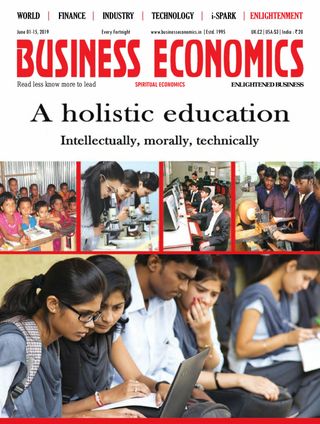
Skill-Based Education To Overcome Job Crisis
BUSINESS ECONOMICS
|June 1-15, 2019
India is projected to have the largest young workforce in the world by 2025 but is failing to cash in on this rich demographic dividend.

According to a draft report from National Sample Survey Organisation (NSSO), India presently has its highest unemployment rate in the last 45 years.
The manufacturing sector needs to be strengthened to combat this crisis. According to government reports, only 4.69% of India’s workforce is formally skilled. An adequate availability of skilled workers is needed for the success of government initiatives such as ‘Make in India’. India needs to upskill its workforce in a big way. According to estimates, if upskilling is ensured, India will be well-poised to add 104.62 million fresh workers by 2022.
The Modi government had identified this issue and accordingly launched the ‘Skill India’ programme on July 15, 2015, which was formally named Pradhan Mantri Kaushal Vikas Yojana 1 (PMKVY 1). The programme aimed to skill 402 million people by 2022. Later, the government launched the Pradhan Mantri Kaushal Vikas Yojana 2 (PMKVY 2) in July 2016. The skill based education schemes are monitored through the National Skill Development Corporation (NSDC). Apart from PMKVY, NSDC has also launched initiatives like Pradhan Mantri Kaushal Kendras (PMKK) and Udaan. However, the success of these programmes has been limited.

This story is from the June 1-15, 2019 edition of BUSINESS ECONOMICS.
Subscribe to Magzter GOLD to access thousands of curated premium stories, and 10,000+ magazines and newspapers.
Already a subscriber? Sign In
MORE STORIES FROM BUSINESS ECONOMICS

BUSINESS ECONOMICS
Why I Uphold Sanatana Dharma?
I am a follower of the Sanatana Dharma -a Sanatanist.

8 mins
March 1-31, 2026

BUSINESS ECONOMICS
Tamil Nadu's Interim Budget 2026-27 An Analysis
On 17 February 2026, Finance Minister Thangam Thennarasu presented the Tamil Nadu Interim Budget for 2026-27.
2 mins
March 1-31, 2026
BUSINESS ECONOMICS
Storm signals in job sector
Arise in the unemployment rate from 4.8% to 5% may appear to be statistical noise.
1 mins
March 1-31, 2026

BUSINESS ECONOMICS
WB Budget 2026-27 and the 16th Finance Commission's Financial Devolution to States
West Bengal’s Finance Minister Chandrima Bhattacharya presented the State Budget for 2026-27 on 12 February 2026. The total expenditure, or size of the Budget for FY 2026-27, has been pegged at ₹3.89 lakh crore. This is about 14% higher than the revised estimate for 2024-25.
3 mins
March 1-31, 2026

BUSINESS ECONOMICS
The global damage to 'Make in India'
The AI Impact Summit, 2026 held in Delhi was a huge opportunity for India to project country's technical skills globally.
2 mins
March 1-31, 2026
BUSINESS ECONOMICS
Indian Railway Finance Corporation
The Indian Railway Finance Corporation is referred to as IRFC.
3 mins
March 1-31, 2026

BUSINESS ECONOMICS
India's Orange Economy : Creativity as the Next Growth Engine
In India's economic lexicon, a vibrant new term is capturing the imagination of policymakers, entrepreneurs, creators and investors alike - The Orange Economy.
3 mins
March 1-31, 2026

BUSINESS ECONOMICS
Why Even Good Intentions Are Failing Global Policy
Across the world, leaders are acting under the pressure of constant crisis.
6 mins
March 1-31, 2026

BUSINESS ECONOMICS
Manufacturing: FM's focus is in the right direction but lessons from the past are crucial
Manufacturing has been a major focus of the annual Budget presented on February 1 by Nirmala Sitharaman. India has long aimed to raise manufacturing’s share in GDP to around 25%, from about 16-17% a few years ago.
2 mins
March 1-31, 2026

BUSINESS ECONOMICS
Budget proposals on Agriculture: Emphasis on high-value products and technology
The Union Budget 2026-27 places significant emphasis on high-value agricultural products and the adoption of advanced technology.
3 mins
March 1-31, 2026
Translate
Change font size