Try GOLD - Free
Kimberley War Hero
Farmer's Weekly
|Farmer's Weekly 17 August 2018
This year celebrates the centenary of the Royal Air Force. It is therefore fitting to recall a famous South African fighter pilot whose skill and bravery became renowned during the Battle of Britain. By Graham Jooste.

Albert Lewis was born in 1918 in Kimberley, where he attended Kimberley Boys’ High School. An excellent sportsman, he was also passionate about aircraft and flying, and took flying lessons. At the age of 20, he made his way to England and joined the Royal Air Force (RAF).
His instructors noted his ability to convert rapidly to any aircraft type, a skill that was to stand him in good stead. The transition in aircraft design from the two-winged biplane to the faster, one-winged monoplane was well under way, producing such legendary aircraft as the Hawker Hurricane and Supermarine Spitfire. These fighters would face similar formidable foes in the Messerschmitt Bf 109 in Europe, and the Japanese Mitsubishi A6M Zero in the Pacific theatre.
In March 1939, Lewis was awarded his wings and posted to an advanced training school, where he passed with merit. From there he was sent to 754 Squadron, Fleet Air Arm. During this period he flew the Walrus, Magister, Mentor, Sea Fox and Swordfish.
In August of that year, Lewis crashed a big Walrus flying boat after engine failure and was confined to hospital for a period. On his recovery, he was posted to 616 (South Yorkshire) Squadron, based at the Doncaster Race Course.
The following month the message went out: “Commence hostilities against Germany at once.” The war had begun.
DUNKIRK AND FIRST BLOOD
Because of his flying skill, Lewis was chosen for a hazardous mission to test a new type of propeller for the Hurricane. The ground staff watched breathlessly as Lewis looped, rolled and screamed down in a dive to level out above the runway. It was a brilliant exhibition of flying that was warmly applauded when he finally taxied to a halt.
Lewis went on to fly 307 hours on convoy patrols in various aircraft. By the time he was posted to 85 Squadron in France, he had honed the skills to become a great pilot.


This story is from the Farmer's Weekly 17 August 2018 edition of Farmer's Weekly.
Subscribe to Magzter GOLD to access thousands of curated premium stories, and 10,000+ magazines and newspapers.
Already a subscriber? Sign In
MORE STORIES FROM Farmer's Weekly

Farmer's Weekly
How AFGRI uses technology to unlock farm finance from asset to market
As modern farming becomes more capital-intensive and digitally driven, AFGRI is reinventing agricultural finance by linking technology directly to lending decisions.

5 mins
January 16-23, 2026

Farmer's Weekly
Adele's Mohair: a living tapestry of craft, colour and rural heritage
Octavia Avesca Spandiel spoke to Adele Cutten, founder of Adele's Mohair, to explore how a small spinning experiment grew into a thriving rural craft enterprise rooted in South Africa's rich mohair heritage.
6 mins
January 16-23, 2026
Farmer's Weekly
Cannabis and marketing in South Africa
The path from cultivation to commercial success remains complicated by regulatory ambiguity. Cultivators who master compliant marketing while delivering verifiable quality will build sustainable businesses, says Thomas Walker.
2 mins
January 16-23, 2026
Farmer's Weekly
Foot-and-mouth disease project targets waste reduction and regulatory reform
A groundbreaking research collaboration between Red Meat Industry Services, the University of Pretoria, and global animal health leader Zoetis is aiming to transform South Africa's approach to foot-and-mouth disease.
3 mins
January 16-23, 2026
Farmer's Weekly
What to expect in 2026
The world faces a complex interplay of economic, geopolitical, environmental, technological, and social pressures.
3 mins
January 16-23, 2026
Farmer's Weekly
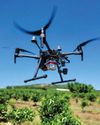
How drones are revolutionising pest and disease detection in agriculture
Drones are reshaping modern crop protection by giving farmers a powerful new vantage point: the sky. With advanced sensors, high-resolution imaging, and artificial intelligence-driven analytics, these unmanned aerial vehicles can detect early signs of disease, water stress, and pest damage long before the human eye can. Jedrie Harmse spoke to agricultural drone specialist Monique Heydenrych.
7 mins
January 16-23, 2026
Farmer's Weekly
Generic advertising in perspective
Dr Koos Coetzee explains how industry organisations and the agriculture sector actually have the ability to prudently manage the negative perceptions surrounding generic advertising campaigns.
2 mins
January 16-23, 2026

Farmer's Weekly
The modern Merino: the benchmark breed
The Merino breed has transformed dramatically over the past seven decades-from the skin-folded wool specialists of the 1950s to today's plain-bodied, fertile, well-balanced sheep prized for their dual-purpose productivity. Yet, despite its versatility, myths persist. Willie van Heerden, manager at Merino South Africa, dispels some of these myths.
2 mins
January 16-23, 2026

Farmer's Weekly
Elsenburg Agricultural Training Institute celebrates excellence
The Elsenburg Agricultural Training Institute marked a major milestone in December 2025, conferring over 200 agricultural qualifications, including bachelor's degrees and various national certificates.
2 mins
January 16-23, 2026

Farmer's Weekly
Grain SA issues guidelines as poor-quality agri inputs threaten farmers livelihoods
Grain SA has urged South African grain and oilseed farmers to act fast when seeds, fertilisers, or agrochemicals underperform, providing clear guidelines to protect crops.
2 mins
January 16-23, 2026
Translate
Change font size