Try GOLD - Free
The GATHERING
BBC Wildlife
|May 2021
In May, the quiet coastal town of Whyalla bursts into life as thousands of Australian giant cuttlefish gather offshore to breed.

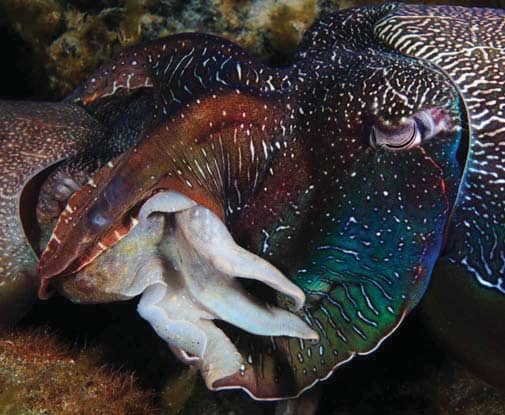
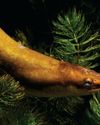
These peculiar creatures are not aliens, of course, but Australian giant cuttlefish. From May to August each year, these spectacular cephalopods, which can reach almost 1m long, gather in their thousands in False Bay, a wide, shallow arc between Point Lowly and the town of Whyalla. The spot sits high inside Spencer Gulf on the coast of South Australia. The cuttlefish come here to spawn, but where they come from, and why they choose this spot, remains a mystery.
The main attraction
The style and energy with which the animals conduct the business of breeding attracts visitors from far and wide. Short-lived cuttlefish have only one chance to pass on their genes, and with 11 males typically competing for each female at the aggregation, they throw everything at it. A suitor positions himself next to a female and turns on the charm, flashing eyecatching shades of neon blue, purple, green, red and gold and intricate patterns of dots and lines. Some blanch completely white; others create bold stripes across their bodies or even ripple in patterns. While he works on his appearance, a male may also gently caress the female using his eight tentacles.

This story is from the May 2021 edition of BBC Wildlife.
Subscribe to Magzter GOLD to access thousands of curated premium stories, and 10,000+ magazines and newspapers.
Already a subscriber? Sign In
MORE STORIES FROM BBC Wildlife
BBC Wildlife
“Our canoe was nearly sunk by a hippo”
Hippos in Niger

3 mins
March 2026

BBC Wildlife
Why does Australia have such weird animals?
AUSTRALIA IS A LONG WAY FROM anywhere and has been for a very long time. The landmass definitively separated from the supercontinent of Gondwana around 40 million years ago and, since then, has existed - as a big blob in the middle of an even bigger ocean - in glorious geographical isolation.
2 mins
March 2026
BBC Wildlife
Which country has the fewest native animals?
AT AROUND 61KM² SAN MARINO, IN Europe, is one of the world's smallest countries. Entirely landlocked, it is surrounded by Italy.
1 min
March 2026

BBC Wildlife
Why do some species sunbathe?
RING-TAILED LEMURS ARE FAMED FOR their 'sun-worshipping' posture, legs and arms outstretched to reveal their pale bellies. Like humans, they do it to save energy and boost health. Sunlight is necessary to many bodily processes. As a source of vitamin D it's required to maintain bone and muscle health. It is also related to the production of serotonin, the chemical that regulates mood, sleep and stress response.
1 mins
March 2026
BBC Wildlife
ALL YOU EVER NEEDED TO KNOW ABOUT THE Piranha
PIRANHAS HAVE A REPUTATION as some of the most dangerous freshwater hunters: terrifying predators capable of devouring a large mammal in mere minutes.
3 mins
March 2026
BBC Wildlife
EAGLES LANDING
Eagle owls were once heavily persecuted. But thanks to a new initiative, these magnificent birds are reclaiming a wetland home
7 mins
March 2026
BBC Wildlife
Do wild guinea pigs exist?
GUINEA PIGS, WHICH ARE NOT pigs and not from Guinea, are domesticated rodents that do not exist in the wild.
1 min
March 2026
BBC Wildlife
SNAP-CHAT: THE INSIDE WORLD OF WILDLIFE PHOTOGRAPHY
Boris Belchev on birds, batteries and battling bears with pop music
3 mins
March 2026
BBC Wildlife
Does anything live in the Bermuda Triangle?
THE BERMUDA TRIANGLE, IN THE NORTH Atlantic Ocean, has become infamous for the planes and ships that are said to have vanished without a trace while travelling through the area.
1 min
March 2026
BBC Wildlife
Do animals have different blood types?
HUMANS HAVE FOUR MAIN BLOOD GROUPS: A, B, AB and O.
1 min
March 2026
Translate
Change font size