Versuchen GOLD - Frei
Practical astronomy projects for every level of expertise DIY ASTRONOMY
BBC Sky at Night Magazine
|October 2022
Create a 24-hour polar star trail photo
-
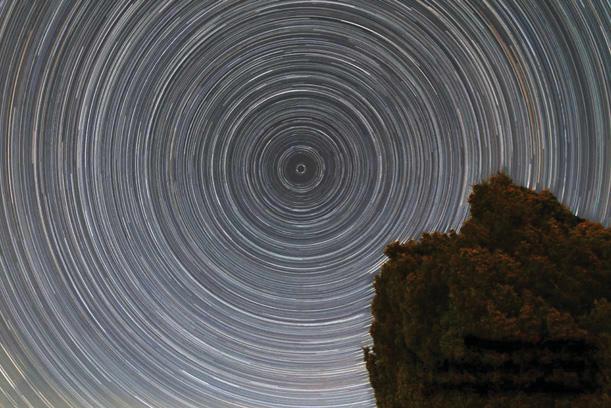
Merge a series of photos to make a spectacular image showing Earth's rotation
Star trails are relatively simple to do yet produce very striking results, especially when centred around the north or south celestial poles. These images capture the movement of Earth as it rotates on its axis, producing star trails that are comprised of fragments of concentric rings. If you are in the polar regions during the winter and have clear, dark skies for 24 hours, the trails will form complete circles, including the pole star Polaris because it is not perfectly aligned with the celestial pole. Most of us will never experience a polar winter, but it is still possible to create a 24-hour star trail photograph by merging together a stack of many images taken with the same setup, from exactly the same spot, on different nights throughout the year.
Although taking a star trail image on a single night is straightforward, replicating it exactly on multiple dates, then merging them together successfully, is the challenge here. First, the camera location must be identical. We placed marks on the ground to ensure the tripod was in exactly the same spot, but attaching the camera to a fixed structure would be even better. Focus must also be the same, otherwise the width of the star trails will differ, and they won't line up perfectly. Circumpolar star trails can be created under moonlight, but doing so will affect the fainter stars, so try to ensure the Moon's brightness - its phase - is consistent between sessions. Also, when you blend your final stacked images, the overlapping regions will be brighter, so only stack what's necessary to complete the full circle.


Diese Geschichte stammt aus der October 2022-Ausgabe von BBC Sky at Night Magazine.
Abonnieren Sie Magzter GOLD, um auf Tausende kuratierter Premium-Geschichten und über 9.000 Zeitschriften und Zeitungen zuzugreifen.
Sie sind bereits Abonnent? Anmelden
WEITERE GESCHICHTEN VON BBC Sky at Night Magazine
BBC Sky at Night Magazine
The Giant Leap: Why Space is the Next Frontier in the Evolution of Life
“Earth is the cradle of humanity, but one cannot live in the cradle forever,” wrote Konstantin Tsiolkovsky in 1911.

1 mins
February 2026
BBC Sky at Night Magazine
Tele Vue Nagler Type-7 series eyepieces
These premium optics were inspired by Apollo - and deliver a giant leap to your views
4 mins
February 2026
BBC Sky at Night Magazine
Once Upon a Time in Space
While the Space Race of the Cold War years was ultimately a geopolitical contest between the USA and the Soviet Union, the rivalry sparked rapid innovation and inspired multiple generations to look skyward.
1 mins
February 2026
BBC Sky at Night Magazine
The Multiverse: When One Universe Isn't Enough
The concept of a 'multiverse' – the idea that our Universe may be just one of many – is widespread in science fiction and a common thread of online discussions.
1 mins
February 2026
BBC Sky at Night Magazine
Q&A WITH A GAMMA RAY SPECIALIST
In 2025, astronomers detected a blast from space that lasted seven hours. Now they're uncovering the strange processes behind the exceptional outburst
3 mins
February 2026
BBC Sky at Night Magazine
Astronomy Photographer of the Year
The world-leading astrophotography competition returns. Could your image take the top prize of £10,000?
2 mins
February 2026
BBC Sky at Night Magazine
MOONWATCH
February's top lunar feature to observe
2 mins
February 2026
BBC Sky at Night Magazine
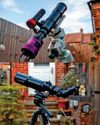
NOVAStar Scarlet A62Q 62mm f/8.4 quadruplet achromatic refractor
Well-built and capable, this beginner scope punches well above its bargain price
4 mins
February 2026
BBC Sky at Night Magazine
STAR OF THE MONTH
Rasalas, Leo the Lion's metal-rich crown
1 min
February 2026
BBC Sky at Night Magazine
Comet 24P/Schaumasse
Having reached perihelion on 8 January, comet 24P/ Schaumasse is now fading. Starting the month at a small-telescope-friendly mag. +10.5, it dims throughout February to below 12th magnitude.
1 min
February 2026
Translate
Change font size