Versuchen GOLD - Frei
How to find a speck in space
BBC Sky at Night Magazine
|October 2025
New Horizons proves stellar parallax can locate a probe in the vastness, using the light of just two stars
-
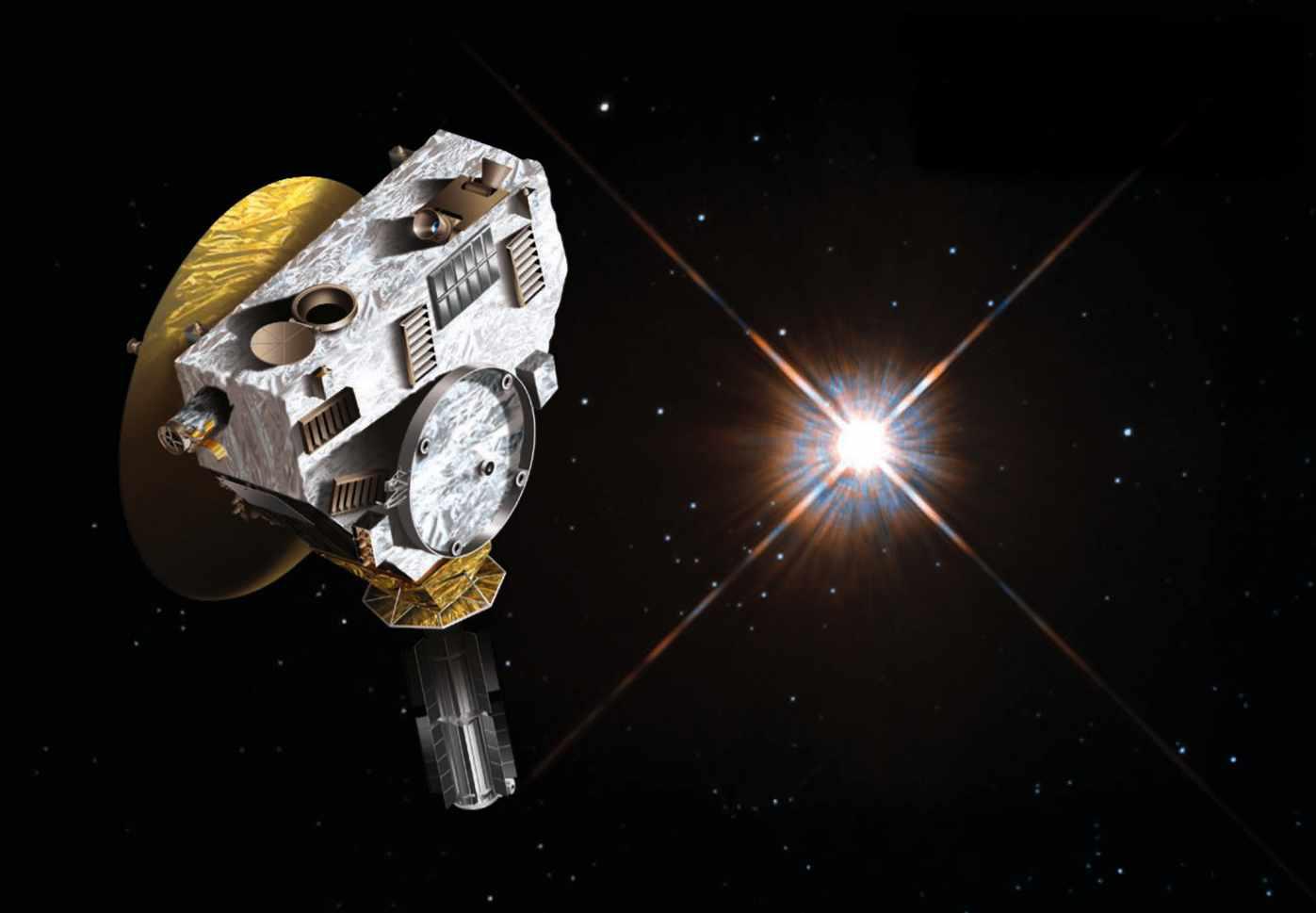
New Horizons was the first mission sent to explore Pluto, conducting a fly-by in July 2015. It was then redirected for a close pass of a much smaller Kuiper Belt object, Arrokoth, in January 2019. Today, it's over 61 AU away - almost twice as distant as Pluto - and racing from the Sun at around 50,000km/h (31,000mph), meaning that it covers the equivalent of the Earth-Sun distance every four months.
It's the fifth robotic spacecraft that we humans have launched on an escape trajectory that will ultimately leave the Solar System altogether and enter interstellar space. Indeed, the craft is already so remote that nearby stars appear to shift in position when viewed from the spacecraft, compared to how we see them from Earth. This displacement in the apparent position of objects seen from two vantage points is known as parallax. You can create this effect for yourself with a simple experiment: hold a finger at arm's length and alternate closing each eye. The finger appears to jump back and forth against the more distant background, because each eye sees it from a slightly different angle.
Tod Lauer, at the NSF National Optical-Infrared Astronomy Research Laboratory in Tucson, Arizona, led a team of 53 coauthors from 46 institutions to demonstrate stellar parallax between New Horizons and Earth. They did this by coordinating the probe to photograph two nearby stars with images taken simultaneously from ground-based observatories.
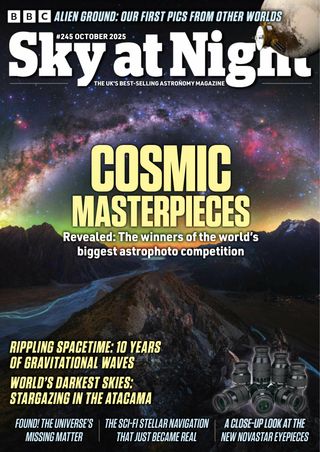

Diese Geschichte stammt aus der October 2025-Ausgabe von BBC Sky at Night Magazine.
Abonnieren Sie Magzter GOLD, um auf Tausende kuratierter Premium-Geschichten und über 9.000 Zeitschriften und Zeitungen zuzugreifen.
Sie sind bereits Abonnent? Anmelden
WEITERE GESCHICHTEN VON BBC Sky at Night Magazine
BBC Sky at Night Magazine
The Giant Leap: Why Space is the Next Frontier in the Evolution of Life
“Earth is the cradle of humanity, but one cannot live in the cradle forever,” wrote Konstantin Tsiolkovsky in 1911.

1 mins
February 2026
BBC Sky at Night Magazine
Tele Vue Nagler Type-7 series eyepieces
These premium optics were inspired by Apollo - and deliver a giant leap to your views
4 mins
February 2026
BBC Sky at Night Magazine
Once Upon a Time in Space
While the Space Race of the Cold War years was ultimately a geopolitical contest between the USA and the Soviet Union, the rivalry sparked rapid innovation and inspired multiple generations to look skyward.
1 mins
February 2026
BBC Sky at Night Magazine
The Multiverse: When One Universe Isn't Enough
The concept of a 'multiverse' – the idea that our Universe may be just one of many – is widespread in science fiction and a common thread of online discussions.
1 mins
February 2026
BBC Sky at Night Magazine
Q&A WITH A GAMMA RAY SPECIALIST
In 2025, astronomers detected a blast from space that lasted seven hours. Now they're uncovering the strange processes behind the exceptional outburst
3 mins
February 2026
BBC Sky at Night Magazine
Astronomy Photographer of the Year
The world-leading astrophotography competition returns. Could your image take the top prize of £10,000?
2 mins
February 2026
BBC Sky at Night Magazine
MOONWATCH
February's top lunar feature to observe
2 mins
February 2026
BBC Sky at Night Magazine
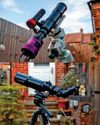
NOVAStar Scarlet A62Q 62mm f/8.4 quadruplet achromatic refractor
Well-built and capable, this beginner scope punches well above its bargain price
4 mins
February 2026
BBC Sky at Night Magazine
STAR OF THE MONTH
Rasalas, Leo the Lion's metal-rich crown
1 min
February 2026
BBC Sky at Night Magazine
Comet 24P/Schaumasse
Having reached perihelion on 8 January, comet 24P/ Schaumasse is now fading. Starting the month at a small-telescope-friendly mag. +10.5, it dims throughout February to below 12th magnitude.
1 min
February 2026
Listen
Translate
Change font size